
Certified Commercial Microbial Compliance Notice: If your commercial facility, multi-family apartment community, corporate office complex, healthcare clinic, or educational campus in the Phoenix Metropolitan Area is confronting active fungal contamination, visible black mold amplification, or persistent tenant indoor air quality (IAQ) grievances, engage our certified environmental response team immediately at (602) 587-1380. Our IICRC-certified Applied Microbial Remediation Technicians (AMRT) provide discreet, OSHA-compliant containment, engineering controls, source elimination, and independent clearance verification across Maricopa County.
In commercial real estate asset management across Phoenix, Scottsdale, Tempe, Mesa, Chandler, and Glendale, discovering indoor microbial growth is never merely a cosmetic janitorial disturbance—it is an acute environmental liability that threatens occupant respiratory health, triggers employee OSHA grievances, exposes ownership entities to tenant constructive eviction lawsuits, and permanently impairs real estate asset capitalization rates. Unlike residential single-family properties where microbial issues are frequently localized, commercial building envelopes feature complex interconnected air distribution networks, shared interstitial ceiling plenums, centralized chilled water loops, and multi-tenant demising partitions that can broadcast microscopic fungal mycotoxins across thousands of square feet within hours.
A prevalent and dangerous misconception across the Desert Southwest is that the arid Arizona climate makes commercial mold colonization impossible. In engineering reality, modern commercial structures throughout the Phoenix Valley are tightly sealed, highly insulated, air-conditioned thermal microclimates. Between intense summer monsoon rainfall deluges, catastrophic roof drain parapet backups, chilled water riser condensation, and unmaintained commercial air handling unit (AHU) drain pan overflows, water trapped behind impermeable commercial vinyl wall coverings or within acoustic ceiling plenums creates an ideal, high-humidity incubation incubator. When persistent indoor humidity exceeds 55% to 60% alongside ambient indoor temperatures between 70°F and 85°F, fungal hyphae proliferate through cellulose-based drywall cores and acoustic insulation within 24 to 48 hours.
When microbial colonization takes hold within a commercial facility, standard janitorial cleaning, bleach application, or superficial surface painting is not only scientifically ineffective—it is legally hazardous. Professional remediation requires a licensed, bonded, and insured **commercial mold remediation company in Phoenix** equipped to execute rigorous physical containment, continuous negative air pressure engineering, controlled hazardous demolition, and third-party laboratory clearance testing under **IICRC S520** standards and **AZ ROC #342819**.
1. Legal Liabilities, Regulatory Frameworks & Arizona Tenant Habitability Statutes
Commercial property owners, asset directors, and institutional landlords in Arizona operate under strict statutory, regulatory, and common-law legal duties regarding environmental hazards and indoor air quality (IAQ). Ignoring or improperly abating commercial mold exposes management entities to compounding financial and legal exposure:

A. Arizona Commercial Landlord Obligations & Constructive Eviction
Under Arizona common law and established commercial leasing precedents (including interpretations surrounding commercial implied warranties of fitness and quiet enjoyment), a commercial landlord who allows hazardous environmental conditions to persist—thereby rendering leased premises unsafe or unusable for ordinary business operations—can be held liable for Constructive Eviction. When constructive eviction is established:
- Lease Termination Without Penalty: Commercial tenants have the legal right to immediately vacate the premises, voiding remaining multi-year lease payment commitments.
- Damages for Lost Business Revenue: Tenants can sue the building owner for lost operational profits, business interruption expenses, and customer defection costs incurred due to facility closure.
- Relocation & Tenant Improvement (TI) Reimbursement: Courts may order landlords to reimburse the tenant for costs associated with relocating corporate operations, moving specialized IT equipment, and constructing replacement tenant improvements.
B. The OSHA General Duty Clause (Section 5(a)(1)) and Employee Safety
While federal OSHA maintains no specific numeric exposure limit for airborne mold spores, the agency aggressively enforces employee protection under the General Duty Clause of the Occupational Safety and Health Act of 1970. Under Section 5(a)(1), every commercial employer and facility operator is legally mandated to furnish a workplace free from recognized hazards that are causing or are likely to cause death or serious physical harm.
When employees in corporate office parks, medical plazas, or distribution centers experience persistent respiratory symptoms, asthma exacerbation, chronic sinusitis, or fungal skin infections caused by unmitigated mold in commercial HVAC plenums, formal OSHA complaints inevitably follow. OSHA compliance officers issue mandatory abatement citations, levy substantial financial penalties, and require documented post-remediation third-party environmental clearance before employees are permitted to re-enter affected spaces.
C. Commercial Lease Rent Abatement Provisions
Standard commercial lease agreements drafted under BOMA (Building Owners and Managers Association) or NAIOP (Commercial Real Estate Development Association) standards almost universally contain rent abatement clauses. If commercial suites suffer environmental contamination through no fault of the tenant (such as common-area roof leaks, domestic riser breaks, or HVAC system condensation failures), the tenant is legally entitled to full monthly rent abatement proportionate to unusable square footage until certified remediation is complete.
D. Real Estate Transaction Impairment & Phase I Environmental Site Assessments
During commercial property acquisitions, debt refinancing, or institutional dispositions across the Phoenix market, commercial lenders mandate rigorous environmental due diligence, including Phase I and Phase II Environmental Site Assessments (ESA). Unaddressed microbial history, visible fungal staining inside mechanical rooms, or lack of certified post-remediation clearance certificates will immediately trigger red flags. Environmental consultants will classify active mold contamination as a Business Environmental Risk (BER), freezing lender funding, stalling escrow, or forcing massive escrow holdbacks until licensed remediation contractors resolve the issue.
| Compliance Vector | Governing Entity / Standard | Failure Consequences for Commercial Owners | Required Mitigation Defense Protocol |
|---|---|---|---|
| Workplace Safety | OSHA 29 U.S.C. § 654 (General Duty Clause) | Federal citations, civil penalties, mandatory facility stop-work orders. | IICRC S520 containment, negative air engineering, written safety logs. |
| Commercial Leases | Arizona Commercial Common Law / ARS Tit. 33 | Constructive eviction lawsuits, loss of lease revenue, tenant rent abatement. | Rapid 24-hour physical isolation, temporary tenant relocation, certified drying. |
| Public Health | Maricopa County Environmental Health Code | Mandatory closure of commercial food kitchens, daycares, medical clinics. | Hospital-grade EPA virucidal/fungicidal application, independent air testing. |
| Property Valuation | ASTM E1527-21 (Phase I ESA Standards) | Lender loan rejection, failed commercial escrow, asset value devaluation. | Formal Third-Party Post-Remediation Verification (PRV) Clearance Certificate. |
2. Commercial Building Microbiology: High-Risk Fungal Pathogens in Phoenix Facilities
Fungal organisms are omnipresent in outdoor ambient desert air. However, inside controlled commercial building envelopes, unmanaged water intrusion alters the microbial ecology, cultivating elevated concentrations of high-toxicity fungal species that produce toxic secondary metabolites known as mycotoxins and volatile organic compounds (mVOCs):
The Primary Commercial Fungal Species Profile
- Stachybotrys chartarum (“Toxic Black Mold”): A tertiary fungal colonizer that requires chronic, continuous water saturation on high-cellulose, low-nitrogen substrates (such as paper-faced commercial gypsum drywall, ceiling tiles, and paper duct insulation). Stachybotrys produces dangerous macrocyclic trichothecene mycotoxins capable of causing pulmonary hemorrhage, severe cognitive dysfunction, and chronic neurological impairment.
- Aspergillus spp. (A. niger, A. fumigatus, A. flavus): Fast-growing opportunistic molds that thrive in low-to-moderate water activity environments, making them rampant across Phoenix commercial HVAC plenums, fan coil units, and acoustic drop ceilings. Certain Aspergillus species produce carcinogenic aflatoxins and represent acute, life-threatening infection risks (aspergillosis) to immunocompromised occupants in medical and healthcare environments.
- Penicillium chrysogenum / P. expansem: Highly aerosolized fungal species characterized by microscopic powdery spores that easily infiltrate HVAC airflow. They produce ochratoxin A and citrinin, causing severe allergic asthma, hypersensitivity pneumonitis, and eye/throat irritation among commercial office workers.
- Chaetomium globosum: A moisture-demanding fungal species frequently recovered from structural wood framing, commercial drywall paper, and wet fiberglass insulation behind vinyl wall coverings. Chaetomium produces chaetoglobosins, carrying potent cytotoxic properties.
- Cladosporium herbarum: The most prevalent indoor/outdoor airborne mold in Arizona, commonly colonizing dirty commercial fiberglass duct liners, cooling coils, and bathroom HVAC returns. Prolonged exposure causes chronic sinus congestion, dermatitis, and occupational asthma.
Commercial HVAC Distribution: The Highway for Contamination
The most catastrophic vector for commercial microbial spread across Phoenix properties is the central heating, ventilation, and air conditioning (HVAC) infrastructure. Commercial HVAC systems recirculate 70% to 85% of conditioned indoor air to maximize energy efficiency in desert heat. When mold establishes colonization within an air handling unit (AHU), variable air volume (VAV) terminal box, or return air plenum, the ventilation system acts as a mechanical super-spreader:
- Cooling Coil & Condensate Drain Pan Biofilms: Air passing over commercial chilled water cooling coils condenses gallons of moisture daily. Dust particles serve as organic nutrients, creating microbial biofilms across aluminum fins and condensate pans.
- Internal Fiberglass Duct Liner Colonization: Many commercial facilities utilize internal acoustical fiberglass duct liners to dampen airflow noise. Once moisture penetrates porous fiberglass insulation, mold roots embed deep within the resin binder. Cleaning fiberglass duct liner is impossible; colonized sections must be removed under full containment and replaced with closed-cell elastomeric foam or external duct wrap in accordance with NADCA (National Air Duct Cleaners Association) standards.
- Plenum Pressurization Failure: In commercial buildings utilizing drop-ceiling return air plenums, water leaks from roof penetrations or chilled water risers saturate acoustic tiles from above. The return airflow draws airborne spores directly from the plenum into the primary air handlers, cross-contaminating every floor within the mechanical zone.
3. The IICRC S520 Commercial Remediation Engineering Process
Professional commercial microbial abatement is governed strictly by the IICRC S520 Standard for Professional Mold Remediation. The standard classifies indoor microbial conditions into three distinct operational states:
- Condition 1 (Normal Fungal Ecology): An indoor environment that reflects normal background fungal ecology, characterized by spore counts and species distributions statistically equivalent to outdoor baseline air.
- Condition 2 (Settled Spores): An indoor environment characterized by settled fungal spores or hyphal fragments that are elevated relative to Condition 1, but without active colonization or physical amplification.
- Condition 3 (Actual Growth): An indoor environment characterized by the presence of actual, active fungal growth and colonization on indoor surfaces, requiring engineering controls and physical removal.
Phoenix Damage Pros transitions commercial facilities from Condition 3 back to verified Condition 1 through a rigorous 6-stage engineering protocol:
“`
[Stage 1: Forensic Environmental Inspection & Diagnostic Thermal Mapping]
│
▼
[Stage 2: Critical Engineering Containment & Decontamination Airlocks]
│
▼
[Stage 3: Continuous Negative Pressure (-0.02 in. W.C.) & HEPA Air Scrubbing]
│
▼
[Stage 4: Controlled Source Demolition of Porous Condition 3 Materials]
│
▼
[Stage 5: Mechanical Abrasion, HEPA Detailing & EPA Fungicidal Sanitization]
│
▼
[Stage 6: Independent Third-Party Post-Remediation Verification (PRV)]
“`
Stage 1: Forensic Diagnostic Inspection & Source Moisture Identification
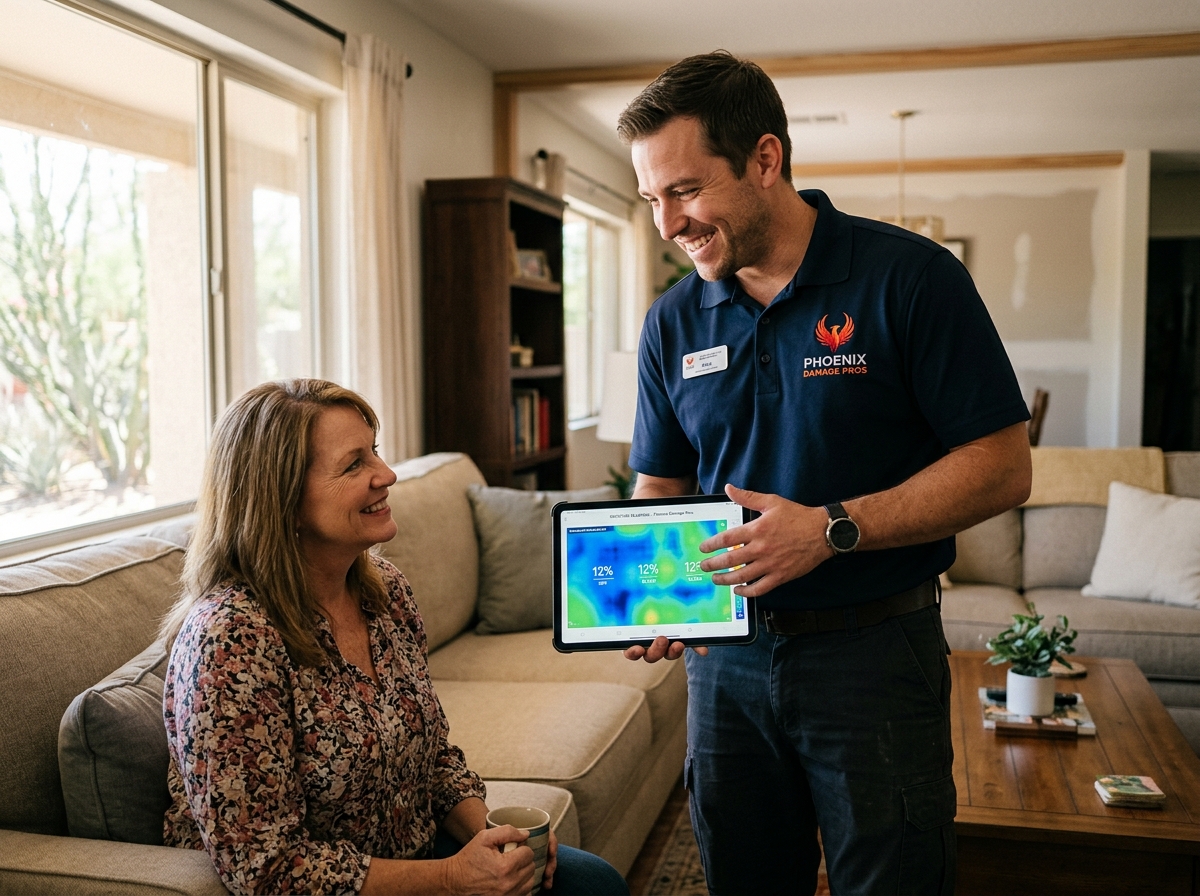
Remediating mold without permanently resolving the underlying water source guarantees reinfection. Our certified commercial project directors utilize FLIR® thermal imaging cameras to locate thermal anomalies indicating hidden moisture pockets behind demising walls and acoustic ceilings. We deploy penetrating pin-meters and non-destructive RF scanners to quantify moisture content (%MC) in structural substrates, tracing leaks back to failed roof flashings, condensation, or plumbing breaches.
Stage 2: Critical Engineering Containment & Decon Airlocks
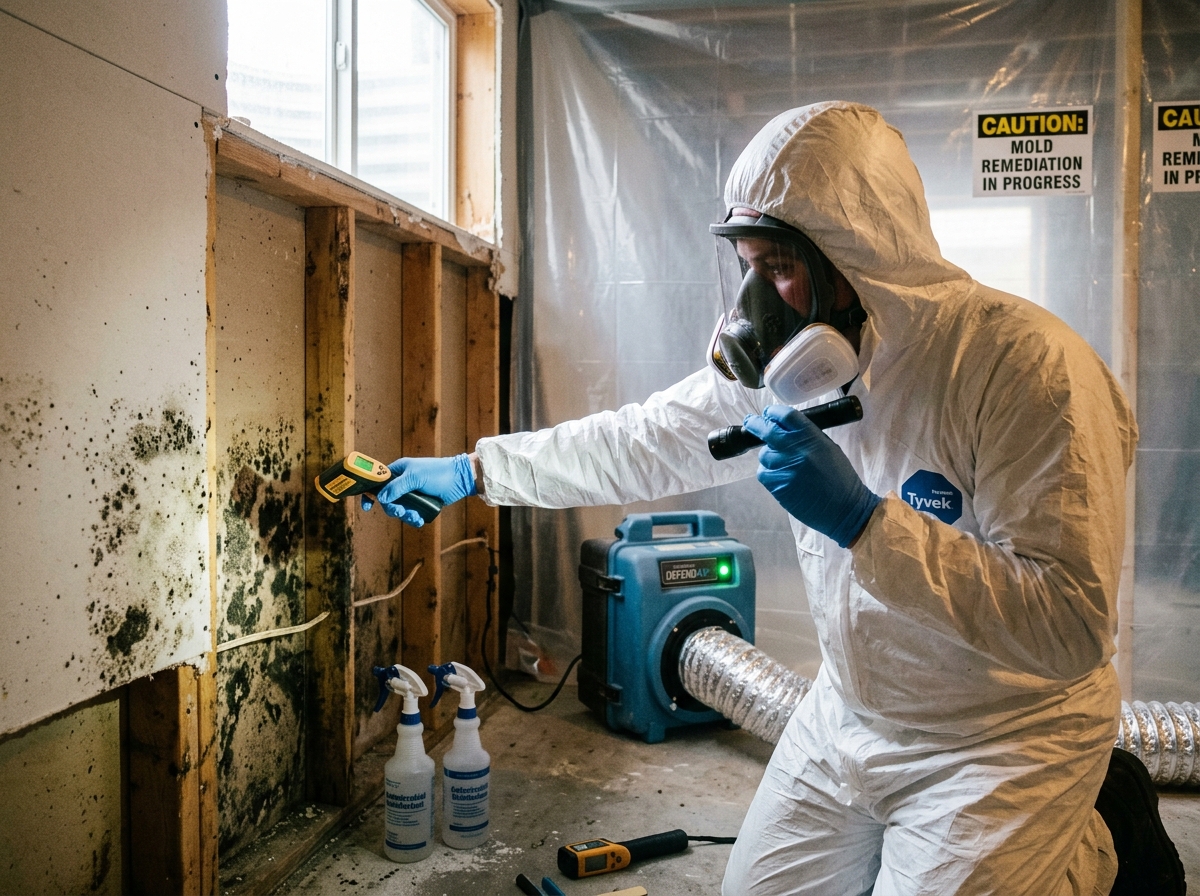
To eliminate cross-contamination into clean tenant suites or public retail corridors, technicians erect physical containment barriers consisting of 6-mil flame-retardant polyethylene sheeting hung from floor-to-ceiling utilizing heavy-duty aluminum spring-loaded tension poles. All seams are hermetically sealed with commercial poly-tape. For large-scale projects, we construct two-stage decontamination airlocks featuring zippered entries, clean equipment staging zones, and dirty transfer chambers.
Stage 3: Continuous Negative Air Pressure Engineering
Within the containment envelope, we deploy industrial HEPA-filtered negative air machines exhausting directly outside the commercial building envelope. We engineer a minimum pressure differential of -0.02 inches of water column (in. W.C.), continuously monitored with digital recording manometers. This negative pressure barrier ensures that whenever personnel enter or exit the airlock, air rushes *into* the containment zone, physically preventing airborne spores from escaping into occupied commercial areas.
Stage 4: Controlled Demolition of Porous Condition 3 Substrates
Porous commercial building materials deeply colonized by fungal hyphae—such as Type X drywall, acoustic ceiling tiles, fiberglass insulation, and tackless carpet strips—cannot be salvaged through topical cleaning. Technicians wearing Level C Personal Protective Equipment (full-face elastomeric PAPR respirators with P100 HEPA filters, disposable Tyvek suits, and nitrile gloves) perform controlled demolition under localized HEPA capture. Demolished materials are immediately double-bagged inside 6-mil hazardous waste bags, sealed airtight with duct tape, and surface-wiped clean within the decon airlock prior to transport via dedicated service elevators.
Stage 5: Mechanical Abrasion, HEPA Vacuuming & EPA Antimicrobial Application
Semi-porous and non-porous structural components (such as concrete slabs, structural steel columns, and heavy metal studs) are meticulously remediated:
- Mechanical Abrasion: Wire-brushing, high-grit orbital sanding, or specialized dry ice blasting strips away embedded fungal root structures from wood framing and masonry.
- Multi-Pass HEPA Vacuuming: Technicians detail all structural surfaces using commercial vacuum systems equipped with true HEPA filtration operating at 99.97% efficiency down to 0.3 microns.
- Hospital-Grade Fungicidal Application: We apply EPA-registered, broad-spectrum antimicrobial fungicides formulated for commercial indoor use. All structural framing is coated with commercial antimicrobial encapsulant barriers to prevent future microbial colonization.
Stage 6: Post-Remediation Verification (PRV) Air Clearance
Following final sanitization, containment negative air machines run continuously for a minimum of 24 to 48 hours to scrub remaining airborne particulates. The containment zone remains completely sealed under negative pressure until an independent third-party environmental consultant conducts formal post-remediation clearance testing.
4. Independent Third-Party Post-Remediation Verification (PRV) Standards
In commercial property management, maintaining an uncompromised ethical and legal boundary between the contractor performing the remediation work and the entity certifying the air quality is mandatory. Phoenix Damage Pros never tests its own remediation work. Contracting the same company to remediate mold and issue clearance testing creates a glaring legal conflict of interest that will not withstand judicial scrutiny in commercial tenant litigation or insurance audits.
Instead, we mandate Independent Third-Party Post-Remediation Verification (Clearance Testing) conducted by licensed, independent Indoor Environmental Professionals (IEPs) or Certified Industrial Hygienists (CIHs):
The Clearance Protocol Workflow
- Visual Inspection Under Raking Light: The independent environmental consultant conducts a rigorous visual audit inside containment. All surfaces must be completely dust-free, debris-free, and showing zero signs of residual fungal staining or moisture intrusion.
- Airborne Spore Trap Cassette Sampling (Air-O-Cell): The consultant collects calibrated air volume samples inside each containment chamber, in adjacent unaffected indoor control zones, and outdoor ambient baseline control locations.
- Surface Tape-Lift & Swab Analysis: Direct surface sampling of remediated structural framing verifies zero active fungal structures under microscopic laboratory examination.
- Accredited AIHA Laboratory Analysis: Samples are analyzed by an independent AIHA-accredited (American Industrial Hygiene Association) environmental microbiology laboratory.
- Clearance Criteria Standards: To achieve formal clearance, the indoor airborne spore concentrations must be statistically equivalent to or lower than outdoor baseline levels, and must show completely zero presence of pathogenic indicator species (such as Stachybotrys, Chaetomium, or Trichoderma).
- Formal Clearance Certificate Issuance: Upon passing laboratory analysis, the IEP issues a legally defensible Post-Remediation Clearance Certificate, providing permanent liability protection for property records, tenant disclosures, and insurance files.
5. Specialized Commercial Sector Protocols: Healthcare, Multi-Family, and Food Service
Different commercial building occupancies demand customized remediation engineering protocols. A one-size-fits-all approach fails to satisfy strict regulatory oversight across specialized commercial sectors:
A. Healthcare Facilities, Surgical Suites & Dental Plazas
In clinical and medical environments, immune-compromised patients face severe morbidity from opportunistic fungal pathogens such as Aspergillus fumigatus. Remediation within healthcare facilities must adhere to Infection Control Risk Assessment (ICRA) Class IV protocols and CDC Guidelines for Environmental Infection Control in Health-Care Facilities:
- Continuous particle counter monitoring logging airborne particulates down to 0.3 microns.
- Antimicrobial sticky walk-off mats positioned at every containment egress point.
- Exhausting 100% of negative air scrubber discharge directly outside clinical air intake zones.
- Utilizing non-toxic, hospital-grade broad-spectrum virucides and sporicides with zero off-gassing volatile organic compounds (VOCs).
B. Multi-Family Residential Portfolios & Apartment Communities
In multi-family apartment communities, water leaks from upper-floor water heaters or AC condensation pans frequently travel down vertical utility shafts into multiple stacked units. Property managers face acute tenant relations challenges:
- Tenant Communication Protocols: Transparent, professional communication prevents panic and organized tenant rent strikes.
- Direct Unit Isolation: Staging isolated containment zones inside affected tenant utility closets allows residents in non-impacted bedrooms to remain safely in their homes without incurring expensive corporate housing costs.
- Documented Clearance Packets: Providing tenants with certified independent laboratory clearance certificates eliminates legal claims of habitability failure upon move-out.
C. Commercial Kitchens, Restaurants & Food Manufacturing Facilities
Commercial food service facilities in Maricopa County operate under relentless regulatory scrutiny from the Maricopa County Environmental Services Department. Microbial contamination inside food prep zones, dry storage rooms, or walk-in refrigeration coils mandates immediate operational suspension. Phoenix Damage Pros executes emergency evening and weekend remediation shifts, utilizing food-contact-safe EPA-registered antimicrobial sanitizers and expediting same-day clearance testing to return kitchens to full health code compliance.
6. Long-Term Facility Management: Preventative Engineering Protocols to Inhibit Mold
Following successful commercial remediation and clearance certification, commercial building directors should institute engineering controls to prevent fungal reinfection. In desert construction, controlling internal humidity and water pathways is the key to permanent prevention:
A. Building Automation System (BAS) Humidity Threshold Programming
Modern commercial facilities should utilize centralized Building Automation Systems (BAS) to continuously monitor indoor relative humidity (%RH) across all floors. Facility engineers should establish automated alarms whenever indoor RH exceeds 55% for more than 4 consecutive hours. During humid monsoon months, commercial chillers should be programmed with dedicated reheat cycles to dehumidify supply air before distributing it to tenant spaces.
B. Quarterly HVAC Drain Pan & Chilled Loop Inspections
Maintenance staff must inspect rooftop units (RTUs) and internal air handlers every 90 days. Technicians should treat condensate pans with slow-release EPA-registered antimicrobial pan tablets, verify proper drain slope (minimum 1/8-inch drop per foot), and clean cooling coils with non-acidic foaming detergents.
C. Roof Parapet and Scupper Maintenance Schedules
Prior to the onset of the Arizona summer monsoon season in June, facility crews should clear all commercial roof drains, inspect parapet expansion joint caulking, and verify that roof membrane flashings around rooftop mechanical curbs remain fully sealed against intense driving rainfall.
7. Commercial Insurance Claims & Xactimate® Itemized Billing Mastery
Navigating commercial property insurance coverage for microbial losses in Arizona requires sophisticated claims presentation. Most modern commercial property insurance policies contain “Mold, Fungus, and Wet Rot Exclusions” or sub-limits (frequently capping standard mold coverage at $15,000 to $50,000). However, experienced commercial restoration contractors understand the legal and contractual principle of the Efficient Proximate Cause:
If microbial amplification is the direct, unsevered consequence of an initial sudden and accidental covered peril—such as an abrupt domestic water riser rupture, a catastrophic commercial fire sprinkler discharge, or sudden monsoon flash flooding—the entirety of the structural containment, demolition, and drying costs are routinely covered under the primary water loss policy rather than being restricted to the narrow mold sub-limit.
Phoenix Damage Pros assists corporate asset managers in documenting the unsevered causal link between the initial water peril and subsequent fungal growth, utilizing standardized Xactimate® line-item estimating codes:
| Xactimate® Code | Standard Commercial Description | Justification for Adjuster Approval |
|---|---|---|
| HMR BARR | Containment Barrier – Plastic Sheeting & Tension Poles | Mandated under IICRC S520 to prevent cross-contamination into clean tenant suites. |
| HMR NEG | Negative Air Machine / HEPA Air Scrubber (per 24 hrs) | Establishes required -0.02 in. W.C. pressure differential and 99.97% HEPA filtration. |
| HMR DECON | Decontamination Chamber – 2-Stage Airlock | Provides OSHA-compliant worker decontamination and clean waste transfer staging. |
| HMR HEPA | HEPA Vacuuming – Detailed Structural Cleaning | Removes microscopic settled fungal spores from non-porous structural framing. |
| HMR APPL | Apply EPA-Registered Antimicrobial / Fungicide Solution | Eradicates remaining fungal roots and protects structural assemblies against regrowth. |
| HMR ENCAP | Apply Antimicrobial Structural Encapsulant Coating | Locks down microscopic fibers and creates permanent moisture-resistant barrier. |
| HMR PRV | Third-Party Post-Remediation Clearance Testing Coordination | Independent industrial hygiene laboratory verification proving Condition 1 clearance. |
8. Commercial Landlord Emergency Action Checklist: Handling Suspected Mold
When tenant air quality complaints arise or maintenance personnel uncover suspected microbial colonies, on-duty facility staff must follow this disciplined triage protocol:
- Cease All Janitorial Surface Bleaching: Immediately instruct maintenance staff never to apply bleach, household biocides, or standard paint over suspected mold. Bleach releases hazardous chlorine gas, fails to penetrate porous drywall cores, and adds moisture that accelerates fungal root expansion.
- Isolate Impacted HVAC Distribution Zones: Close supply registers and return air dampers serving the contaminated suite. If the facility utilizes localized fan coil units or split systems, de-energize the unit at the sub-panel to prevent airborne spore broadcast into common plenums.
- Cordon Off the Suite Discretely: Lock suite doors, post professional maintenance service placards, and restrict access exclusively to authorized personnel to eliminate foot-traffic cross-contamination and tenant panic.
- Log All Moisture History & Maintenance Records: Gather building mechanical logs, previous roof inspection reports, and plumbing repair work orders to establish a clear chronological timeline for insurance adjusters and environmental consultants.
- Mobilize a Certified Commercial Remediation Contractor: Contact Phoenix Damage Pros immediately at (602) 587-1380. Our emergency project directors deploy within 30 to 45 minutes to install negative air containment and safeguard facility operations.
Protect Your Facility, Tenants, and Capital Asset Value
Do not allow microbial contamination to escalate into tenant constructive eviction lawsuits, OSHA citations, and multi-million-dollar asset impairment. Phoenix Damage Pros provides discreet, certified, and fully compliant commercial mold remediation across Phoenix, Scottsdale, Tempe, Mesa, Chandler, and Glendale.
Call Commercial Remediation Dispatch: (602) 587-1380
Licensed, Bonded & Insured: AZ ROC #342819 | IICRC Certified in Applied Microbial Remediation (AMRT) | OSHA 1910 Compliant
Frequently Asked Questions for Commercial Landlords and Facility Directors
1. Can our commercial office building remain occupied during mold remediation?
Yes. By engineering physical floor-to-ceiling 6-mil polyethylene containment barriers, two-stage decontamination airlocks, and dedicated negative air machines exhausting 100% of scrubbed air directly outside the facility, our technicians isolate all airborne contaminants within the designated work zone. Adjoining office wings, common lobbies, and adjacent tenant suites remain completely uncontaminated, safe, and fully operational throughout the project.
2. Does commercial property insurance cover mold remediation in Arizona?
While commercial property policies routinely carry narrow mold sub-limits, full remediation coverage is almost universally secured if our documentation proves the mold resulted directly from a covered sudden and accidental water peril (such as an abrupt domestic riser burst, fire sprinkler line discharge, or catastrophic monsoon roof drain overflow). We provide detailed line-item Xactimate® packages substantiating the unsevered causal chain of loss.
3. How long does a typical commercial mold remediation project take?
Depending on square footage, depth of porous material penetration, and mechanical HVAC involvement, standard commercial remediation projects require between 3 and 7 business days from initial engineering containment setup through controlled demolition, HEPA detailing, antimicrobial encapsulation, and final third-party laboratory air clearance certification.
4. What specific credentials must a commercial mold contractor possess in Arizona?
In Arizona, contractors performing commercial structural remediation must hold an active commercial contractor license with the Arizona Registrar of Contractors (**AZ ROC #342819**), carry commercial general liability and environmental pollution liability insurance, and maintain active IICRC AMRT (Applied Microbial Remediation Technician) certifications for on-site supervisory personnel.
5. Why is bleach strictly prohibited for commercial drywall remediation?
Household chlorine bleach consists of roughly 90% to 95% water. The chlorine ion is chemically incapable of penetrating the dense, porous cellulose core of commercial gypsum drywall. The chlorine remains on the surface while water soaks into the drywall core, feeding deep fungal hyphae roots and triggering aggressive fungal re-amplification within days.
6. What constitutes legal proof of clearance after commercial remediation?
Legal clearance requires a formal Post-Remediation Verification (PRV) Certificate issued by an independent, third-party licensed industrial hygienist (CIH or IEP) following accredited laboratory analysis of calibrated airborne spore traps and surface tape-lifts demonstrating Condition 1 normal fungal ecology.
7. Are building owners required to notify commercial tenants about mold?
While Arizona does not maintain a statutory residential-style mold disclosure form for commercial leases, common law fraud by omission and implied warranty precedents mandate that landlords cannot knowingly conceal active environmental hazards that impact tenant health. Providing prompt containment and verified clearance documentation provides the strongest legal shield against tenant claims.
8. How does commercial HVAC duct cleaning fit into mold remediation?
If mold spores have settled inside commercial sheet metal ductwork, mechanical brush cleaning paired with HEPA-filtered negative air collection is conducted under NADCA ACR standards. Any porous fiberglass duct liner showing active mold growth must be removed under containment, as porous insulation cannot be sanitized.
Commercial Indoor Air Quality (IAQ) Legal Compliance Note for Arizona Asset Directors
In accordance with Maricopa County public health standards and Arizona commercial real estate statutes, commercial building managers are strongly advised to preserve all original copies of third-party air sampling laboratory results, daily negative air pressure manometer logs, and IICRC S520 work authorizations for a minimum statutory retention period of seven (7) to ten (10) years. These certified records constitute vital legal documentation in defense against subsequent tenant toxic tort claims, worker compensation disputes, and prospective buyer due diligence inquiries during commercial property acquisitions.
