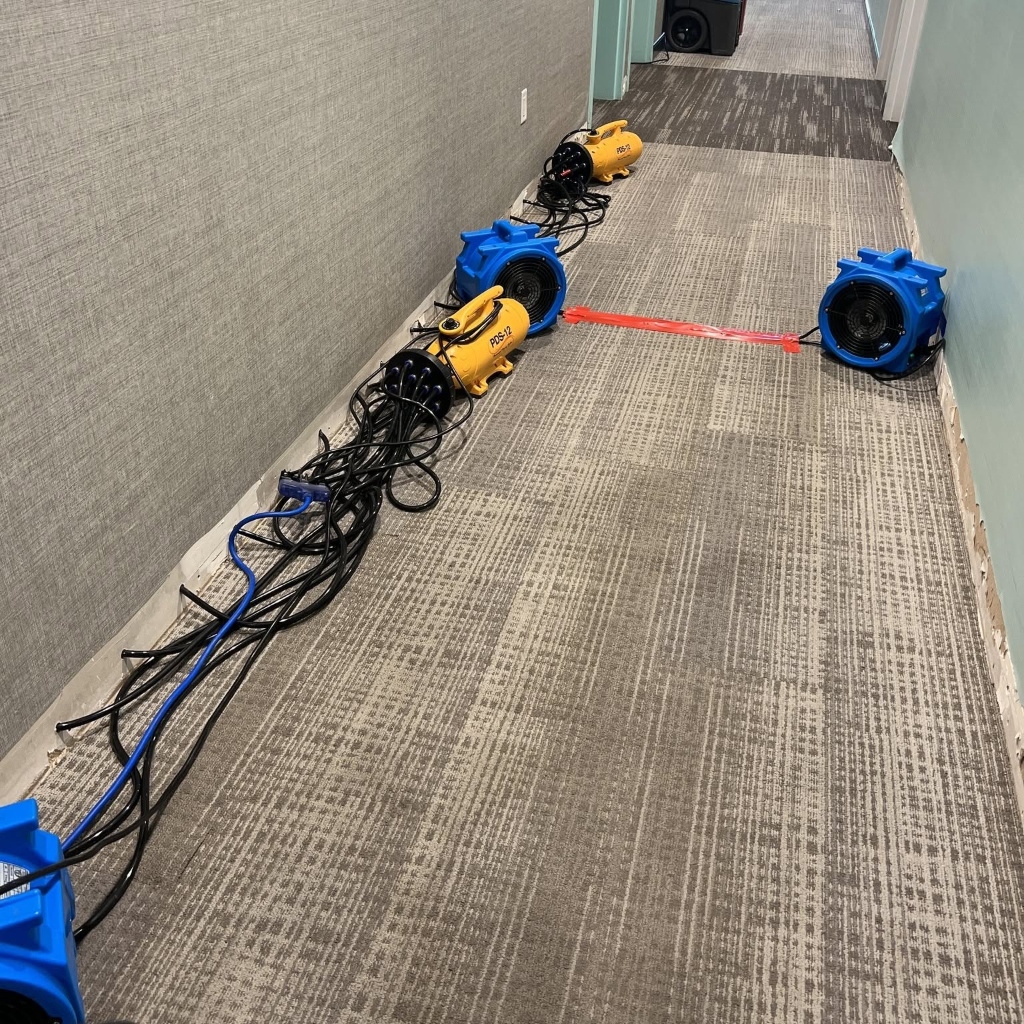

24/7 Commercial Office Disaster Response Hotline: If a pressurized water supply riser break, multi-floor restroom overflow, HVAC chilled water loop rupture, or fire sprinkler malfunction is threatening tenant suites in your corporate office building in Phoenix, Scottsdale, Tempe, Glendale, Chandler, or Mesa, contact our dedicated commercial disaster restoration division immediately at (602) 587-1380. Our IICRC-certified Master Restorers deploy heavy industrial extraction units, high-capacity desiccant drying trailers, and negative-pressure containment systems within 45 minutes under Arizona Commercial General Contracting License AZ ROC #342819.
Greater Phoenix boasts one of the most dynamic, rapidly expanding commercial office markets in the American Southwest. Spanning prestigious corporate submarkets—including the Camelback Corridor, Downtown Phoenix high-rises, Scottsdale Airpark commercial parks, and Tempe Town Lake corporate headquarters—these multi-story office complexes house critical corporate enterprises, technology headquarters, legal firms, accounting practices, and healthcare administrations. In commercial office asset management, continuous operations, tenant lease satisfaction, and physical property preservation are the foundational pillars of financial viability. When an unexpected indoor water disaster strikes a multi-tenant commercial office facility, the structural, financial, and operational reverberations are immediate and severe.
Commercial office buildings feature complex, vertical engineering systems that differ drastically from standalone low-density structures. Pressurized domestic water risers, vertical hydronic cooling loops, chilled-water fan coils, and automatic fire suppression mains traverse hundreds of vertical feet through dense utility chases and elevator core shafts. When a mechanical connection fails on an upper floor—such as the 8th floor of an urban tower or the 3rd floor of a suburban corporate park—gravity transforms clean municipal water into an aggressive, multi-floor vertical cascade. Thousands of gallons of pressurized water pour downward, migrating through metal deck concrete floor slabs, flooding suspended acoustic ceiling grids, saturating low-profile access floors, and penetrating demising drywall partitions across multiple corporate tenant suites simultaneously.
In the corporate office sector, every hour of tenant displacement inflicts crippling financial consequences. Executive work stops, mission-critical computer workstations short-circuit, confidential legal and financial paper documents are ruined, and tenant lease disputes regarding rent abatement and Common Area Maintenance (CAM) liabilities erupt. Traditional residential water cleanup crews lack the specialized high-volume desiccant equipment, building automation system (BAS) diagnostic expertise, and commercial structural drying protocols necessary to stabilize multi-tenant office environments. Phoenix Damage Pros provides comprehensive, turnkey commercial office water damage restoration engineered specifically to mitigate tenant disruption, protect high-density IT infrastructure, dry commercial building assemblies in-place, and safeguard building asset values across Maricopa County.
1. Primary Mechanical & Hydraulic Vulnerabilities in Multi-Story Corporate Office Buildings
Modern commercial office towers, mid-rise corporate facilities, and multi-tenant business parks operate continuous, high-pressure mechanical plumbing and climate-control infrastructures. When operating in the extreme Sonoran Desert climate—where outdoor summer temperatures regularly exceed 115°F and monsoon storms generate intense atmospheric pressure differentials—these mechanical systems experience immense thermal and hydraulic stress.
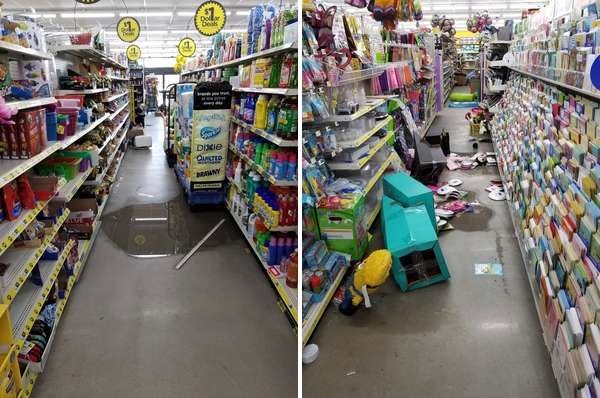
A. Pressurized Domestic Water Supply Risers & Copper Joint Failures
Multi-story commercial office buildings utilize vertical water supply risers constructed of heavy copper or ductile iron that distribute domestic water to common restrooms, breakrooms, and executive kitchenettes across every floor. These risers operate under continuous high pressure (often boosted by subterranean variable-frequency drive pumps to maintain 65 to 80 PSI on upper stories):
- Water Hammer Shock & Joint Fatigue: Rapid solenoid shutoffs on commercial sensor-activated flush valves and automated breakroom appliances generate intense hydraulic shockwaves (water hammer) through vertical plumbing columns. Over time, recurring hydraulic shock weakens soldered copper fittings and mechanical grooved couplings, leading to sudden, catastrophic pipe wall ruptures.
- Unattended Weekend Deluges: Because commercial corporate offices are largely unoccupied between Friday evening and Monday morning, a pipe rupture occurring on a weekend can flow undetected for thirty-six to forty-eight hours. A 2-inch pressurized riser discharging at 70 gallons per minute releases over 100,000 gallons of municipal water throughout the building envelope before security personnel detect the breach.
B. Chilled-Water Hydronic Cooling Loops & Fan Coil Condensate Overflow
To cool large floor-plate commercial offices in Phoenix, buildings utilize central chiller plants that circulate chilled water (typically 42°F to 45°F) through insulated steel pipe loops to individual Variable Air Volume (VAV) terminal units and fan coil units (FCUs) concealed in dropped ceiling plenums:
- Condensate Pan Choking & Algal Slime: High-humidity monsoon conditions combined with ambient airborne office dust cause aggressive microbial slime formation inside condensate drain pans. Blocked drain lines cause drip pans to overflow silently into ceiling spaces.
- Chilled-Water Pipe Condensation & Vapor Barrier Tears: If the closed-cell elastomeric insulation surrounding chilled-water pipes tears or degrades, blistering Phoenix air contacts the freezing pipe surface. Continuous heavy condensation drips onto acoustic ceiling tiles, causing sudden ceiling tile collapses onto employee desks and computer hardware.
C. Multi-Tenant Restroom Flush Valve Backups & Multi-Floor Cascades
Commercial restrooms experience heavy, high-frequency daily usage from hundreds of office workers and visitors. Foreign objects, paper towel clogs, or defective diaphragms in commercial Sloan flushometer valves cause continuous commercial toilet overflows. Water rapidly covers the non-porous ceramic tile floor, breaches the marble threshold into common tenant hallways, and seeps through expansion joints and plumbing sleeve penetrations into the ceiling plenums of tenants occupying the floors directly below.
D. Breakroom Ice Machine Line & Reverse Osmosis (RO) Filtration Failures
Nearly every modern corporate office suite features an employee breakroom equipped with commercial coffee makers, commercial ice dispensers, and under-sink Reverse Osmosis (RO) drinking water filtration systems. These appliances are connected to continuous water supplies via small-diameter flexible plastic tubing (1/4-inch or 3/8-inch poly tubing). In the desert heat, plastic tubing degrades, fittings slip under water surges, or rodents in ceiling chases gnaw through lines, triggering localized high-pressure leaks that saturate custom cabinetry, luxury vinyl tile (LVT), and adjacent server closets.
E. Automatic Fire Sprinkler Head Ruptures & Forklift Strikes in Loading Docks
Commercial corporate buildings maintain comprehensive wet-pipe fire sprinkler systems under NFPA 13 standards. While highly effective for life safety, accidental sprinkler head discharges—caused by maintenance ladders bumping ceiling heads, mechanical warehouse strikes in loading docks, or thermal head degradation—discharge black, chemically treated, stagnant water containing iron oxides and cutting oils at 30 to 60 GPM, contaminating sensitive corporate workspace environments.
2. The Economic Equation of Office Downtime: Lease Liabilities, CAM Disputes & Business Interruption
In commercial real estate asset management, building profitability depends upon uninterrupted lease occupancy, timely rent collections, and minimal tenant attrition. When an indoor flood strikes an office tower, the compounded economic damages rapidly outpace physical repair expenses.
A. Calculating the Compounding Losses of Tenant Displacement

When water intrusion forces corporate tenants to evacuate their commercial office suites, the financial disruption ripples across multiple stakeholders:
- Direct Business Interruption for Corporate Tenants: A mid-sized professional firm (such as an engineering consultancy, law firm, or regional accounting office) occupying 15,000 square feet with 75 employees faces payroll overhead exceeding $30,000 to $50,000 per working day. If employees cannot access workstations, telephone systems, or secure servers, productivity drops to zero while overhead continues unabated.
- Tenant Rent Abatement Obligations: Under standard commercial gross and modified-gross lease agreements, if a tenant suite becomes unusable due to a base building plumbing failure or landlord-managed utility breach, the tenant has the legal right to claim rent abatement. Taking three floors of Class-A corporate space offline in Phoenix or Scottsdale for three weeks results in tens of thousands of dollars in unrecoverable lease income for property ownership.
- Tenant Attrition & Sublease Risks: Disgruntled corporate tenants whose high-value office spaces suffer recurrent water leaks or prolonged, disruptive remediation projects frequently refuse lease renewals, demand lease terminations, or file constructive eviction lawsuits against commercial landlords.
B. Triple Net (NNN) Leases & Common Area Maintenance (CAM) Conflicts
Resolving insurance and financial responsibility following an office building water intrusion requires forensic clarity regarding lease boundaries:
- Base Building Infrastructure (Landlord Coverage): The commercial property owner is legally responsible for structural exterior envelopes, vertical plumbing risers, central chiller loops, main fire suppression risers, elevator systems, and core common-area corridors. Damage originating from these systems falls under the building owner’s commercial property and general liability policies.
- Tenant Improvements & Betterments (Tenant Coverage): Individual corporate tenants are responsible for interior architectural finishes (custom glass demising walls, executive wood trim, tenant-installed carpeting), personal business property, computer servers, trade fixtures, and specialized office furniture, covered under their Commercial Property and Business Owners Policy (BOP).
- CAM Deductible Pass-Through Disputes: If a water disaster originates in a common utility chase and damages common corridors, property managers often attempt to allocate insurance deductible expenses across tenants through year-end CAM reconciliations. Tenants routinely dispute these charges unless an independent, certified restoration contractor provides incontrovertible moisture mapping and forensic origin reports. Phoenix Damage Pros supplies court-defensible forensic documentation that eliminates lease litigation.
C. Critical Corporate Electronic Hardware & IT Server Salvage
Modern corporate offices house expensive electronics: modular workstation computers, enterprise network switches, multi-function commercial printers, and high-density telecom equipment. While standing water on carpet tiles is destructive, ambient relative humidity exceeding 70% RH causes microscopic condensation on internal circuit boards, triggering short-circuits, electrolytic corrosion, and catastrophic server crashes. Phoenix Damage Pros stabilizes corporate atmospheres within sixty minutes, preventing secondary hardware destruction.
3. Engineering In-Place Structural Drying: Raised Access Floors, Acoustic Plenums & Demising Walls
Traditional restoration contractors rely on destructive demolition: cutting out four-foot drywall swaths, tearing down acoustic ceiling grids, and ripping out glued carpet tiles. In a high-end corporate office, this heavy-handed approach paralyzes business operations for six to ten weeks, requiring complex architectural permitting and costly contractor mobilization. Phoenix Damage Pros deploys scientific in-place structural drying protocols that preserve corporate architectural assets with minimal downtime.
A. Restoring Raised Access Floor Plenums (Low-Profile Cable Decks)
Modern technology and financial offices utilize modular raised access flooring systems (such as Tate Access Floors) to route high-voltage electrical cabling, fiber optic data lines, and chilled airflow beneath carpeted floor panels. When water enters a raised floor environment:
- Sub-Floor Water Pooling: Water flows unimpeded across the structural concrete sub-slab beneath the raised floor tiles, submerging electrical junction boxes, telecommunication wire trays, and air supply plenums.
- Controlled Negative-Pressure Tile Extraction: Rather than dismantling hundreds of modular steel-cementitious floor panels—which requires unbolting office workstations and disconnecting computer cables—our technicians utilize heavy-duty vacuum suction lifters to remove select tiles every twenty feet. We install high-volume negative-pressure desiccant air manifolds directly into the sub-floor plenum, circulating ultra-dry, heated process air through the cavity until electronic relative humidity sensors confirm the sub-slab is fully dried to equilibrium.
B. Acoustic Ceiling Tile Salvage & Plenum Cavity Decontamination
Suspended acoustic ceiling grids (featuring 2×2 or 2×4 mineral fiber tiles) conceal fire sprinkler lines, electrical conduits, and HVAC ductwork. When upper-floor leaks infiltrate the plenum:
- Directly saturated ceiling tiles lose structural binding integrity, sag under water weight, and pose immediate falling hazard risks. Technicians carefully remove and bag wet tiles to prevent water from dripping onto executive desks below.
- The overhead ceiling plenum is dried using directed axial air movers and commercial desiccant dehumidification ducted into the plenum space.
- Metal ceiling T-bar grids and structural hanger wires are inspected and sanitized with EPA-registered botanical antimicrobials to eliminate corrosion and microbial colonization, allowing property managers to simply drop in matching new ceiling tiles without replacing entire suspended ceiling grid frameworks.
C. Non-Destructive Commercial Demising Wall & Modular Glass Partition Drying
Commercial office tenant suites are separated by metal-stud demising partitions lined with 5/8-inch Type X fire-rated gypsum board, often finished with architectural vinyl, fabric wallcoverings, or high-end sound-attenuation batting. Interior executive offices feature modular demountable architectural glass wall systems (such as DIRTT or Muraflex) anchored to floor tracks:
- Capillary Wicking in Steel-Stud Assemblies: Water pooling on concrete slabs travels underneath bottom runner tracks. Porous drywall wicks moisture vertically through capillary action, saturating drywall several feet above the floorline.
- Discrete In-Cavity Desiccant Injection: Rather than tearing down fire-rated walls, our crews remove decorative vinyl cove baseboards and drill discrete 5/8-inch ventilation ports into each stud cavity below the baseboard line. High-velocity desiccant air is injected directly into the wall cavity, forcing moisture-laden vapor out opposing ports. Once certified dry, ports are sealed with fire-rated intumescent acoustic sealant, and baseboards are reattached with zero damage to upper decorative finishes.
- Architectural Glass Track Preservation: Aluminum and steel floor channels supporting modular glass walls are dried in-place using high-suction vacuum extraction blankets, eliminating the enormous cost and technical complexity of dismantling custom glass office systems.
D. Commercial Carpet Tile & Hydrophobic Adhesive Re-Bonding
Class-A office spaces utilize commercial modular carpet tiles installed over concrete slabs using “releasable” pressure-sensitive latex adhesives. Untrained contractors often tear up and discard thousands of square yards of commercial carpet tiles. Phoenix Damage Pros deploys self-propelled, weighted extraction rovers that apply over 1,200 pounds of downward compression, pulling up to 95% of trapped water directly out of carpet fibers and acoustic cushions. By controlling relative humidity with trailer-mounted desiccant systems, we prevent adhesive breakdown, allowing the carpet tiles to dry flat and re-bond securely to the concrete sub-slab.
4. Indoor Environmental Air Quality (IAQ), Acoustic Decibel Management & Off-Hours Workflow
In a populated corporate office environment, restoration operations must never disrupt ongoing executive functions, client meetings, or telephone conferences. Operating loud commercial air movers and industrial equipment during normal working hours alienates corporate tenants and provokes immediate complaints to property management. Phoenix Damage Pros enforces strict acoustic containment and environmental air quality management.
A. “Whisper-Mode” Low-Decibel Drying Equipment (< 52 dB)
Standard industrial centrifugal air movers generate noise levels between 72 and 78 decibels (equivalent to a vacuum cleaner operating continuously next to a worker’s desk). To allow corporate tenants to conduct business in adjacent suites without acoustic disruption, Phoenix Damage Pros operates a dedicated fleet of low-decibel drying machinery:
- Brushless DC Axial Air Movers: Our high-efficiency axial fans feature aerodynamic cowls and brushless DC motors that produce powerful laminar airflow while operating at whisper-quiet sound levels below 50 to 52 dB—quieter than normal conversational speech.
- Sound-Baffled Commercial LGR Dehumidifiers: Internal acoustic dampening insulation and vibration-dampening neoprene footings prevent low-frequency motor vibrations from conducting through concrete floor slabs into executive offices on lower levels.
- Exterior Loading Dock Staging for Industrial Desiccants: For large multi-floor water disasters, our heavy trailer-mounted desiccant generators remain staged in ground-level service docks or parking areas. High-pressure, ultra-dry air is ducted discreetly into the building through service elevator shafts and fire stairs, eliminating all mechanical compressor noise from corporate office corridors.
B. HEPA Negative-Pressure Dust Containment & Micro-Filtration
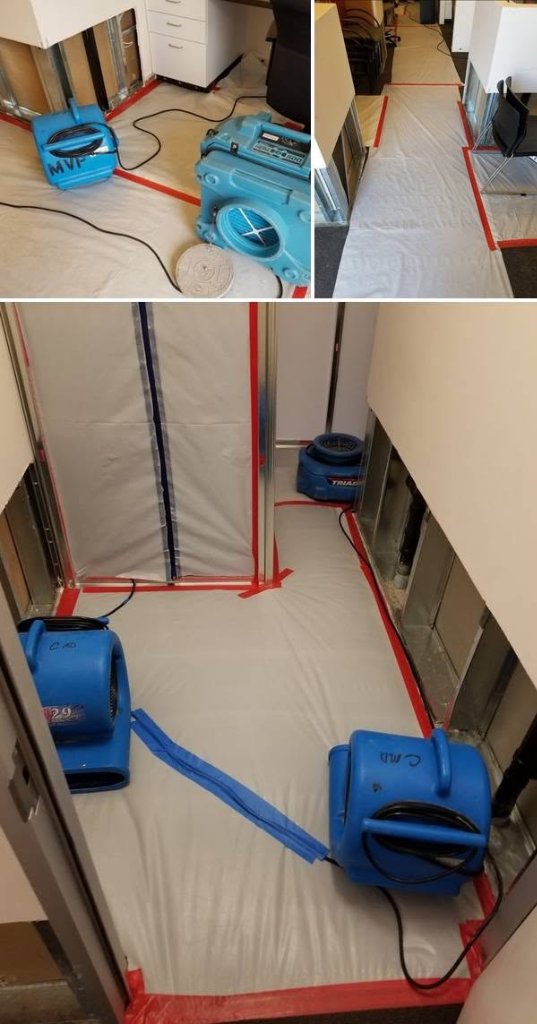
When working within water-damaged office areas, preventing the migration of dust, particulate matter, and fungal spores into active tenant workspaces is mandatory under OSHA and ASHRAE standards. Our technicians erect floor-to-ceiling temporary containment barriers built from 6-mil flame-retardant polyethylene sheeting, sealed with magnetic self-closing doorways. Industrial HEPA air filtration devices (air scrubbers) run continuously under negative pressure, exchanging room air 6 to 8 times per hour through true 99.97% HEPA filters to scrub airborne contaminants before air exhausts safely outside.
C. Molecular Hydroxyl Odor Neutralization (Safe for Occupied Workplaces)
Water-damaged office furniture, cubicle fabric panels, executive leather chairs, and damp drywall release musty, stagnant odors. Ozone generators cannot be operated in occupied office buildings because ozone gas is hazardous to human respiratory systems and degrades computer electronics. Phoenix Damage Pros deploys industrial atmospheric hydroxyl generators that mimic solar UV oxidation. Hydroxyl radicals ((cdot OH)) neutralize volatile organic odor molecules at the molecular level. Hydroxyl technology is 100% safe for continuous operation in occupied corporate offices, ensuring employees experience fresh, neutral air without requiring building evacuations.
D. Commercial Office Space Restoration & Mitigation Engineering Matrix
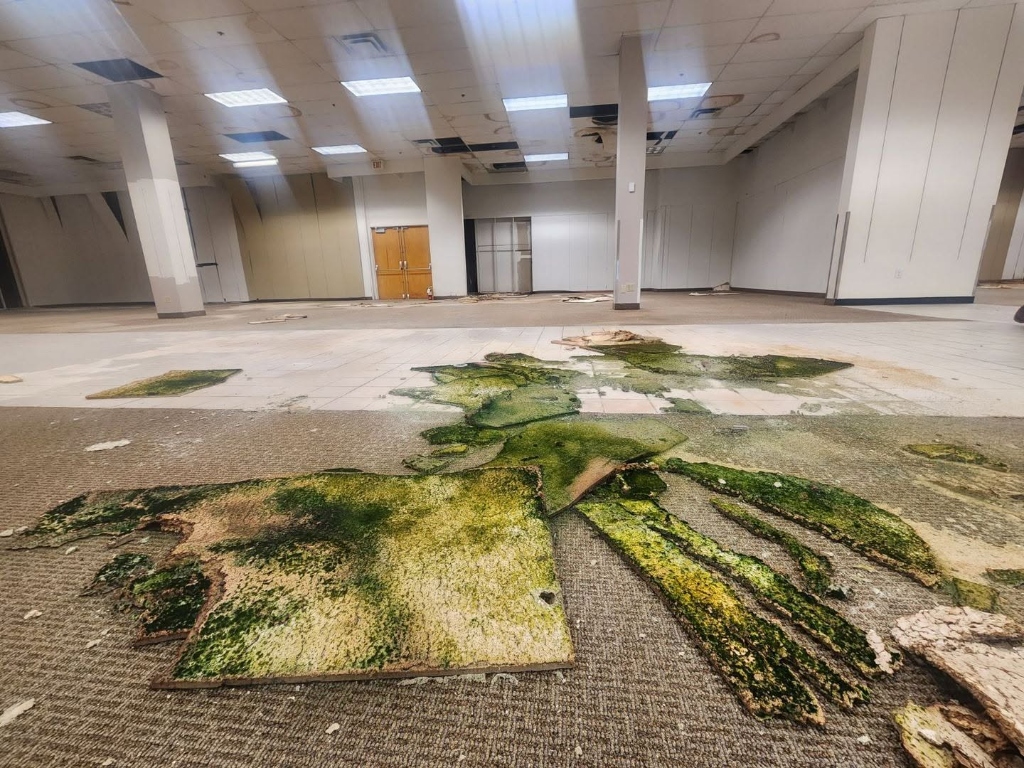
The following technical matrix outlines specific commercial office building zones, common water failure mechanisms, property vulnerabilities, and specialized restoration solutions deployed by Phoenix Damage Pros:
| Corporate Office Zone | Water Infiltration Mechanism | Vulnerability & Business Risk | Phoenix Damage Pros Specialized Solution |
|---|---|---|---|
| Multi-Story Executive Suites | Vertical plumbing supply riser rupture | Executive desk saturation, custom millwork warping, tenant rent abatement claims | Non-destructive thermal drying mats, in-cavity wall desiccant drying, whisper-mode LGR fleets. |
| Technology & Telecom Server Rooms | Overhead chilled-water FCU pipe burst | Server rack short-circuits, catastrophic network downtime, data loss | Emergency electronic desiccant de-moisturization, raised floor plenum extraction, MERV 13 filtration. |
| Open-Plan Cubicle Workstations | Commercial fire sprinkler head accidental release | Modular carpet tile delamination, cubicle fabric odor, electrical wire tray flooding | Weighted Hydro-X extraction rovers, in-place carpet preservation, botanical antimicrobial sanitization. |
| Multi-Tenant Restroom Banks | Flushometer commercial toilet backup (Cat 3) | Pathogenic biohazard contamination, floor-to-ceiling plumbing chase wicking | Category 3 sewage extraction, hospital-grade disinfection, CIH ATP swab verification. |
| Corporate Breakrooms & Cafeterias | Commercial coffee brewer or ice maker supply leak | Luxury Vinyl Tile (LVT) adhesive hydrolysis, base cabinetry rot, mold growth | Negative-pressure sub-floor extraction, precision toe-kick desiccant injection, mold barrier sealing. |
| Building Elevator Core & Hoistways | Top-down water cascade down elevator shaft | Traveling cable saturation, elevator car mechanical red-tag, lobby flooding | Pit sump pumping, industrial hoistway desiccant purging, ADOSH safety coordination. |
5. End-to-End Corporate Office Restoration Workflow: Phased Rapid Turnover Protocol
To eliminate unnecessary business interruption and return corporate office tenants to full operational capacity, Phoenix Damage Pros executes a disciplined, multi-phase commercial disaster workflow engineered specifically for corporate commercial facilities:
Phase 1: Emergency Command Mobilization & Discrete Site Arrival (0–45 Minutes)
Upon receiving an emergency dispatch call from a property manager, building engineer, or facility director, our heavy commercial response team arrives on-site within 45 minutes anywhere in Greater Phoenix. To maintain tenant confidentiality and professional decorum, crews enter via subterranean service bays and freight elevators with discrete, unmarked professional equipment.
Phase 2: Source Isolation, Life-Safety Verification & Forensic Moisture Mapping (Hour 1–2)
Technicians coordinate directly with on-site building engineering to verify plumbing shutoffs and confirm electrical life safety in affected zones. Deploying high-resolution FLIR® thermal imaging infrared cameras, non-invasive digital capacitance meters, and deep-wall probe hygrometers, we forensically map the exact vertical and lateral migration footprint of water across all floors and tenant demising partitions.
Phase 3: High-Volume Industrial Extraction & High-Value Asset Protection (Hour 2–4)
Deploying heavy truck-mounted vacuum extractors and self-propelled weighted rovers, our technicians extract standing water from commercial carpet tiles, tile walkways, and sub-floor utility channels. Concurrently, certified content restoration technicians elevate computer CPUs, confidential paper files, and executive furniture onto water-resistant structural blocks.
Phase 4: Environmental Containment & Deep Desiccant Structural Drying (Days 1–3)
We install negative-pressure plastic containment vestibules to isolate active work zones from occupied office suites. Low-decibel whisper air movers (< 52 dB) and trailer-mounted desiccant dehumidifiers circulate heated, low-grain air through wall cavities, raised floor plenums, and acoustic ceiling spaces, drying structural materials in-place without disruptive wall demolition.
Phase 5: Molecular Hydroxyl Air Decontamination & Micro-Sanitization (Day 3)
Industrial hydroxyl generators run continuously to neutralize volatile organic compounds and musty moisture odors from cubicle fabrics and office carpets. All hard architectural surfaces are sanitized with EPA-registered, hospital-grade botanical antimicrobials to eliminate microbial proliferation.
Phase 6: Forensic Moisture Auditing & White-Glove Tenant Turnover (Day 4)
Project managers perform rigorous final digital moisture auditing, confirming that all drywall, metal framing, sub-slabs, and carpeting have reached verified baseline dry standards (EMC < 10%). Wall access ports are sealed with fire-rated intumescent compound, baseboards are reinstalled, furniture is reset to exact corporate configurations, and the suite is officially released to building ownership for immediate tenant re-occupancy.
6. Why Phoenix & Scottsdale Commercial Office Property Managers Trust Phoenix Damage Pros
Commercial office asset managers, corporate facility directors, high-rise property engineers, and commercial leasing brokers throughout Phoenix, Scottsdale, Tempe, Glendale, and Mesa depend on Phoenix Damage Pros as their premier commercial restoration contractor:
- Dual-Licensed Contracting & Mitigation Authority: Operating under Arizona General Commercial Contracting License AZ ROC #342819, we seamlessly handle emergency high-volume water extraction, specialized in-place structural drying, and full tenant improvement commercial buildouts under a single, accountable corporate contract.
- Guaranteed 45-Minute Emergency Mobilization: Our commercial disaster fleet is strategically positioned across the Valley of the Sun, guaranteeing rapid on-site arrival 24 hours a day, 365 days a year to contain multi-story plumbing leaks before they spread across multiple tenant suites.
- Advanced In-Place Structural Drying Capabilities: We maintain Arizona’s largest inventory of whisper-quiet drying fleets (< 52 dB), trailer-mounted industrial desiccant dehumidifiers, and in-cavity wall drying systems that eliminate drywall demolition, saving fire-rated demising partitions and shortening office closures by weeks.
- Impartial Cause-and-Origin Forensic Documentation: We provide detailed moisture maps, thermal scans, and photographic logs that clearly establish whether water originated from base building risers or tenant improvements, eliminating contentious NNN lease and CAM reconciliation disputes.
- Insurance Billing & Xactimate® Precision: All estimates, moisture curves, and daily drying logs are compiled using insurance-standard Xactimate® software, providing comprehensive documentation that supports Business Interruption and Extra Expense claims for seamless carrier settlements. In addition, our commercial division provides direct electronic billing coordination with all major corporate insurance syndicates, streamlining Business Owners Policy (BOP) and commercial property underwriting reviews with certified moisture curves.
- Local Corporate Headquarters in Phoenix: With executive corporate offices located at 2415 E Camelback Rd, Suite 400, Phoenix, AZ 85016, our commercial leadership team is accessible, accountable, and deeply committed to preserving the value of Arizona commercial real estate.
Protect Your Commercial Office Tenants & Building Assets Today: Do not let multi-story pipe bursts, chilled-water leaks, or roof intrusions disrupt business operations or trigger tenant lease disputes. Call Phoenix Damage Pros 24/7 at (602) 587-1380 for immediate commercial emergency dispatch or to establish a priority Commercial Office Emergency Response Plan (ERP).
7. Frequently Asked Questions: Commercial Office Building Water Damage in Phoenix AZ
1. Who is legally responsible for water damage in a commercial office building under a modified-gross or NNN lease?
Legal responsibility is determined by the lease agreement and the point of water origin. Typically, the commercial building owner (landlord) is responsible for base building infrastructure, including vertical domestic supply risers, central HVAC chilled-water loops, structural exterior walls, commercial roof membranes, and fire sprinkler systems. The corporate tenant is responsible for interior tenant improvements (TI), decorative wall finishes, tenant-installed floor coverings, computer hardware, trade fixtures, and stored business records. Phoenix Damage Pros provides objective forensic origin documentation that resolves liability disputes immediately.
2. How quickly can Phoenix Damage Pros return flooded commercial office suites to service?
By deploying non-destructive in-place structural drying, weighted Hydro-X extraction rovers, and in-cavity wall desiccant drying, we typically restore commercial office suites to certified dry standards within 3 to 4 days. In comparison, traditional contractors who rely on heavy drywall demolition and reconstruction often keep office spaces closed for 6 to 10 weeks, causing catastrophic business interruption losses.
3. Can commercial office operations continue while water damage restoration is actively underway?
Yes. If water intrusion is confined to specific sectors (such as a core restroom bank, an individual tenant bay, or perimeter offices), our crews erect floor-to-ceiling negative-pressure containment barriers and deploy specialized whisper-mode drying fleets operating below 52 decibels. We route all cables beneath ADA-compliant safety ramps, allowing unaffected office departments to maintain normal daily business operations without acoustic or environmental disruption.
4. What happens when water leaks through suspended acoustic ceiling tiles in an office building?
Saturated acoustic ceiling tiles lose structural integrity and must be carefully removed and bagged to prevent ceiling collapse onto employee desks. Our certified technicians then access the overhead plenum cavity, using directed axial airflow and desiccant dehumidifiers to dry electrical conduits, ductwork, and structural slabs. Metal ceiling T-bar grids are sanitized with EPA-registered botanical antimicrobials to prevent corrosion and fungal growth before new matching ceiling tiles are installed.
5. How do you dry water trapped beneath modular raised access flooring systems?
Rather than disassembling hundreds of modular floor panels and disconnecting computer workstations, we remove select access panels using heavy-duty vacuum suction lifters. We connect positive-pressure desiccant air manifolds directly into the sub-floor cavity, forcing high-velocity, ultra-dry air through the plenum. This rapidly evaporates standing moisture off the concrete sub-slab and telecommunication trays without disturbing office desk furniture.
6. Can commercial modular carpet tiles be saved after a plumbing flood?
Yes, provided the water is clean Category 1 domestic tap water and extraction begins within 24 to 48 hours. We deploy weighted extraction rovers that apply over 1,200 pounds of distributed compression to extract up to 95% of trapped water from carpet fibers and cushion backing. By running industrial desiccant dehumidifiers, we prevent the pressure-sensitive adhesive from emulsifying, allowing carpet tiles to remain glued flat to the concrete slab without buckling or curling.
7. Why should commercial office property managers establish an Emergency Response Plan (ERP)?
An ERP pre-authorizes emergency restoration labor rates, maps all primary water isolation valves, documents building engineer emergency protocols, and guarantees priority equipment reservations before disaster strikes. During major Valley weather emergencies or winter freeze pipe breaks when restoration fleets are in high demand across Arizona, ERP partner buildings receive guaranteed 45-minute on-site response priority.