
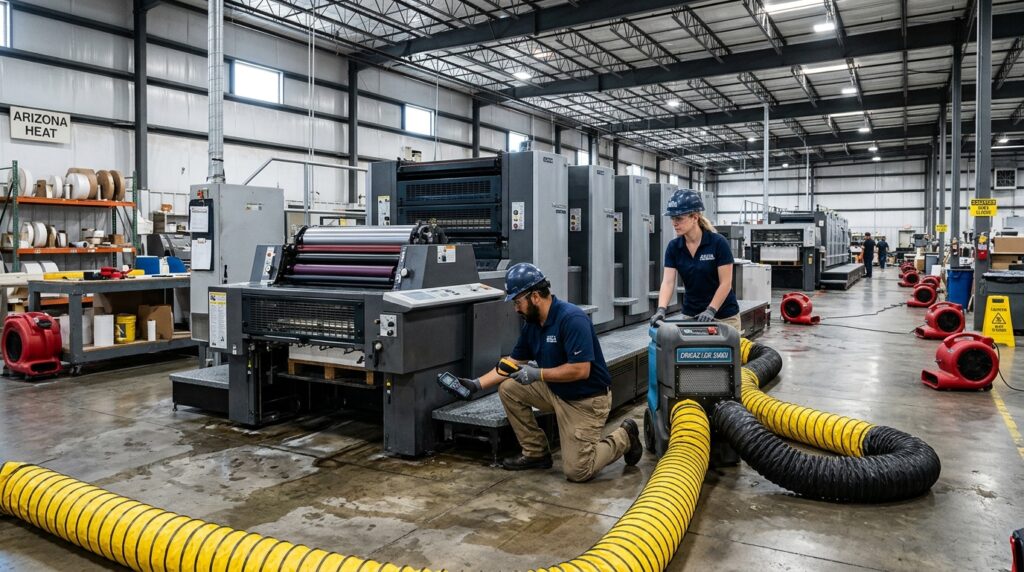
Commercial Printing Press Water Damage Restoration in Phoenix: Industrial Facility Stabilization & Machinery Recovery
The Greater Phoenix metropolitan region is a major Southwest graphics manufacturing, publication printing, and folding carton packaging hub. Key industrial corridors—including Broadway and 48th Street, Sky Harbor Center, Deer Valley Airpark, the Tolleson Interstate 10 logistics corridor, and manufacturing districts across Tempe and Chandler—house high-volume commercial printing plants. These facilities operate multi-million-dollar production assets: multi-unit sheetfed offset lithographic presses (Heidelberg Speedmaster XL 106, Komori Lithrone GLX 40), high-speed commercial web presses (Goss Sunday series), and continuous digital production platforms (HP Indigo 100K, Canon ProStream). Supporting operations include climate-controlled warehouses holding multi-ton paper rolls, automated saddle stitchers, folder-gluers, and precision cutters. When an industrial water emergency strikes, production stops immediately.
Whether caused by overhead fire sprinkler main ruptures, process chiller line breaks, Sonoran Desert monsoon roof failures, or subterranean slab plumbing fractures, water intrusion into a commercial pressroom is an acute operational crisis. Print plants operate in tightly balanced thermodynamic environments where moisture creates immediate destruction. Cellulosic paper rolls absorb water through capillary action, causing rapid fiber swelling, core chuck deformation, and roll explosions. Mirror-finished chilled-iron cylinders and ink roller trains flash rust within 4 to 12 hours of elevated humidity exposure. Subterranean utility raceways housing 480-volt 3-phase feeds face catastrophic short circuits, while monolithic concrete inertia pads absorb water, threatening sub-millimeter press alignments.
Remediating a flooded commercial printing facility requires specialized industrial psychrometric engineering, heavy machinery dewatering protocols, hazardous ink and fountain solution effluent containment, and deep micro-climate desiccant dehumidification driving grain depression below 20 GPP. Phoenix Damage Pros is Arizona’s premier commercial disaster recovery contractor, licensed under Arizona Registrar of Contractors commercial classification AZ ROC #342819. From our executive headquarters at 2415 E Camelback Rd, Suite 400, Phoenix, AZ 85016, we maintain dedicated industrial rapid-mobilization fleets providing guaranteed 45-minute on-site arrival across Phoenix, Tempe, Deer Valley, Tolleson, Chandler, Mesa, Scottsdale, and Glendale. Commercial printing directors and plant managers can activate our 24/7 emergency dispatch line directly at (602) 587-1380.
Facility Architectural Vulnerabilities, Structural Substrates & Inundation Mechanics
Commercial printing press facilities feature distinct architectural designs engineered to support massive dead loads, continuous web travel, and dynamic rotational forces. These structural characteristics introduce severe moisture-trapping vulnerabilities during an inundation event:
- Vibration-Isolated Monolithic Concrete Inertia Pads: Heavy offset lithographic presses weighing 40 to 90 tons require monolithic, reinforced concrete inertia foundations isolated from surrounding slabs by perimeter vibration-damping expansion joints lined with cork or elastomeric mastic. When floodwaters cover the pressroom floor, water enters these perimeter expansion joints. Trapped subterranean moisture generates continuous upward hydrostatic vapor pressure that corrodes foundation anchor bolts, bedplate leveling jacks, and precision leveling shims, destroying mechanical alignment tolerances calibrated to tenths of a thousandth of an inch.
- Subterranean Utility Trenches & Recessed Basements: Pressrooms utilize below-grade concrete utility trenches covered by heavy steel diamond plates. These trenches house 480-volt 3-phase busways, servo drive cables, chiller lines, pneumatic feeds, and fountain solution returns. During flooding, these trenches act as drainage sumps, submerging electrical conduits. Trapped moisture inside unventilated raceways drives relative humidity to 100%, causing rapid galvanic corrosion across copper busbars, terminals, and optical sensor connections.
- Raised Flooring in Control Consoles: Digital presses and press control desks (Heidelberg Prinect, Komori KHS-AI) sit atop pedestal-mounted raised access computer flooring. Standing water beneath floor tiles saturates acoustic insulation, pools around data cabling, and fosters rapid microbial growth in warm Sonoran interior environments within 24 to 48 hours.
- Climate-Controlled Raw Substrate Warehousing: Paper warehouses require strict environmental control (45% to 50% RH). When water covers warehouse slabs, concrete acts as an expansive moisture radiator, destabilizing warehouse vapor pressure and exposing millions of dollars in rolled paper stock to rapid capillary absorption.
Core Machinery, Electrical & Specialized Mechanical System Dewatering
A multi-unit commercial printing press represents a complex assembly of precision mechanical, electrical, and optical systems. Water ingress causes catastrophic breakdown unless countered by specialized forensic mitigation and chemical displacement procedures:
Plate Cylinders, Blanket Cylinders & Impression Cylinders Flash Corrosion
Offset presses utilize mirror-finished, alloy steel and chilled-iron cylinders operating under thousands of pounds of nip pressure. These cylinders are precision-ground to micro-inch tolerances for uniform ink transfer. Exposure to standing water or elevated relative humidity (RH > 60%) initiates rapid flash oxidation (rusting) within 4 to 12 hours. Surface pitting as shallow as 0.001 inches on an impression cylinder impairs halftone dot reproduction, ruining print resolution and forcing expensive cylinder replacement or on-site electroplating. Phoenix Damage Pros performs immediate mechanical moisture extraction, pneumatic wiping, and application of MIL-PRF-16173 Class II dewatering rust inhibitors to protect polished cylinder surfaces before permanent oxidation pits the metal.
Ink Distribution Roller Trains & Bearings Emulsification
Each print unit incorporates an ink distribution train consisting of alternating steel oscillating vibrators and precision elastomeric form rollers. Floodwater mixing with ink residues forms an acidic emulsion that migrates into roller end-bearings, drive gears, and pneumatic actuators. Trapped moisture strips lubricating grease from double-row spherical roller bearings, inducing hydrogen embrittlement and surface spalling upon press restart. Our mechanical restoration protocols include ink train moisture stripping, dry-ice blasting of ink-encrusted sideframes, bearing flushing with dielectric displacement solvents, and dry-air purge cycles.
Direct-Drive Servo Motors, PLC Automation & Optoelectronic Encoders
Modern high-speed presses utilize shaftless direct-drive servo motors synchronized by high-speed industrial Ethernet and fiber-optic communication loops. When floodwater reaches press sideframes, it threatens brushless AC synchronous motors, optical rotary encoders, and Programmable Logic Controllers (PLCs). Even without direct immersion, high humidity causes dew-point condensation inside drive enclosures, bridging circuit board traces. We establish positive-pressure micro-containments around drive cabinets, ducting ultra-dry desiccant air (< 20 GPP) directly through enclosures while performing insulation resistance testing (megohmmeter testing) before power re-energization.
Closed-Loop Chilled Water & Hydraulic Ink Lines
Commercial presses utilize closed-loop water chillers to regulate ink roller temperatures, preventing ink emulsification. High-pressure hydraulic circuits power web-tension arms, roll splices, and impression throw-off cylinders. Floodwaters entering hydraulic breathers, chiller expansion tanks, or couplings contaminate hydraulic fluid. Operating hydraulic systems with as little as 0.05% water causes cavitation, valve sticking, and pump failure. Phoenix Damage Pros performs fluid sampling, vacuum dehydration, and bypass filtration to prevent hydraulic failure.
Roll Paper Stock Hygroscopic Swelling, Core Chuck Deformation & Burst Mitigation
One of the most financially destructive consequences of a commercial printing plant water intrusion involves rolled paper stock inventory. Web offset and flexographic plants store thousands of paper rolls weighing between 1,500 and 4,500 pounds each, stacked up to four tiers high on concrete slabs. Paper is manufactured from cellulosic plant fibers that possess an extreme hygroscopic affinity for water molecules. When floodwaters reach paper storage areas, capillary moisture absorption initiates a destructive sequence:
- Capillary Wicking & Differential Stress: Cellulosic fibers draw water upward through tightly wound paper convolutions via capillary action. A submerged roll base wicks moisture upward through hundreds of paper layers within minutes. Fibers expand 20% to 30% in diameter while gaining virtually no longitudinal dimension, creating immense differential internal stresses within the tightly wound roll.
- Radial Expansion & Roll Bursting: As thousands of concentric paper layers expand simultaneously, internal radial forces reach thousands of pounds per square inch. This massive swelling pressure bursts heavy kraft outer wraps and steel strapping bands with explosive force. In stacked configurations, lower rolls swell unevenly, causing stack tilting, roll destabilization, and warehouse structural collapse hazards.
- Core Chuck Crushing & Out-of-Round Deformation: The core of an industrial paper roll consists of a heavy-duty 3-inch or 6-inch reinforced fiberboard or steel composite tube. As surrounding paper swells inward, it crushes the center core. When the core deforms out-of-round by as little as 1/16th of an inch, the roll cannot accept motorized expanding chucks on high-speed web unwinds, causing violent web flutter and breaks.
- Moisture Edge-Waving and Sheetfed Blocking: In sheetfed facilities, palletized paper skids absorb moisture around perimeter edges while the center remains compressed, creating severe edge-waving. When fed into high-speed presses, wavy sheets strike double-sheet detectors and cause feeder jams. In extreme cases, moisture dissolves clay coatings on gloss stocks, causing sheets to fuse into a solid block of cellulose (“blocking”) upon drying.
Phoenix Damage Pros utilizes thermal imaging and radio-frequency moisture meters to triage paper stock immediately upon arrival. Intact rolls above standing water are segregated into hermetically sealed micro-containments supported by desiccant dehumidifiers delivering process air below 15% relative humidity to halt boundary absorption. Saturated, structurally compromised rolls are isolated and documented for total-loss insurance recovery.
Specialized Environmental & Regulatory Containment Standards (MCAQD, ADEQ, OSHA, IICRC Class 4)
Restoring a flooded commercial printing facility in Greater Phoenix intersects with rigorous environmental, worker-safety, and technical restoration standards governing every phase of our mitigation process:
Maricopa County Air Quality Department (MCAQD) Rule 337 Compliance
Printing operations across Maricopa County are regulated under MCAQD Rule 337 (Graphic Arts Operations), mandating strict VOC limits for cleaning solvents, fountain solutions, and press washes. During restoration, displaced solvents and evaporative washes cannot be vented to ambient air. Phoenix Damage Pros utilizes low-VOC, EPA SNAP-approved moisture-displacing compounds and certified carbon scrubbers to maintain compliance.
Arizona Department of Environmental Quality (ADEQ) & RCRA Wastewater Controls
Industrial floodwater in a printing facility cannot be discharged into municipal storm drains or sanitary sewers. When water inundates press wash sumps, ink mixing rooms, and fountain solution reservoirs, it becomes contaminated with heavy metal pigments (barium, copper, chromium), ethylene glycols, isopropyl alcohol, and solvent residues. Under ADEQ guidelines and RCRA, this liquid constitutes hazardous industrial effluent. Phoenix Damage Pros mobilizes certified closed-loop wastewater recovery tankers and coordinates licensed hazardous waste manifest disposal to protect clients from regulatory penalties.
OSHA 29 CFR 1910 Subpart S & 1910.120 HAZWOPER Safety Standards
Subterranean electrical trenches and flooded 480V 3-phase switchboards present extreme arc-flash and confined-space hazards. Phoenix Damage Pros enforces strict OSHA 29 CFR 1910.333 Lockout/Tagout (LOTO) protocols prior to water extraction. Technicians entering recessed ink pits or subterranean utility trenches hold certified OSHA 40-Hour HAZWOPER and Confined Space Entry certifications, utilizing continuous multi-gas detectors and intrinsically safe negative-air extraction blowers.
IICRC S500 Class 4 Specialty Drying Situations
Under the IICRC S500 Standard, commercial print facilities represent a Class 4 Water Intrusion. Class 4 situations occur when water saturates low-porosity, high-density materials—including concrete inertia blocks, dense rolled paper inventory, deep structural cavities, and mechanical assemblies. Conventional refrigerant or LGR dehumidifiers cannot establish the ultra-low vapor pressures required to draw trapped moisture out of dense cellulose and subterranean concrete. Phoenix Damage Pros deploys multi-ton industrial solid-rotor desiccant dehumidification systems specifically engineered for Class 4 drying.
Hazardous Materials, Secondary Effluent & Chemical Solvent Ink Decontamination
A printing facility is an active chemical processing plant containing vast quantities of specialized chemical compounds. When water breaches these storage and circulation zones, rapid chemical cross-contamination occurs:
- Solvent Blanket & Roller Washes: Automatic blanket cleaning systems use aliphatic or hydrocarbon solvent washes to dissolve dried ink from rubber blankets. Floodwaters entering wash reservoirs displace these lower-density solvents, creating a floating flammable layer across floodwaters. This presents immediate vapor explosion hazards requiring explosion-proof air-driven diaphragm pumps and vapor-suppressing aqueous foam application.
- Acid & Alkaline Fountain Solutions: Offset lithography relies on fountain solutions containing water, phosphoric or citric acid buffers, gum arabic, wetting agents, and alcohol substitutes. Floodwater alters conductivity and pH balance, causing chemical leaching and salt deposition inside precision delivery manifolds and spray bars. Phoenix Damage Pros performs complete chemical flushes and deionized water rinsing to restore chemical equilibrium across dampening trains.
- UV and LED Curable Inks & Photoinitiators: Packaging and commercial presses utilize ultraviolet (UV) curable inks containing monomeric acrylates and photoinitiators. Unlike conventional oil-based inks that dry via oxidation, uncurable UV ink components are potent skin sensitizers and toxic aquatic pollutants. Flooded UV ink dispensing stations require immediate containment using specialized absorbent polymers, followed by chemical neutralization and disposal under strict hazardous material chain-of-custody protocols.
- Aqueous & Coating Overflows: Coater units apply aqueous, soft-touch, or high-gloss UV coatings at the end of the press line. Water intrusion into coating sumps causes rapid coagulative polymerization of polymer emulsions, forming rubbery dams that clog drain lines and bind mechanical pumps. We utilize specialized chemical enzymatic clearing agents and thermal flushes to dissolve coating blockages without harming underlying stainless steel piping.
Deep Psychrometric Engineering: Industrial Desiccant Fleets & Sub-Surface Extraction
The desert climate of Greater Phoenix presents a distinct thermodynamic paradox for restoration engineers. During the summer monsoon season (July through September), outdoor temperatures frequently exceed 110°F while outdoor humidity surges dramatically during microburst storms, pushing dew points into the mid-70s. Inside a flooded printing plant, the interior micro-climate becomes an artificial swamp, saturated with thousands of gallons of evaporating moisture trapped within concrete foundations, paper stock, and press frames.
To successfully dry a Class 4 printing facility without causing secondary condensation on multi-million-dollar steel machinery, Phoenix Damage Pros applies advanced psychrometric science utilizing heavy industrial solid-rotor desiccant dehumidifiers (deploying units from 5,000 CFM to 15,000 CFM capacity):
The Physics of Deep Grain Depression & Sub-Desert Vapor Pressure
Standard refrigerant (LGR) dehumidifiers condense moisture on cold coils. When ambient grain weight falls below 45 to 50 GPP or temperatures drop below 68°F, refrigerant units lose efficiency and freeze up. Phoenix Damage Pros deploys industrial solid-rotor desiccant dehumidifiers utilizing synthesized silica gel matrices. Operating on chemical adsorption, our units deliver process air below 15 to 25 GPP, maintaining interior pressroom grain weights well below 30 GPP. Sub-zero dew points (-10°F to 20°F) create a massive thermodynamic vapor pressure differential (ΔVp > 0.45 psi) between trapped moisture and the surrounding air. Suppressing ambient dew points below machinery surface temperature guarantees zero condensation (“machine sweating”), preventing flash corrosion across unpainted precision surfaces.
Targeted Ducting Matrices & Positive-Pressure Machine Shrouding
Our Master Restorers construct positive-pressure micro-environments around vulnerable press lines using flame-retardant poly shrouding, encapsulating individual print units, delivery consoles, and paper aisles. High-static desiccant ductwork routes bone-dry air through press units, around ink trains, and beneath subterranean electrical trenches. Moisture-laden reactivation air is ducted 100% outside, expelling hundreds of gallons of water vapor per hour into the Phoenix atmosphere.
Psychrometric Calculation Modeling
For an average 50,000-square-foot printing plant with 25-foot clear heights (1,250,000 cubic feet of airspace) experiencing a Class 4 water loss, Phoenix Damage Pros calculates required dehumidification capacity using strict thermodynamic formulas: Required CFM = (Air Volume × Desired Air Changes per Hour) ÷ 60. Under Class 4 standards requiring 2.5 air changes per hour (ACH) in high-density industrial facilities, Required CFM = (1,250,000 cu. ft. × 2.5 ACH) ÷ 60 = 52,083 CFM.
Technical Operational Matrix: Standard Restoration vs Phoenix Damage Pros Protocol
Commercial print facility recovery demands specialized technical engineering that standard commercial water damage restoration vendors simply cannot provide. The following operational matrix illustrates the critical technical differences between standard restoration practices and the advanced industrial protocol executed by Phoenix Damage Pros:
| Operational Parameter | Standard Commercial Restorer | Phoenix Damage Pros Precision Industrial Protocol |
|---|---|---|
| Emergency Response & Mobilization | Generic 4- to 12-hour response window; dispatch from shared residential-commercial depots. | Guaranteed 45-minute on-site arrival across Greater Phoenix from Camelback corridor HQ; dedicated industrial response fleet. |
| Psychrometric Dehumidification Technology | Low-Grain Refrigerant (LGR) dehumidifiers; stalls below 45 GPP; ineffective in Class 4 specialty situations. | Industrial solid-rotor desiccant dehumidifier fleets (5,000–15,000 CFM); deep grain depression below 20 GPP; dew points below -10°F. |
| Precision Cylinder & Roller Protection | Wipe down with standard towels; high ambient humidity leaves microscopic moisture that causes flash rusting. | Immediate solvent moisture displacement (MIL-PRF-16173 Class II); precision micro-air drying; positive-pressure desiccant air shroud. |
| Roll Paper Inventory Triage & Salvage | Assumes all paper is lost or leaves standing rolls in ambient dampness, causing explosive core burst. | Thermal imaging and RF core moisture mapping; immediate boundary micro-containment; radial tension relief; segregating salvageable stock. |
| Sub-Floor Trench & Inertia Pad Dewatering | Surface sump pumping only; leaves saturated sand, mastic, and high humidity inside unventilated raceways. | Negative-pressure vacuum extraction; deep cavity desiccant injection; concrete core moisture telemetry; alignment baseline verification. |
| Chemical & Environmental Compliance | Dumping contaminated wastewater into municipal sewer; unmonitored solvent vapor release. | Strict ADEQ/RCRA closed-loop wastewater containment; MCAQD Rule 337 VOC vapor scrubbing; licensed hazardous waste manifest disposal. |
Substrate & Printing Machinery Moisture Thresholds and Recovery Dynamics
Restoring a commercial printing operation requires deep understanding of critical moisture tolerances across heterogeneous paper stocks, precision mechanical alloys, and sensitive automation electronics. The following engineering matrix outlines specific operational thresholds and restoration protocols applied by Phoenix Damage Pros:
| Substrate / Component | Baseline Dry Standard | Critical Moisture Threshold | Restoration Protocol & Salvage Feasibility |
|---|---|---|---|
| Coated Fine Paper Rolls (Gloss / Matte) | 4.5% – 5.5% Moisture Content (MC) | > 7.5% MC or bottom edge saturation > 1/2″ | High risk of clay-coating blocking and core chuck deformation. If wicking is shallow, peel wet outer wraps; encapsulate in < 15% RH desiccant zone. |
| Uncoated Newsprint & Offset Book Rolls | 6.0% – 7.0% MC | > 9.0% MC or standing water contact | Rapid capillary uptake. Lower rolls undergo severe fiber expansion and core crushing within 2 hours. Salvage via precision unwinding/rewinding or claim loss. |
| Polished Press Cylinders (Blanket / Plate) | 0.0% surface water; < 50% ambient RH | > 60% ambient RH or liquid film > 4 hours | Flash oxidation pitting occurs rapidly. Immediate mechanical dewatering, solvent displace flush, low-grain desiccant tenting, microscopic surface polish. |
| Sub-Floor Concrete Inertia Pads | < 75% In-Situ Equilibrium RH (ASTM F2170) | > 85% In-Situ Equilibrium RH | Moisture exerts continuous vapor drive, corroding anchor bolts and shims. Deep concrete desiccant extraction via negative-pressure floor mats; 7-day drying cycle. |
| Servo Drives, PLCs & Optical Encoders | Dielectric Megohm > 50 MΩ; < 40% RH | Direct liquid contact or condensation film | Do not energize. Ultrasonic cleaning with deionized solvent, baking desiccant purge chamber, contact pin resoldering, and full megohmmeter insulation verification. |
| Subterranean Cable & Ink Trenches | Standing water = 0; < 55% RH | Standing liquid or sludge > 1 inch | Confined-space entry; explosion-proof sludge pumping; ADEQ chemical manifest disposal; high-pressure forced desiccant duct purge. |
Commercial Insurance Claims Resolution, Xactimate® Itemization & Forensic Telemetry
Commercial printing press facilities represent immense capital investments where business interruption (BI) losses exceed $50,000 to $150,000 per day in missed publication deadlines and print run penalties. In such high-stakes environments, insurance claims face intense carrier scrutiny.
Phoenix Damage Pros bridges the technical gap between pressroom engineering and claims adjudication. We utilize Xactimate®, populated with precise commercial line items reflecting Class 4 industrial recovery costs, supported by rigorous forensic telemetry:
- Digital Psychrometric Telemetry Logs: Continuous ambient, dew-point, grain-depression (GPP), and surface temperature logs demonstrate why high desiccant CFM was necessary to prevent cylinder rust.
- Calibrated FLIR® Thermal Infrared Mapping: Radiometric images delineate moisture boundaries within paper roll stacks, sub-floor concrete slabs, and insulated press housings throughout stabilization.
- ASTM F2170 In-Situ Relative Humidity Concrete Probes: Electronic sensor sleeves inserted into concrete inertia pads verify structural drying completion according to scientific standards.
- Insulation Resistance & Megohmmeter Reports: Pre- and post-drying insulation resistance readings (Megohms) provide incontrovertible technical proof of electrical motor and drive safety.
Commercial Xactimate® Itemization Schedule
| Xactimate® Code | Item Description | Industrial Application & Technical Justification |
|---|---|---|
| WTR DESIC> | Desiccant Dehumidifier – Extra Large (10,000+ CFM) | Class 4 industrial psychrometric stabilization; deep grain depression below 20 GPP to prevent flash oxidation of press cylinders and paper roll swelling. |
| WTR EXTW> | Extraction – Industrial Sub-Floor / Deep Trench | Pumping contaminated water and ink-sludge from subterranean raceways, electrical utility vaults, and recessed press basements. |
| WTR HEPA | HEPA Negative Air Machine – High Static (2,000 CFM) | Containment of aerosolized paper dust, ink mist, and mold spores during aggressive mechanical drying and structural demucking. |
| DRY INJ | Positive/Negative Pressure Cavity Injection System | Direct desiccant air conveyance into subterranean raceways, raised flooring plenums, and hollow press sideframe cavities. |
| CONT CLNR | Specialty Equipment Chemical Clean & Corrosion Inhibit | Solvent wiping, moisture displacement, and anti-corrosive chemical application (MIL-PRF-16173) across polished steel cylinders and roller gears. |
| HAZ DISP | Hazardous Effluent Disposal – Industrial Manifest | RCRA-compliant transport and disposal of floodwaters contaminated with heavy metal inks, fountain solutions, and solvent blanket washes. |
Why Greater Phoenix Facility Directors Rely on Phoenix Damage Pros
When millions of dollars of printing machinery, critical paper inventory, and publication contracts are at risk, commercial printing directors rely on Phoenix Damage Pros. As Arizona’s premier industrial disaster recovery authority, we deliver proven technical performance:
- Arizona Commercial Contractor Licensing: Fully licensed, bonded, and insured under Arizona commercial classification AZ ROC #342819 for major industrial recovery projects.
- Guaranteed 45-Minute Emergency Mobilization: Operating from our headquarters at 2415 E Camelback Rd, Suite 400, Phoenix, AZ 85016, crews arrive within 45 minutes across Phoenix industrial parks, Deer Valley, Tolleson, Tempe, Chandler, Mesa, Scottsdale, and Glendale.
- Certified Master Technical Personnel: On-site leadership by IICRC Master Water Restorers, Commercial Drying Specialists, and OSHA 40-Hour HAZWOPER Supervisors experienced in printing press mechanics and electrical systems.
- Self-Contained Industrial Fleet: Trailer-mounted desiccant dehumidifiers (up to 15,000 CFM), diesel generators, explosion-proof slurry pumps, and high-capacity extraction units.
- Proven Commercial Claims Defense: Comprehensive Xactimate® estimates supported by infrared thermography, psychrometric logs, and megohmmeter reports ensuring rapid claim settlement.
- 24/7 Priority Commercial Dispatch: Direct access to a commercial project director anytime by calling (602) 587-1380.
Detailed Technical Frequently Asked Questions
How rapidly does flash corrosion develop on offset printing press cylinders, and how do you arrest it?
Flash corrosion on precision ground chilled-iron or alloy steel cylinders begins within 4 to 12 hours whenever relative humidity exceeds 60% or direct water droplets contact unpainted metal. Because presses operate with micro-gap tolerances, surface pitting as shallow as 0.001 inches distorts halftone dot transfer, ruining print clarity. Phoenix Damage Pros arrests oxidation immediately upon arrival.
Can water-damaged paper rolls in warehouse storage be salvaged, or are they a total loss?
Salvageability depends on exposure duration, stock grade, and capillary wicking depth. Rolls standing in water over 2 to 4 hours experience severe fiber swelling, core collapse, or outward burst, rendering them unrunnable on web presses where out-of-round cores cause web breaks. However, upper-tier rolls or rolls with minimal boundary exposure can often be saved. Phoenix Damage Pros performs infrared thermography and radio-frequency moisture depth profiling.
Why are standard refrigerant (LGR) dehumidifiers inadequate for printing plant drying?
Standard refrigerant and LGR dehumidifiers condense moisture on chilled coils. In Class 4 industrial print losses, LGR units lose thermodynamic efficiency below 45 GPP, making it impossible to achieve the deep grain depression (< 20 GPP) needed to draw trapped moisture from dense concrete inertia pads, paper rolls, and mechanical assemblies. Additionally, refrigerant units generate liquid condensation, creating hazards near 480V switchboards. Solid-rotor desiccant dehumidifiers utilize silica gel rotors operating via chemical adsorption, delivering dry process air at dew points down to -10°F.
How do you remediate water trapped in subterranean pressroom utility and cable trenches?
Subterranean trenches house 480V 3-phase feeds, drive cabling, fiber optics, chilled-water lines, and fountain returns. When flooded, they become confined-space sumps. Under OSHA 29 CFR 1910.120 and 1910.146 standards, our confined-space crews execute Lockout/Tagout (LOTO) protocols and continuous atmospheric monitoring (LEL, O2, VOCs). We remove steel trench plates, deploy explosion-proof diaphragm pumps to extract standing liquid and chemical sludges, and inject high-static desiccant air through containment sleeves directly into raceways.
What environmental regulations govern floodwater disposal in a commercial printing facility?
In Greater Phoenix, print facility floodwater cannot be discharged into sanitary sewers or storm drains. Floodwaters mix with blanket washes, UV monomers, glycol fountain solutions, and heavy metal ink pigments (barium, copper, chromium). Under MCAQD Rule 337 and ADEQ hazardous waste rules under RCRA, this wastewater is regulated industrial effluent.
Emergency Contact & Priority Commercial Mobilization Call-to-Action
If your commercial printing plant, packaging facility, or direct-mail fulfillment pressroom in Greater Phoenix has suffered an unexpected water intrusion event—whether from a sprinkler break, chiller loop failure, flash flood inundation, or plumbing rupture—immediate technical intervention is critical to prevent machinery loss and extensive business downtime. Every hour of delay increases the risk of cylinder flash rusting, roll paper explosions, and weeks of lost production.
Trust Arizona’s industrial disaster recovery leader. Phoenix Damage Pros deploys certified Master Restoration Engineers, trailer-mounted desiccant fleets, and forensic moisture telemetry to stabilize your facility, protect precision press assets, and resume production safely.
Our commercial mobilization teams operate 24/7/365 with guaranteed 45-minute emergency response across Phoenix, Tempe, Deer Valley, Tolleson, Chandler, Mesa, Scottsdale, and Glendale. Contact our emergency dispatch center at (602) 587-1380 or coordinate through our executive headquarters at 2415 E Camelback Rd, Suite 400, Phoenix, AZ 85016.
Phoenix Damage Pros
Corporate Operations Center: 2415 E Camelback Rd, Suite 400, Phoenix, AZ 85016
24/7 Commercial Rapid Response Dispatch: (602) 587-1380
Arizona Commercial Contracting License: AZ ROC #342819
Emergency Mobilization: Guaranteed 45-Minute On-Site Arrival Across Greater Phoenix