
24/7 Commercial Roof Leak Emergency Dispatch: If your commercial facility, industrial warehouse, retail shopping center, or multi-tenant office building in Phoenix or Maricopa County is experiencing active ceiling leaks, roof drain backups, parapet wall water intrusion, or monsoon storm roof breaches, call our rapid response team immediately at (602) 587-1380. Our IICRC-certified Master Water Restorers deploy within 30 to 45 minutes with emergency roof tarping crews, high-volume extraction units, and industrial structural drying fleets under AZ ROC #342819.
Commercial low-slope and flat roofing systems across Phoenix endure some of the most punishing climatic extremes in North America. Throughout the scorching desert summer, rooftop surface temperatures on Thermoplastic Polyolefin (TPO), Ethylene Propylene Diene Monomer (EPDM), and Built-Up Roofing (BUR) membranes routinely exceed 165°F to 180°F. This intense thermal solar baking causes severe ultraviolet degradation, thermal expansion strain, and loss of elastomeric plasticity. When the summer North American Monsoon arrives between July and September, this baked roofing infrastructure is abruptly bombarded by torrential downpours, severe microburst winds exceeding 60 to 75 MPH, and hail.
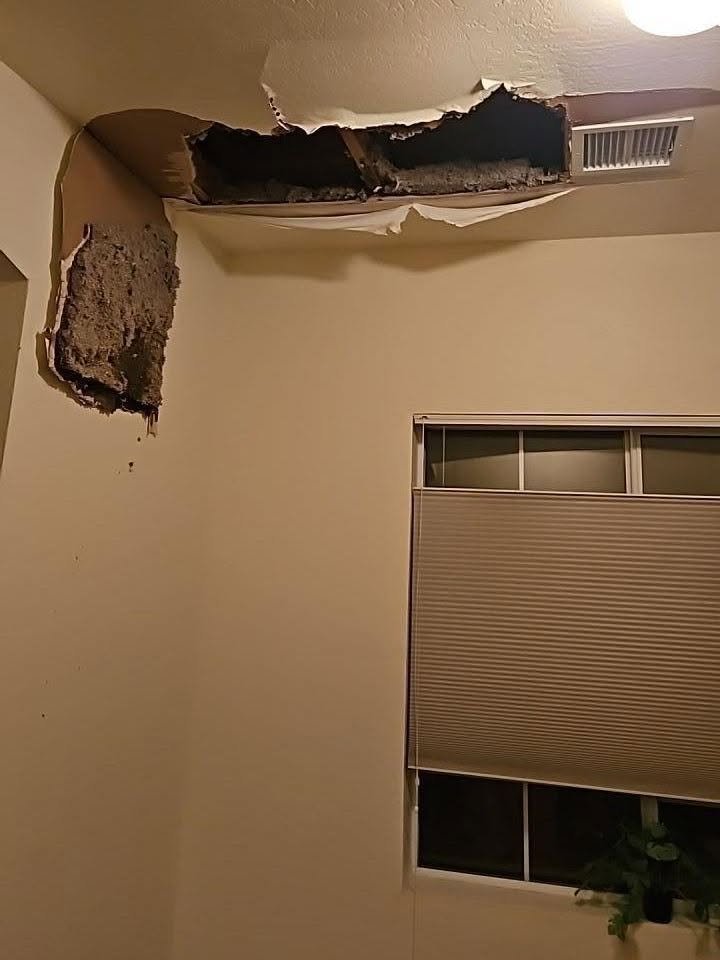
When a commercial roof membrane tears, a roof scupper clogs with desert debris, or parapet flashing fails under hydrostatic head pressure, water intrusion into the building envelope is swift and catastrophic. Hundreds of gallons of storm runoff overwhelm internal drainage networks, pooling in suspended acoustic ceiling plenums, cascading through fluorescent light fixtures, soaking drywall demising walls, and flooding expensive tenant inventory, server rooms, and commercial flooring below.
Commercial roof leak water damage restoration requires far more than placing plastic collection bins beneath ceiling drips or patching exterior membrane tears. Water entering a commercial roofing assembly saturates multi-layer polyisocyanurate (polyiso) rigid board insulation, corrodes corrugated metal structural decking, degrades interior drywall fire ratings, and creates ideal microbial incubation environments in humid Phoenix weather. This technical operational guide provides commercial building owners, facility engineers, and asset managers with an end-to-end framework for rapid emergency mitigation, precision psychrometric moisture extraction, and commercial insurance claims navigation following major commercial roof failures in Phoenix.

1. The Mechanical & Structural Anatomy of Commercial Roof Failures in Phoenix
Commercial roofing architecture differs fundamentally from residential steep-slope construction. The vast majority of corporate office complexes, industrial distribution warehouses, flex parks, and retail strip malls in Maricopa County utilize low-slope roofing assemblies designed to manage horizontal stormwater movement toward internal drains, perimeter scuppers, and downspout collector heads.
A. Low-Slope Membrane Vulnerabilities Under Desert Solar Exposure
Low-slope commercial roofing systems deployed throughout the Phoenix Valley rely on specialized single-ply or multi-ply membranes, each presenting distinct failure profiles under desert environmental conditions:
- Thermoplastic Polyolefin (TPO) & Polyvinyl Chloride (PVC): Widely favored for high solar reflectivity, single-ply white membranes suffer heat embrittlement over 10 to 15 years of desert sun. Extreme thermal cycling weakens hot-air welded seams, causing microscopic fissures that split open under heavy monsoon hydrostatic pressure.
- Ethylene Propylene Diene Monomer (EPDM): Synthetic rubber roofs expand and contract significantly. In Phoenix, intense radiant heat deteriorates seam adhesive tapes and uncured neoprene flashing around mechanical curbs, creating direct water paths into the roof substrate.
- Built-Up Roofing (BUR) & Modified Bitumen: Multi-ply asphalt systems dry out and lose volatile oils under extreme solar radiation. This results in “alligatoring” (surface cracking), blister formations, and membrane shrinkage, allowing ponding water to seep through multiple underlying felts.
- Commercial Metal Standing Seam Roofs: Common on Phoenix industrial flex spaces and logistics distribution centers. Heavy monsoon winds loosen mechanical fasteners, dislodge neoprene washers, and separate ridge caps, allowing wind-driven rain to enter attic spaces.
B. The Danger of Ponding Water and Structural Deflection
The National Roofing Contractors Association (NRCA) defines ponding water as any water standing on a roof deck 48 hours after precipitation. In Phoenix, flat roofs often accumulate substantial ponding depth within mere minutes during high-intensity microburst cloudbursts. Consider the physical physics of standing water on a commercial roof:
One inch of standing water across a 10,000-square-foot commercial roof weighs approximately 52,000 pounds (over 26 tons). When internal roof drains or perimeter scuppers become obstructed by windblown desert foliage, bird nesting materials, or roofing gravel, stormwater ponds rapidly. This concentrated dead load causes structural steel bar joists and corrugated decking to deflect downward, creating deeper low spots that draw even more water in a catastrophic process known as progressive deflection ponding, which can culminate in partial or total roof deck collapse.
C. Internal Roof Drain Assembly Failures and Clamping Ring Breaches

Unlike residential buildings that drain water off sloped eaves, large-footprint commercial facilities in Phoenix rely on internal cast-iron roof drain assemblies. Each drain features a sump receiver, an under-deck clamp, a cast-iron drain bowl, and a bolt-down clamping ring that secures the roofing membrane flashing collar. Under prolonged solar baking and thermal deck movement, clamping ring bolts loosen, and neoprene compression gaskets deteriorate. When torrential monsoon cloudbursts generate hydrostatic head pressure above the drain, water forces its way past the loosened clamping ring, bypassing the drain pipe entirely and pouring directly into ceiling plenums. Furthermore, aging cast-iron vertical leaders within interior utility chases suffer thermal expansion crack failures, releasing hundreds of gallons per minute into wall cavities.
| Commercial Roof Assembly | Primary Failure Mechanism in Phoenix | Moisture Penetration Velocity | Key Secondary Damage Risks |
|---|---|---|---|
| Single-Ply TPO / PVC Membrane | Seam separation, mechanical curb flashing failure, wind puncture. | Rapid (Direct conduit into underlying polyiso insulation) | Saturated insulation boards, ceiling tile collapse, interior drywall saturation. |
| Multi-Ply Built-Up Roofing (BUR) | Alligatoring splits, gravel erosion, blister ruptures under ponding. | Moderate to High (Spreads horizontally between felts before dripping) | Deck corrosion, widespread hidden plenum moisture, delayed leak detection. |
| Commercial Metal Standing Seam | Fastener backing out, thermal washer degradation, parapet lap separation. | Variable (Wind-driven rain penetration during microbursts) | High-bay electrical bus duct flooding, warehouse inventory saturation. |
| Modified Bitumen Cap Sheet | Thermal shock splitting, parapet counterflashing detachment. | Moderate (Lateral tracking along structural steel purlins) | Commercial carpet delamination, server room flooding, mold blooms. |
2. Phoenix Monsoon Dynamics: Microbursts, Wind Uplift & Flashing Failures
The Arizona monsoon season (June 15 through September 30) generates extreme convective thunderstorms characterized by intense microburst downdrafts, violent straight-line winds, haboob dust storms, and localized rain rates exceeding two to three inches per hour. Understanding how these meteorological phenomena compromise commercial building envelopes is vital for property managers:
A. Aerodynamic Wind Uplift Forces and Edge Metal Detachment
Bernoulli’s aerodynamic principle dictates that high-velocity winds flowing over the flat edge of a commercial building create massive negative pressure (suction) across roof perimeters and corners. In Phoenix, microburst winds frequently exceed 70 MPH, generating extreme uplift pressures that rip perimeter metal fascia, gravel stops, and parapet coping caps away from structural curbs. Once perimeter metal edge flashing is compromised, wind peels back hundreds of square feet of adhered or mechanically attached roofing membrane like a sardine can, exposing raw structural decking to torrential downpours.
B. Parapet Wall Coping and Reglet Counterflashing Failures
Parapet walls—the structural perimeter walls extending above the flat roof plane—are notorious failure points in Phoenix commercial properties. Parapets are subject to differential thermal expansion between the roof deck and exterior masonry or stucco walls. During violent monsoon storms, driving horizontal rain strikes exterior parapet facades, driving water behind loose counterflashing, unsealed reglets, and deteriorated coping joints. Water bypasses the primary roof membrane entirely, entering the building through exterior wall cavities.
C. HVAC Rooftop Unit (RTU) Curb Leaks and Ductwork Infiltration
Phoenix commercial facilities feature massive arrays of Rooftop Units (RTUs), make-up air fans, exhaust hoods, and refrigeration condensers. Each unit requires a structural roof curb, electrical conduit penetrations, and sheet metal supply and return duct plenums. During severe storms, degraded curb corner pitch pockets, failed elastomeric sealants, and unbaffled fresh air intake louvers allow high-pressure rainwater to enter air distribution systems, sending torrents of water directly into tenant office ceiling diffusers.
D. Lateral Water Tracking: The Hidden Water Migration Trap
One of the most vexing challenges for commercial property managers is identifying the exact entry point of a roof leak. Unlike residential attics where water drips straight down, commercial roof assemblies contain dense layers of rigid polyisocyanurate insulation, vapor barriers, and fluted steel or precast concrete decking. Water entering a small membrane breach often migrates laterally dozens or even hundreds of feet along fluted steel decking or vapor barrier seams before finding a joint, electrical box, or pipe penetration to cascade down into occupied tenant suites. Professional thermal infrared auditing is essential to trace this subterranean water path back to its true source.
E. Haboob Dust Accumulation and Drainage Sludge Formation
Prior to monsoon rainfalls, Phoenix experiences severe dust storms known as haboobs, which loft millions of pounds of fine particulate silt into the atmosphere. This dense desert silt settles across commercial roof decks, accumulating inches deep around drains and scuppers. When sudden heavy precipitation begins, this silt transforms into heavy, viscous mud sludge that immediately cakes over drain strainer domes, blocking gravity flow and triggering instant roof flooding even when mechanical drains are undamaged.
3. The 5-Phase Commercial Roof Leak Restoration Protocol
Executing commercial water damage mitigation following a roof breach requires disciplined engineering protocols governed by the IICRC S500 Standard and Reference Guide for Professional Water Damage Restoration. Below is the phased engineering methodology executed by Phoenix Damage Pros:
“`
[Phase 1: Emergency Tarping, Shrink-Wrapping & Life-Safety Isolation] (0-2 Hours)
│
▼
[Phase 2: High-Volume Industrial Extraction & Overhead Water Management] (2-6 Hours)
│
▼
[Phase 3: Thermal Moisture Auditing, Deck Inspection & Saturated Insulation Removal]
│
▼
[Phase 4: Psychrometric Controlled Dehumidification & Cavity Drying] (Days 1-4)
│
▼
[Phase 5: Antimicrobial Sanitization, IAQ Clearance & Reconstruction Handoff]
“`
Phase 1: Emergency Tarping, Shrink-Wrapping & Life-Safety Isolation (0–2 Hours)

Upon emergency dispatch, our crews prioritize securing the building envelope to stop ongoing water intrusion while isolating interior hazards:
- Commercial Emergency Roof Tarping & Shrink-Wrapping: Our technicians deploy heavy-duty commercial reinforced polyethylene tarps, securing them with weighted ballast sandbags, 2×4 wood battens, and mechanical fasteners outside water drainage channels to prevent further water ingress during active rainstorms. For complex mechanical configurations, we deploy commercial heat-shrink wrap systems.
- Drain and Scupper De-Clogging: Technicians clear clogged roof drains, remove storm debris from overflow scuppers, and install temporary strainer domes to restore gravity stormwater flow off the roof deck.
- Electrical Hazard Lockout: Water cascading through ceiling plenums saturates commercial fluorescent ballasts, LED drivers, and fire alarm strobes. We coordinate with facility engineers to de-energize affected overhead circuits while establishing temporary battery-powered emergency illumination.
- Tenant Asset Relocation & Tarping: Crews immediately drape commercial poly sheeting over computer workstations, tenant file cabinets, executive furniture, and warehouse pallet racks to shield high-value assets from dripping ceiling plenums.
Phase 2: High-Volume Industrial Water Extraction (2–6 Hours)
Standing water on commercial floor surfaces and in suspended ceiling systems must be removed rapidly to halt capillary wicking into vertical drywall partitions:
- Truck-Mounted Deep Extraction Units: Industrial positive-displacement vacuum units extract standing water from commercial broadloom carpeting, polished concrete, and vinyl tile floors.
- Ceiling Plenum Water Evacuation: Technicians remove waterlogged acoustic ceiling tiles systematically, utilizing containment funnels and catch drums to drain water trapped above suspended T-bar grids without splashing tenant furnishings.
- Weighted Ride-On Carpet Extractors: For commercial gluedown carpet, motorized weighted extractors press deep moisture out of backing materials, drastically speeding up structural drying times.
Phase 3: Thermal Moisture Auditing & Roof Deck Inspection
Accurate moisture mapping prevents hidden moisture from being sealed inside the roof sandwich or building walls:
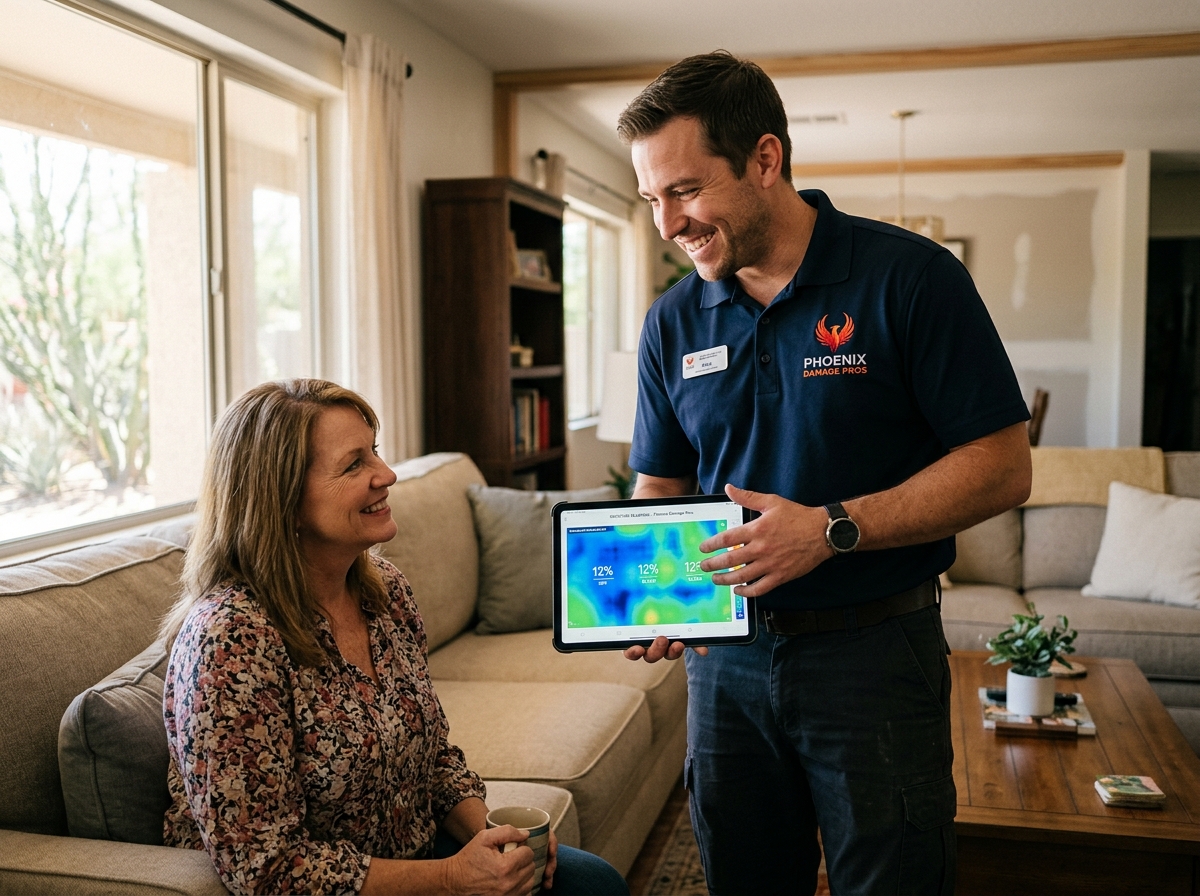
- FLIR® Infrared Thermal Imaging: High-resolution thermal cameras identify evaporative cooling patterns, delineating the exact boundaries of wet roof insulation, saturated drywall studs, and trapped plenum moisture.
- Tramex Non-Destructive Roof Moisture Scanners: Provide deep RF impedance scanning through roofing membranes to pinpoint wet polyisocyanurate insulation boards without cutting destructive test cores.
- Structural Deck Integrity Inspection: Corrugated metal roof decks and wood tongue-and-groove decking are inspected from the underside for rust, delamination, or deflection that could compromise structural capacity.

Phase 4: Psychrometric Structural Drying & Humidity Control (Days 1–4)
Commercial roof leaks typically represent Class 3 water intrusion, where water falls from overhead, saturating ceilings, interior walls, acoustic insulation, and floor coverings across large commercial spaces. Drying requires scientific psychrometric engineering:
Volumetric Dehumidifier Sizing Formula for Class 3 Overhead Losses:
Under IICRC S500 guidelines, dehumidification equipment capacity must match the thermodynamic moisture load of the impacted volume:
- Calculate total cubic feet:
Cubic Feet = Impacted Floor Square Footage × Ceiling Height. - Apply Class 3 divisor:
Class 3 Divisor = 30. Required AHAM Pints/Day = Cubic Feet ÷ 30.
For example, a 15,000-square-foot corporate office suite with 12-foot suspended ceiling plenums (180,000 cu ft) requires: 180,000 ÷ 30 = 6,000 AHAM Pints of Dehumidification Capacity per Day. To achieve this, Phoenix Damage Pros deploys banks of industrial Low-Grain Refrigerant (LGR) dehumidifiers and trailer-mounted desiccant dehumidifiers ducted directly into ceiling plenums.
- High-CFM Axial Air Movers: Positioned in vortex patterns across floors and angled upward toward ceiling grids to maximize boundary layer evaporation.
- Plenum Cavity Drying Systems: Warm, ultra-dry air is ducted into interstitial ceiling plenums above suspended ceiling grids to dry metal bar joists, structural steel, and HVAC duct insulation.
- HEPA Negative Air Filtration: Industrial air scrubbers equipped with certified HEPA filters run continuously to capture airborne mold spores, dust, and particulate matter in occupied tenant spaces.
Phase 5: Antimicrobial Sanitization, IAQ Clearance & Reconstruction Handoff
All exposed structural framing, metal decking, concrete slabs, and wall cavities receive topical treatment with EPA-registered broad-spectrum antimicrobial solutions. Once comprehensive digital moisture logs confirm that all materials have reached baseline dry standards, our reconstruction estimators provide seamless handoff for roof replacement, ceiling grid re-hanging, and drywall refinishing.
4. Protecting Mission-Critical Facilities: Server Rooms, Warehouses & Healthcare
Commercial roof breaches create severe operational vulnerabilities across specialized business sectors in Phoenix. Each environment requires tailored mitigation protocols:
A. Commercial Data Centers & Corporate Server Rooms
Water intrusion into IT server rooms presents immediate risks of electrical arcing, data loss, and mission-critical network downtime. When roof leaks threaten server racks:
- Immediate Anti-Static Containment: We construct anti-static poly containment shrouds above server racks, routing water safely into drainage reservoirs away from power distribution units (PDUs).
- Desiccant Humidity Stabilization: Standard refrigerant dehumidifiers can cause condensation fluctuations. We deploy precision desiccant dehumidifiers to maintain Relative Humidity strictly between 40% and 55%, preventing both static discharge and moisture condensation on server motherboards.
- Sub-Floor Air Plenum Extraction: Raised-floor server rooms frequently trap water beneath access tiles. We remove tiles strategically, deploying specialized vacuum extractors and laminar air movers to dry under-floor cabling raceways.
B. Industrial Warehouses & Logistics Distribution Centers
Phoenix flex parks and logistics centers store millions of dollars in boxed inventory on high-bay pallet racking. Overhead roof leaks saturate cardboard packaging, compromising structural stacking integrity and causing high-rack pallet collapses. Our teams deploy high-volume industrial extractors, establish floor-level containment, and assist warehouse managers in segregating damaged goods to protect untouched inventory.
C. Healthcare Clinics & Medical Office Buildings (MOBs)
In medical facilities, commercial roof leaks carry severe infection control risks. Water entering ceiling plenums can dislodge dustborne Aspergillus and bacterial spores into patient treatment areas. We implement strict Infection Control Risk Assessment (ICRA) Class IV protocols, establishing negative-pressure containment barriers, continuous HEPA air filtration, and hospital-grade antimicrobial disinfection to maintain regulatory compliance.
D. Commercial Retail Shopping Centers & Big-Box Store Inventory
In retail malls, department stores, and big-box outlets, roof leaks threaten high-value retail merchandise and create acute customer liability. Saturated corrugated cardboard packaging loses up to 85% of its Box Compression Test (BCT) structural strength within two hours, threatening vertical shelf collapses. Our commercial crews deploy perimeter barrier dams, rapid ride-on extractors, and dehumidification fans overnight so retail stores can reopen for morning shoppers without slip-and-fall hazards or revenue loss.
5. Commercial Insurance Claims, Xactimate® Mastery & Tenant Lease Liabilities
Commercial roof leak property insurance claims are among the most heavily scrutinized by commercial insurance carriers. Adjusters meticulously differentiate between “sudden and accidental storm damage” (such as wind uplift tears or microburst tree impacts) and “wear, tear, and deferred maintenance” (such as aged, brittle membranes or pre-existing ponding). Phoenix Damage Pros protects commercial property owners by providing forensic documentation that establishes clear causation:
A. Forensic Storm Documentation for Adjuster Approval
To support your commercial property claim, our certified project managers compile a comprehensive forensic claims packet:
- Official Meteorological NOAA Storm Data: Certified weather logs demonstrating wind gusts, microburst velocity, and precipitation rates in your specific Phoenix zip code at the time of the loss.
- High-Resolution Drone and Roof Aerial Photography: Geo-tagged, timestamped imagery documenting wind-torn membranes, uplifted coping caps, displaced ballast, and storm-impact punctures.
- Infrared Thermal Mapping Reports: Detailed thermographic scans proving the precise boundaries of water intrusion immediately following the storm event.
- Daily Psychrometric Moisture Logs: Verification of drying progress showing temperature, RH, GPP, and substrate moisture content (%MC) until scientific dry standard completion.
B. Standardized Xactimate® Itemized Commercial Line Items
All emergency tarping, water extraction, equipment deployment, and structural drying is billed using standardized Phoenix commercial Xactimate® pricing codes:
| Xactimate® Code | Commercial Description | Claim Justification |
|---|---|---|
| RFG TARP> | Emergency Roof Tarping – Commercial Flat Roof | Immediate mitigation to prevent progressive secondary interior water loss. |
| WTR EXT> | Water Extraction – Commercial Gluedown Carpet | Weighted high-vacuum extraction to salvage commercial broadloom carpet. |
| WTR DHM> | Dehumidifier – Large Industrial LGR / Desiccant | Psychrometric chamber dehumidification per 24-hour operational cycle. |
| WTR DRY> | Air Mover – Commercial High-Velocity Axial Fan | Laminar structural airflow across wet commercial drywall and concrete floors. |
| WTR BARR> | Containment Barrier – 6-Mil Flame Retardant Poly | Zoned isolation separating damaged tenant suites from operational suites. |
| WTR AIRSCR | HEPA Air Scrubber – Negative Air Machine | Airborne particulate capture and IAQ protection in occupied tenant spaces. |
C. Navigating Commercial Lease Obligations & Business Interruption
For commercial property managers and REIT asset directors, roof leak mitigation directly affects tenant rent collection and lease enforceability. Rapid restoration mitigates commercial lease liabilities:
- Preserving Tenant Occupancy & Avoiding Rent Abatement: Commercial leases frequently stipulate that tenants may abate base rent proportionally if premises become untenantable due to roof leaks. By deploying rapid zoned containment and 24/7 drying, we restore premises to full operational standards days faster, minimizing lost rental revenue.
- Preventing Constructive Eviction: Lingering mold odors and unresolved indoor air quality issues can give corporate tenants legal grounds to claim constructive eviction and break long-term leases. Our continuous HEPA air scrubbing and antimicrobial treatment protect building air quality and prevent lease cancellations.
- Clear Partition of Landlord vs. Tenant Property Losses: Our itemized estimates clearly distinguish between building structural elements (landlord casualty coverage) and tenant business personal property (BPP – desks, merchandise, computers), eliminating costly insurance subrogation disputes.
D. Roofing Manufacturer NDL Warranty Compliance
Many commercial properties carry 15- to 30-year No Dollar Limit (NDL) manufacturer warranties from commercial roofing suppliers (such as Carlisle, GAF, Firestone, or Johns Manville). Inappropriate emergency repairs or uncertified penetration patching can instantly void these high-value warranties. Phoenix Damage Pros executes emergency non-destructive ballast tarping and collaborates directly with manufacturer-authorized roofing contractors, protecting your NDL warranty coverage while executing rapid structural drying.
6. Commercial Facility Emergency Action Checklist: The First 60 Minutes
When monsoon storm rains breach a commercial roof in Phoenix, the initial 60 minutes determine whether your property experiences a manageable localized repair or an catastrophic multi-million dollar business interruption loss. Follow this facility emergency checklist:
- Prioritize Human Life Safety & Electrical Hazard Isolation: De-energize electrical sub-panels serving flooded ceiling plenums and wet floor areas immediately from a dry electrical room. Never allow staff to enter standing water beneath active ceiling leaks with energized lighting fixtures.
- Drape Impermeable Poly Tarps Over Critical Assets: Cover server racks, computer workstations, critical paper files, and high-value merchandise with plastic sheeting. Stage clean trash cans, commercial barrels, or plastic containment bins beneath active drips.
- Safely Inspect Roof Drains and Scuppers (If Safe): If weather conditions allow safe rooftop access, dispatch maintenance personnel to clear windblown leaves, trash, and desert debris from roof drain strainer baskets and scupper outlets to relieve ponding water weight. Never access a commercial roof during active lightning storms or extreme microburst winds.
- Establish Containment Booms and Slip-and-Fall Barriers: Stage absorbent containment socks around affected corridors, lock exterior doors leading into flooded suites, and deploy high-visibility commercial wet-floor signage to prevent tenant injuries.
- Relocate Ground-Level Inventory and Pallets: In warehouse environments, use forklifts to move lower-tier palletized inventory away from roof leak drip lines to dry warehouse aisles.
- Engage Phoenix Damage Pros Immediately: Call our 24/7 commercial emergency dispatch at (602) 587-1380. Inform our project directors of building square footage, roof type, estimated leak locations, and site access instructions.
7. Proactive Monsoon Roof Maintenance: Preventing Future Breaches
Following emergency restoration and roof repair, commercial property managers should institute a rigorous preventative maintenance schedule tailored to Phoenix desert conditions:
- Pre-Monsoon Roof Audits (Every May): Perform comprehensive roof inspections before the monsoon season begins in June. Inspect all perimeter edge metal, parapet counterflashing, coping cap joints, and mechanical curb seals.
- Drain and Scupper Strainer Maintenance: Clean all roof drain strainer baskets, clear scupper conductor heads, and ensure secondary overflow drains are unobstructed.
- Non-Destructive Thermal Drone Scans: Conduct nighttime infrared thermographic drone scans across flat roofs to detect subsurface insulation moisture before water penetrates interior ceiling assemblies.
- HVAC Curb Pitch Pocket Resealing: Re-pour deteriorated pourable sealant in HVAC electrical penetration pitch pockets, and replace cracked elastomeric caulking around duct transitions.
- Maintain an Emergency Roof Tarping Partner on Retainer: Establish a pre-loss emergency response agreement (ERP) with Phoenix Damage Pros to guarantee priority dispatch, pre-negotiated commercial pricing, and rapid mobilization when severe monsoon storms hit.
Facing an Active Commercial Roof Leak Emergency in Phoenix?
Do not allow monsoon stormwater intrusion to compromise your commercial roof deck, destroy expensive tenant inventory, and trigger costly business interruption. Phoenix Damage Pros provides rapid 24/7/365 commercial emergency response throughout Phoenix, Scottsdale, Tempe, Mesa, Chandler, and Glendale.
Call Emergency Commercial Dispatch: (602) 587-1380
Licensed, Bonded & Insured: AZ ROC #342819 | IICRC Certified Master Water Restorers | Direct Commercial Insurance Billing
Frequently Asked Questions for Commercial Facility Managers
1. Can our commercial tenants continue operating while roof leak restoration is underway?
Yes. We deploy airtight 6-mil polyethylene containment barriers, negative air scrubbers, and designated transit hallways. This isolates the drying zone, allowing unaffected tenant suites, corporate offices, and retail storefronts to remain fully operational during restoration.
2. How quickly can your emergency tarping and restoration crews arrive on-site?
We maintain emergency response vehicles staged across Phoenix, Scottsdale, Tempe, Mesa, Chandler, and Glendale. For commercial roof breaches, our crews typically arrive on-site within 30 to 45 minutes of dispatch, equipped with commercial tarps, pumps, and extraction units.
3. Does commercial property insurance cover water damage from a roof leak?
Yes, provided the water damage resulted from a sudden and accidental storm-created opening (such as microburst wind uplift, flying debris puncture, or hail damage). We provide complete forensic documentation and Xactimate® itemized estimates to support your insurance claim.
4. What happens if wet polyiso roof insulation is left inside the roof assembly?
Wet rigid board insulation permanently loses its R-value thermal insulating capacity, corrodes underlying metal decking, creates internal vapor blisters that destroy roof membranes, and fosters hazardous mold growth. Saturated insulation must be detected via thermal imaging and replaced.
5. Why can’t facility maintenance staff handle roof leak extraction with shop vacuums?
Standard maintenance shop vacuums lack the vacuum lift and CFM capacity required to extract water from deep building substrates and broadloom carpeting. Furthermore, standard vacuuming does not address trapped moisture inside ceiling plenums, insulated wall cavities, or concrete slabs, virtually guaranteeing mold blooms within 24 to 48 hours.
6. How do you verify that commercial ceiling plenums and structural decking are fully dry?
Our project managers utilize FLIR® infrared cameras, deep-wall resistance probes, and digital hygrometers to track daily moisture content (%MC) and Grains Per Pound (GPP) until structural decking and framing meet verified baseline dry standards.