
24/7 Commercial Concrete Slab Drying & ASTM Moisture Diagnostics: If your commercial facility, industrial warehouse, medical office building, or retail center in Phoenix, Scottsdale, Tempe, Mesa, or Chandler is facing post-flood slab saturation, high concrete vapor emissions, or imminent flooring adhesive failure, contact our specialized concrete diagnostics engineering division immediately at (602) 587-1380. Our IICRC-certified Commercial Structural Drying (CSD) specialists and ICRI-certified concrete moisture testing technicians deploy with trailer-mounted desiccant drying fleets, calibrated ASTM F2170 in-situ relative humidity probes, and quantitative MVER testing kits under AZ ROC #342819.
In commercial real estate development, tenant improvement fit-outs, and post-flood disaster recovery across Phoenix, Arizona, no structural component represents a more deceptive financial hazard than the poured concrete slab. To the uninitiated facility manager or general contractor, concrete appears dense, rock-solid, and impervious to water. In reality, cured concrete is a complex, microporous silicate sponge honeycombed with millions of microscopic capillary pathways, gel pores, and air voids. Following an indoor flood, fire sprinkler activation, burst domestic water main, or chilled water loop rupture, a typical 4- to 8-inch commercial slab can absorb thousands of gallons of water, storing it deep within its core matrix long after the surface has visually dried.
When saturated concrete slabs are prematurely covered with moisture-sensitive finished flooring—such as commercial vinyl composition tile (VCT), luxury vinyl tile (LVT), engineered hardwood, monolithic epoxy coatings, or carpet tiles—the consequences are financially devastating. Moisture trapped inside the slab slowly migrates upward driven by thermodynamic vapor pressure differentials. As this alkaline water vapor reaches the impermeable floor backing, it condenses into a caustic liquid with a pH ranging from 11.0 to 13.5. This high-alkaline fluid saponifies organic adhesives, breaks down water-based acrylic polymers, blisters seamless industrial epoxies, and causes widespread flooring bucking, adhesive oozing, and mold propagation.
Nationwide, commercial flooring failures caused by excessive concrete slab moisture vapor emissions cost building owners and insurers over $2.4 billion annually. In the extreme climate of Greater Phoenix, where high ambient surface temperatures accelerate internal vapor drive, standard drying techniques and visual evaluations are completely inadequate. Successfully rehabilitating a saturated commercial slab demands rigorous scientific diagnostics governed by ASTM F2170 and ASTM F1869 standards, combined with high-capacity trailer-mounted desiccant dehumidification engineering. Phoenix Damage Pros delivers definitive slab testing, deep desiccant structural extraction, and guaranteed adhesive protection across Maricopa County.

1. The Microstructure of Concrete: Capillarity, Alkaline Hydrolysis & Desert Vapor Drive
To understand why concrete slabs require specialized structural drying rather than superficial fan placement, facility managers must understand the physical chemistry of hydraulic cement hydration and capillary pore network development.
A. Capillary Porosity and the Water-Cement Ratio
Fresh concrete requires a specific volume of water to chemically hydrate Portland cement into calcium silicate hydrate (C-S-H) gel, the mineral binder that provides compressive strength. However, ready-mix concrete suppliers routinely add excess water—known as “water of convenience”—to increase slump and workability during commercial pumping and flatwork finishing. As concrete cures, this excess unreacted water evaporates toward the surface, leaving behind an extensive network of microscopic capillary tubules measuring between 10 nanometers and 5 micrometers in diameter.
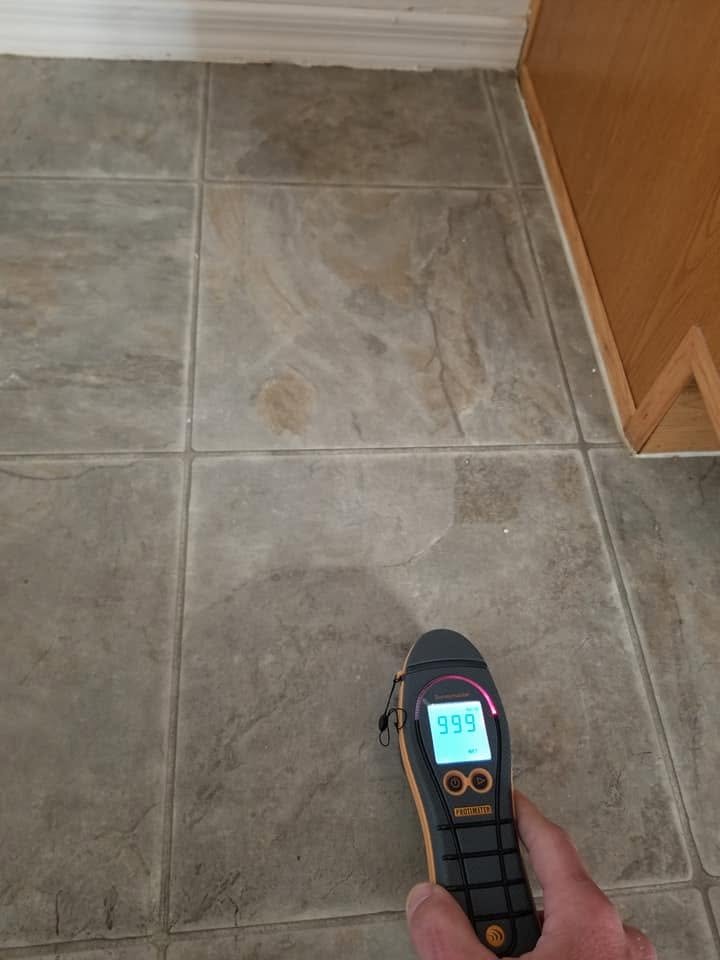
When a plumbing flood occurs inside a commercial building, liquid water is drawn into these empty capillary channels through capillary action (the same physical force that pulls water up a paper towel). Because capillary suction pressure increases exponentially as pore diameter decreases, water is pulled deep into the internal core of the slab. Once inside, this water cannot simply evaporate under ambient Phoenix room temperatures because surface-level relative humidity rapidly reaches equilibrium with the thin boundary air layer, halting further natural drying.
B. The Phenomenon of Moisture Vapor Emission Rate (MVER)
Even after standing floodwater has been extracted and the concrete slab appears bone dry and chalky white to the naked eye, the slab is continuously exhaling moisture vapor. This continuous upward gaseous transmission is quantified in commercial construction as the Moisture Vapor Emission Rate (MVER), expressed in pounds of water vapor released per 1,000 square feet of slab over a 24-hour period (lbs/1,000 sq ft/24 hr):
- Baseline Unflooded Desert Slabs: A properly cured commercial slab resting on an intact vapor retarder in Phoenix typically exhibits an MVER between 1.5 and 3.0 lbs/1,000 sq ft/24 hr. Most commercial adhesives and floor coverings are warranted for slabs with MVERs up to 3.0 or 5.0 lbs.
- Post-Flood Saturated Slabs: Following a catastrophic water intrusion, MVER readings routinely skyrocket to 8.0, 15.0, or even 22.0 lbs/1,000 sq ft/24 hr. At these extreme emission levels, any non-permeable floor covering installed will experience total adhesive failure and catastrophic delamination within 14 to 90 days.
C. Alkaline Saponification and Chemical Adhesive Breakdown
The primary mechanism of commercial flooring failure is not pure water alone, but rather alkaline chemical decomposition known as saponification. Concrete pore solution contains high concentrations of soluble calcium hydroxide ((Ca(OH)_2)), sodium hydroxide ((NaOH)), and potassium hydroxide ((KOH)), giving fresh and saturated concrete an extremely high pH of 12.0 to 13.5.
When upward moisture vapor condenses beneath an impermeable floor covering, it dissolves these mineral salts, creating a concentrated alkaline solution. This caustic fluid chemically attacks the ester bonds in organic adhesives (such as carpet mastics, pressure-sensitive acrylics, and vinyl adhesives), converting the sticky polymer chains into a slippery, soapy sludge resembling wet lard. As saponification progresses:
- Adhesives lose all shear and peel strength, causing vinyl tiles to slide laterally under foot traffic.
- Caustic fluid oozes up through floor tile joints, staining grout lines and depositing sticky alkaline residues that destroy carpet fibers.
- Sub-surface anaerobic bacteria and mold species thrive in the dark, warm, moisture-rich alkaline slurry beneath the flooring, generating volatile organic compounds (VOCs) that create sour odors and trigger indoor air quality complaints.
2. Scientific ASTM Concrete Moisture Diagnostics: ASTM F2170 vs. ASTM F1869
In commercial litigation, insurance coverage disputes, and construction warranty enforcement, subjective moisture assessments using uncalibrated hand-held prong meters have zero legal standing. Phoenix Damage Pros executes quantitative concrete diagnostic evaluations strictly adhering to standards established by the American Society for Testing and Materials (ASTM) and the International Concrete Repair Institute (ICRI).
A. ASTM F2170: In-Situ Relative Humidity (RH) Probe Testing
Widely acknowledged by structural engineers, forensic flooring consultants, and material manufacturers as the definitive standard for concrete moisture assessment, ASTM F2170 measures the internal relative humidity inside the concrete slab at specific, scientifically calibrated depths:
- 40% Slab Thickness Rule: For slabs drying from one side only (e.g., ground-supported slabs poured on a plastic vapor retarder), the internal moisture gradient exhibits an inverted parabolic curve, with moisture increasing toward the bottom. ASTM F2170 mandates drilling precision holes to exactly 40% of the total slab thickness (e.g., exactly 1.6 inches deep in a 4-inch slab, or 2.4 inches in a 6-inch slab). For elevated suspended slabs drying from both sides, probes are placed at 20% thickness.
- Thermal & Vapor Equilibrium: Calibrated electronic sensor sleeves are hermetically sealed into the drilled test holes and allowed to equilibrate for 24 hours (or per probe manufacturer certification) before digital hygrometers take final internal relative humidity (% RH) and slab temperature readings.
- Flooring Thresholds: Most modern resilient flooring manufacturers (Armstrong, Mannington, Tarkett, Shaw Contract) mandate an internal slab relative humidity of (le 75% text{ to } 80% text{ RH}) prior to floor installation. Flooded slabs in Phoenix routinely test between 88% and 98% RH, requiring aggressive mechanical desiccant drying to bring them down to specification.
B. ASTM F1869: Anhydrous Calcium Chloride Surface Dome Testing
The traditional quantitative test for measuring Moisture Vapor Emission Rate (MVER) is ASTM F1869. While less indicative of deep internal moisture than F2170, F1869 is still frequently cited in legacy architectural specifications and epoxy coating warranty guidelines:
- Technicians mechanically grind a 20-by-20-inch area of concrete down to clean, bare aggregate, removing all curing compounds, adhesives, and surface contaminants.
- A pre-weighed dish of anhydrous calcium chloride crystals is placed on the slab beneath a sealed transparent plastic dome gasketed with butyl sealant tape.
- The test chamber is left undisturbed for 60 to 72 hours, during which the hygroscopic salt crystals absorb all moisture vapor exhaled by the concrete footprint.
- The dish is resealed, weighed on a precision analytical balance accurate to 0.001 grams, and mathematically converted to MVER (lbs/1,000 sq ft/24 hr).
| Testing Standard | Diagnostic Measurement | Test Depth / Location | Manufacturer Acceptance Threshold | Phoenix Damage Pros Deployment Role |
|---|---|---|---|---|
| ASTM F2170 (In-Situ RH) | Internal Relative Humidity (% RH) | 40% depth (single-side) / 20% (both sides) | (le 75% – 85% text{ RH}) (Per spec) | Primary benchmark for desiccant drying progress and flooring warranty clearance. |
| ASTM F1869 (Calcium Chloride) | Moisture Vapor Emission Rate (MVER) | Surface top 0.5 to 0.75 inches | (le 3.0 – 5.0 text{ lbs/1,000 sq ft/24 hr}) | Secondary validation for industrial epoxy primers and legacy contract specs. |
| ASTM F710 (Surface pH) | Concrete surface alkalinity (pH) | Direct slab surface using deionized water | pH 7.0 to 9.0 (Ideal for adhesives) | Essential post-flood verification to prevent chemical adhesive saponification. |
| ASTM F2659 (Electronic Impedance) | Comparative surface electrical impedance | Top 1 inch non-destructive scanning | Relative comparative scale | Rapid initial triage to map the exact perimeter of post-flood moisture boundaries. |
3. High-Stakes Flooring Failures: VCT, Epoxy & Commercial Wood Delamination
When water damage inside a Phoenix commercial facility is not dried to ASTM standards, the ensuing flooring failures result in massive capital losses, extensive tenant downtime, and bitter construction defect litigation. Different commercial flooring types react to concrete vapor emissions in distinct, destructive ways:
A. Commercial Luxury Vinyl Tile (LVT) & Sheet Vinyl Failures
LVT has become the dominant flooring specification across Phoenix healthcare facilities, corporate offices, multi-family corridors, and retail stores due to its aesthetic appeal and durability. However, LVT is essentially an impermeable PVC plastic sheet. When installed over an un-dried slab with relative humidity exceeding 85%:
- Peaking and Curling: As water vapor condenses under the vinyl, adhesive fails along the perimeter edges of each plank. The planks absorb moisture at their backing, swell, and force tile edges to curl upward (peaking), creating serious trip hazards that violate Americans with Disabilities Act (ADA) compliance.
- Adhesive Bleed: Liquefied, saponified adhesive is forced upward through tile joints by the pressure of foot traffic and rolling carts, depositing sticky, black or amber tar-like ribbons across the finished floor surface that cannot be removed by normal janitorial cleaning.
B. Industrial Epoxy & Seamless Resin Floor Blistering
In aerospace manufacturing cleanrooms, automotive service bays, pharmaceutical laboratories, and commercial kitchens across Phoenix, monolithic epoxy and polyurethane flooring systems are chosen for their seamless chemical resistance. When applied over a concrete slab containing elevated moisture:
- Osmotic Blistering: Soluble salts within the concrete create an osmotic cell beneath the impermeable resin film. Liquid water is pulled upward through the concrete pores by osmotic pressure, generating hydraulic forces exceeding 200 psi—far surpassing the tensile strength of the concrete-epoxy bond.
- Surface Delamination: Large hollow blisters ranging from the size of a coin to several square feet erupt across the floor. As forklift traffic or heavy machinery rolls across these blisters, the brittle epoxy fractures and shatters, exposing bare concrete and halting industrial operations.
C. Commercial Hardwood & Engineered Wood Floor Buckling
In high-end corporate boardrooms, boutique hotels in Scottsdale, and athletic facilities across Phoenix, hardwood flooring systems react violently to slab moisture. As wood planks absorb upward-migrating moisture vapor, they expand across their width. Once the expansion gaps along perimeter walls are closed, the tremendous lateral compressive forces cause the wood planks to buckle violently, lifting off the slab in high arches that require complete floor tear-out and sub-floor reconstruction.
Case Example: Phoenix Medical Plaza Flooring Failure
A 28,000-square-foot medical plaza in Central Phoenix suffered a domestic copper line rupture. The building owner hired an uncertified janitorial service that ran residential dehumidifiers for 72 hours before installing $210,000 worth of new commercial LVT flooring. Four weeks later, tiles curled, adhesive liquefied, and outpatient surgeries were halted due to subterranean mold. Independent ASTM F2170 testing revealed the slab was holding at 94% internal RH. The owner was forced to remove the new flooring, perform deep desiccant drying, and absorb $140,000 in tenant interruption claims—a $435,000 total loss that proper ASTM testing would have prevented.
4. Deep Structural Desiccant Dehumidification: Engineering Vapor Pressure Differentials
Standard refrigerant dehumidifiers become ineffective once ambient relative humidity drops below 35% or when moisture is bound deep within dense mineral matrices like commercial concrete. To extract water locked inside a 6-inch commercial slab, restoration engineers must deploy industrial desiccant dehumidification systems.
A. Thermodynamic Adsorption vs. Condensation
Desiccant dehumidifiers utilize chemical adsorption via a rotating synthesized silica gel wheel. Water vapor is physically bound to the desiccant surface without changing liquid state, while a separate heated reactivation air stream (250°F to 300°F) continuously expels captured moisture outdoors. This process operates with relentless efficiency even during the hottest Phoenix summer months.
B. Generating the Vapor Pressure Gradient
The rate at which moisture exits a porous concrete slab is governed strictly by Fick’s First Law of Diffusion, which states that mass transfer rate is directly proportional to the concentration gradient and the vapor pressure differential:
- Inside a saturated concrete slab at 75°F and 95% internal RH, the internal vapor pressure is approximately 0.82 inches of mercury (in. Hg).
- Standard ambient air inside a Phoenix commercial building might sit at 75°F and 50% RH, with a vapor pressure of 0.43 in. Hg—a modest differential that produces painfully slow drying.
- When Phoenix Damage Pros injects industrial desiccant process air into the drying chamber, we drive ambient conditions down to 5% to 10% RH and specific humidity below 15 grains per pound (GPP), creating a process air vapor pressure of just 0.06 in. Hg.
- This massive vapor pressure differential ((0.82 – 0.06 = 0.76 text{ in. Hg})) creates an intense drawing force, pulling deeply bound water molecules out of capillary pores toward the concrete surface, where they evaporate into the dry air stream and are exhausted outdoors.
C. Negative-Pressure Floor Drying Grids
To accelerate drying across massive commercial slab footprints, Phoenix Damage Pros deploys specialized high-vacuum directional floor drying mats. Non-permeable containment mats are sealed directly to the concrete surface and attached to industrial high-static vacuum blowers. By depressurizing the space beneath the mat to -5 to -10 inches of water column while simultaneously introducing heated desiccant air, we force deep pore moisture to vaporize at an accelerated rate, cutting total concrete drying times by up to 60% compared to open-air dehumidification.

5. Commercial Topical Vapor Barriers & ASTM F3010 Mitigation Systems
In fast-track commercial construction, tenant move-in deadlines, or cases where sub-slab moisture is continuously fed by an unsealed hydrostatic water table or missing sub-slab plastic vapor barrier, mechanical drying alone may not permanently lower MVER to acceptable levels. In such complex commercial scenarios, Phoenix Damage Pros integrates specialized topical moisture mitigation systems complying strictly with ASTM F3010.
A. What Constitutes an ASTM F3010 Membrane?
Not all concrete sealers are moisture mitigation barriers. Standard latex primers, acrylic curing compounds, and cheap water-based epoxies are semi-permeable and will rapidly fail when exposed to continuous hydrostatic pressure and high alkalinity. ASTM F3010: Standard Practice for Two-Component Resin Based Membrane-Forming Moisture Mitigation Systems specifies rigorous performance benchmarks that any commercial moisture barrier must achieve:
- Permeance Rating: The cured epoxy membrane must exhibit a water vapor permeance of (le 0.1 text{ perm}) ((5.7 times 10^{-9} text{ kg}/(text{m}^2 cdot text{s} cdot text{Pa}))) when tested in accordance with ASTM E96 at a relative humidity differential of 50% to 100%.
- 100% Solids Epoxy Formulation: The system must be a two-component, 100% solids epoxy containing zero solvents or water fillers that could evaporate and leave microscopic pinholes in the protective barrier.
- High Alkaline Tolerance: The resin formulation must be chemically inert and entirely impervious to prolonged immersion in concrete pore solutions with pH levels up to 14.0.
B. Concrete Surface Preparation (CSP-3 / ICRI Standards)

An ASTM F3010 barrier depends directly on mechanical surface bonding. Phoenix Damage Pros follows strict ICRI surface preparation protocols:
- Mechanical Shot-Blasting: We utilize HEPA-filtered planetary shot-blasters to mechanically abrade the slab to a standardized Concrete Surface Profile of CSP-3, exposing solid aggregate and opening capillary pores.
- Tensile Pull-Off Testing (ASTM C1583): We conduct hydraulic pull-off adhesion testing to confirm tensile bond strength exceeding 200 psi within the concrete core.
- Application & Self-Leveling: The 100% solids epoxy is back-rolled to 10–14 mils thickness, followed by cementitious self-leveling underlayment to produce a flat, warrantable finish.
| System Type | Vapor Permeance | Permissible Slab RH Limit | Surface Preparation Required | Typical Commercial Application |
|---|---|---|---|---|
| ASTM F3010 100% Solids Epoxy | (le 0.1 text{ perm}) (Hermetic seal) | Up to 100% RH / 25 lbs MVER | Mechanical Shot-blasting to CSP-3, vacuum micro-cleaning | Hospitals, cleanrooms, data centers, fast-track retail, luxury vinyl over saturated slabs. |
| Standard Acrylic / Latex Sealer | (1.5 – 5.0 text{ perms}) (Semi-permeable) | (le 75% text{ RH} / 3.0 text{ lbs MVER}) | Light broom sweep, solvent wipe | Low-cost dust-proofing in unfinished warehouses only. Never suitable for resilient flooring. |
| Reactive Silicate Hardener | Variable (Densifier only) | (le 80% text{ RH} / 5.0 text{ lbs MVER}) | Diamond grinding to CSP-1 / CSP-2 | Polished concrete warehouse floors. Does not stop moisture vapor transmission. |
| Deep Desiccant Extraction + Buffer | Natural slab equilibrium ((< 75% text{ RH})) | Returns slab to baseline (le 75%) | Thorough adhesive removal and surface cleaning | Standard post-flood insurance restoration where building vapor barrier is intact. |
6. Turnkey Restoration & Slab Rehabilitation Workflow: From Flood to Certified Flooring Warranty
Restoring a water-damaged commercial concrete slab requires systematic execution where every phase is measured and scientifically verified. Phoenix Damage Pros executes a disciplined 7-step engineering protocol designed to achieve manufacturer flooring warranty compliance:
Step 1: Multi-Point Extraction & Mapping (Hours 0–4)
We deploy truck-mounted extractors to remove standing surface water. Certified technicians use non-invasive electromagnetic impedance scanners to map the exact perimeter of concrete saturation, establishing clear boundaries for progress tracking.
Step 2: Flooring Demolition & Mastic Abatement (Hours 4–12)
Saturated carpet, buckled vinyl, and damaged underlayments are removed under full HEPA containment to prevent airborne dust dispersal. Legacy black cutback mastic is abated strictly in accordance with ADEQ environmental standards.
Step 3: Baseline ASTM Diagnostic Benchmark Testing (Day 1)
Technicians install baseline ASTM F2170 relative humidity sleeves and perform surface pH testing across a representative grid (minimum 3 tests for the first 1,000 sq ft), establishing empirical documentation for property insurance adjusters.
Step 4: High-Capacity Desiccant Dehumidification Deployment (Days 2–6)
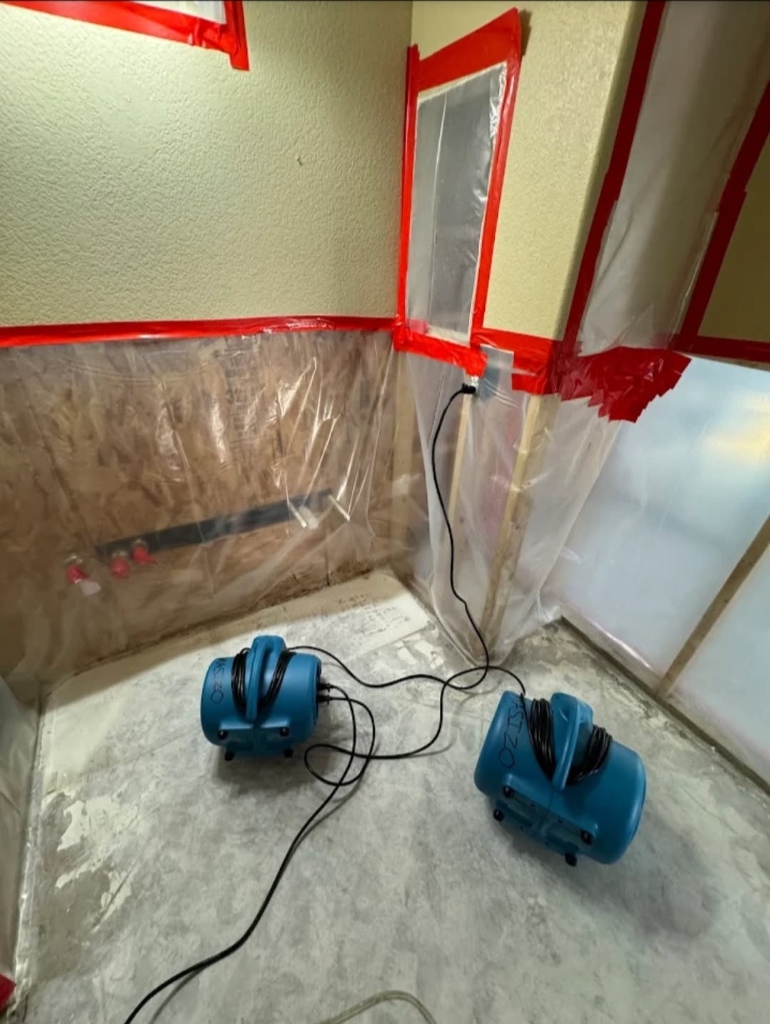
We deploy trailer-mounted desiccant dehumidifiers generating ultra-low grain process air (< 15 GPP) alongside commercial axial air movers and vacuum floor mats, accelerating evaporation from deep capillary pores.
Step 5: Daily Electronic Moisture Logging (Days 2–7)
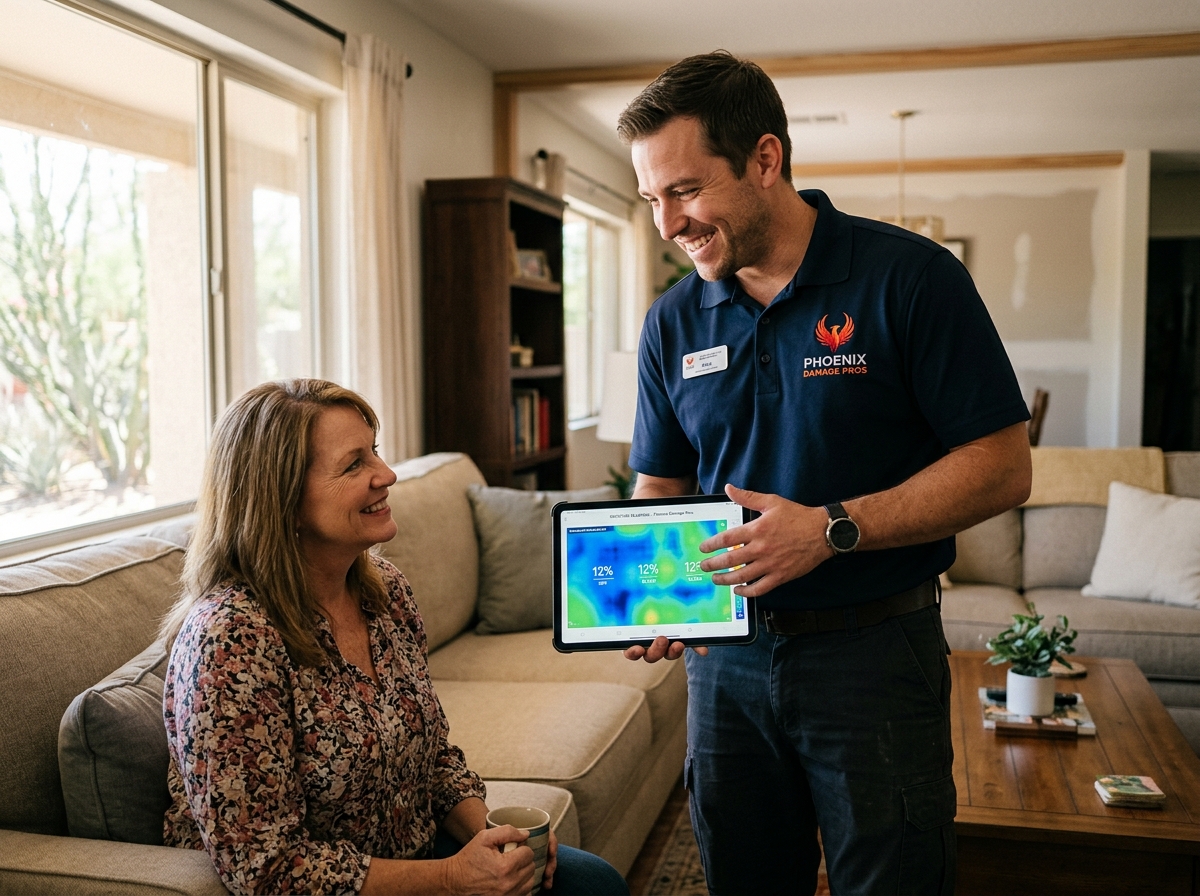
Every 24 hours, ICRI-certified technicians insert digital probes into sealed in-situ sleeves, logging slab temperature, relative humidity, and dew point gradients to create an unassailable audit trail for insurers and floor manufacturers.
Step 6: Final Quantitative ASTM F2170 Certification (Day 7)
Once internal slab relative humidity stabilizes below the target threshold ((le 75% – 80% text{ RH})) and surface pH tests between 7.0 and 9.0, we issue an official Certified Slab Moisture Diagnostic Certificate signed by an ICRI-certified inspector.
Step 7: Surface Preparation & Flooring Re-Installation (Days 8+)
Under AZ ROC #342819, our commercial reconstruction division prepares the slab with diamond grinding, applies moisture-tolerant primers, pours laser-flat self-leveling underlayment, and installs new commercial flooring backed by full manufacturer warranties.

7. Why Phoenix General Contractors & Commercial Facility Managers Rely on Phoenix Damage Pros

Commercial developers, general contractors, healthcare facility directors, and property insurance carriers across Maricopa County recognize Phoenix Damage Pros as the premier authority on commercial concrete slab moisture control and disaster recovery:
- Dual-Licensed Mitigation & Commercial Contracting: Operating under Arizona ROC #342819, we seamlessly bridge the gap between emergency structural drying and complete concrete rehabilitation, offering true turnkey accountability under one contract.
- ICRI & IICRC Certified Specialists: Our technicians hold advanced certifications from the International Concrete Repair Institute (ICRI) in Concrete Slab Moisture Testing and the IICRC in Commercial Structural Drying (CSD).
- Trailer-Mounted Industrial Desiccant Fleets: We operate self-contained, mobile desiccant dehumidification trailers capable of delivering up to 15,000 CFM of ultra-dry process air, enabling rapid drying of massive 100,000+ square foot warehouses and commercial buildings.
- Forensic Insurance & Warranty Documentation: We provide comprehensive ASTM F2170 and F1869 testing dossiers, daily psychrometric logs, and Xactimate® itemized billing that satisfy both commercial insurance adjusters and flooring manufacturer warranty requirements.
- Central Phoenix Headquarters: Based at 2415 E Camelback Rd, Suite 400, Phoenix, AZ 85016, our response teams reach commercial sites throughout Phoenix, Scottsdale, Tempe, Mesa, Chandler, and Glendale within 45 minutes.
Protect Your Commercial Flooring Investment Today: Do not let hidden slab moisture or high vapor emissions void your flooring warranty, ruin new adhesives, or disrupt business operations. Call Phoenix Damage Pros 24/7 at (602) 587-1380 for emergency moisture extraction or to schedule an ASTM concrete moisture diagnostic evaluation.
8. Frequently Asked Questions: Commercial Concrete Slab Drying & Testing in Phoenix AZ
1. How long does it take to dry a flooded commercial concrete slab in Phoenix?
Natural ambient drying of a saturated concrete slab can take 6 to 12 months in an enclosed building. However, by deploying industrial trailer-mounted desiccant dehumidifiers and directional vacuum drying mats, Phoenix Damage Pros typically achieves ASTM F2170 flooring compliance ((le 75% – 80% text{ RH})) within 5 to 9 days, depending on slab thickness and initial saturation depth.
2. Why is ASTM F2170 in-situ probe testing superior to calcium chloride dome testing?
Calcium chloride dome testing (ASTM F1869) only measures moisture vapor exiting the top 0.5 to 0.75 inches of the slab and is highly sensitive to ambient room humidity. In contrast, ASTM F2170 measures the internal relative humidity deep within the core of the slab (at 40% depth), accurately predicting what the relative humidity will be once impermeable flooring is installed and the slab reaches internal equilibrium.
3. What is the acceptable moisture level in a concrete slab before installing luxury vinyl tile (LVT)?
Most commercial LVT manufacturers require an internal slab relative humidity of (le 80% text{ to } 85% text{ RH}) (via ASTM F2170) and a maximum Moisture Vapor Emission Rate of 3.0 to 5.0 lbs/1,000 sq ft/24 hr (via ASTM F1869). Some specialized moisture-tolerant adhesive systems permit up to 90% RH, but proceeding without certified testing risks voiding the flooring manufacturer warranty.
4. What causes white powder and sticky sludge under failed commercial floor tiles?
The white powder is efflorescence, composed of soluble mineral salts carried up from the concrete by evaporating moisture. The sticky sludge is the result of alkaline saponification, a chemical reaction where high-pH moisture vapor (pH 11.0 to 13.5) dissolves and breaks down the polymers in organic floor adhesives, destroying bond strength.
5. Can Phoenix Damage Pros apply an ASTM F3010 moisture mitigation barrier if the slab cannot be dried?
Yes. In fast-track construction projects or tenant fit-outs where time constraints do not allow a full multi-day drying cycle, our certified crews shot-blast the slab to an ICRI CSP-3 profile and install a 100% solids, zero-perm ASTM F3010 epoxy vapor barrier that permanently seals moisture inside the slab, allowing immediate flooring installation.
6. Will commercial property insurance pay for ASTM concrete moisture testing and desiccant drying?
Yes. Commercial property and business interruption insurance policies cover necessary diagnostic testing, structural dehumidification, and sub-floor remediation required to return the building to its pre-loss condition. We provide comprehensive Xactimate® billing and empirical ASTM data logs to ensure rapid carrier claim approval.
7. How many ASTM F2170 test holes are required in a commercial facility?
ASTM F2170 mandates a minimum of three test locations for the first 1,000 square feet of slab area, and at least one additional test probe for each additional 1,000 square feet. For a 10,000 square foot commercial space, a minimum of 12 probe locations are required to provide statistically valid, warranty-compliant coverage across all building zones.
