
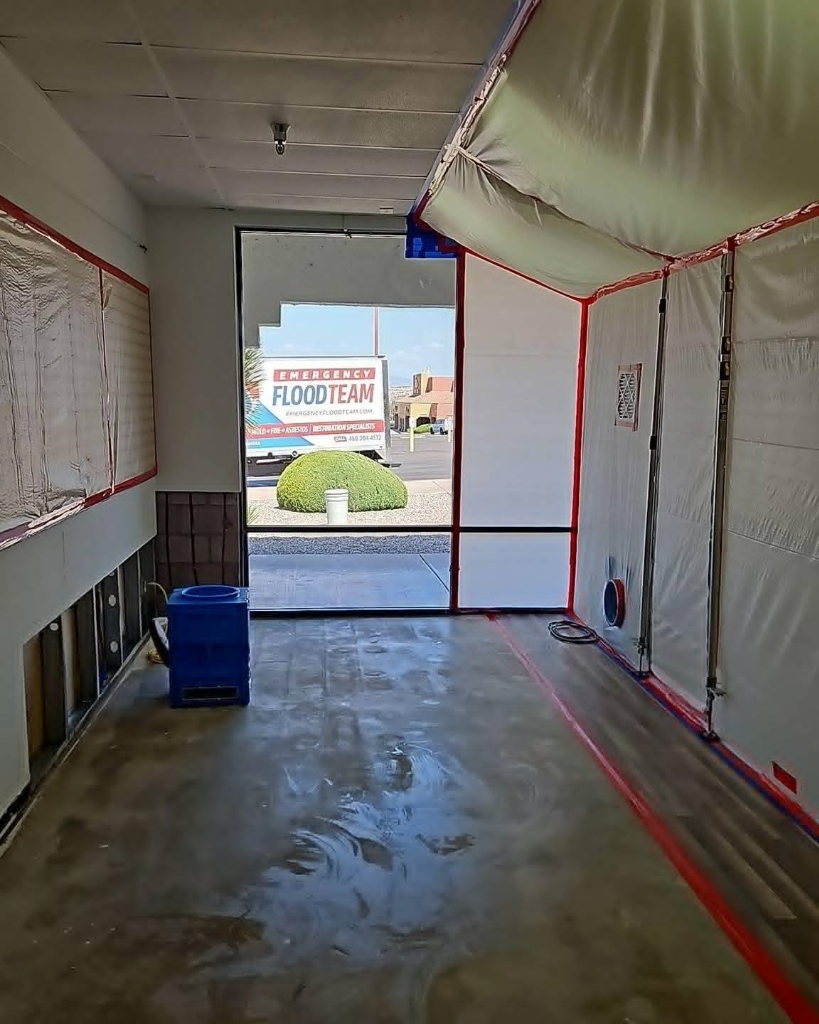
Subterranean utility infrastructure across Greater Phoenix represents the critical electrical and telecommunications backbone supporting enterprise commercial facilities, hyperscale data halls, regional medical centers, and industrial corridors. Deep beneath desert caliche hardpan, subterranean electrical transformer vaults, telecommunications and fiber-optic manholes, and commercial stormwater lift sumps face severe environmental hazards. When intense Sonoran Desert monsoonal flash floods, municipal water main ruptures, or lift station malfunctions inundate these below-grade chambers, facility managers face catastrophic operational risks. Standing floodwater inside energized utility vaults threatens high-voltage switchgear, risks lethal arc flash explosions, accelerates dielectric insulation breakdown, and submerges mission-critical fiber trunks. Phoenix Damage Pros provides specialized, 24/7 commercial utility vault dewatering services phoenix az, mobilizing OSHA-certified Permit-Required Confined Space (PRCS) rescue teams, explosion-proof pneumatic pumping arrays, continuous 4-gas atmospheric telemetry, hydrocarbon sheen separation systems, and industrial desiccant dehumidifiers to extract floodwaters, decontaminate energized infrastructure, and restore subterranean utility operations across Maricopa County.
24/7 Subterranean Utility Vault Emergency Dewatering Dispatch: Saturated electrical transformer vaults, flooded telecommunications manholes, or overflowing stormwater lift stations require immediate confined-space mitigation. Contact Phoenix Damage Pros 24/7 at (602) 587-1380. Our OSHA-certified Confined Space Entry teams mobilize within 45 minutes across Phoenix, Scottsdale, Tempe, Mesa, Chandler, Glendale, Gilbert, Peoria, Tolleson, and Goodyear under Arizona Commercial Contracting License AZ ROC #342819.
1. Comprehensive Master Title & Commercial Overview in Greater Phoenix
The rapid expansion of commercial, industrial, and technology corridors throughout Greater Phoenix has driven dense subterranean utility networks. From commercial high-rises along Central Avenue to semiconductor campuses in Chandler, Mesa, and Goodyear, modern enterprises rely on underground vaults for primary high-voltage service interconnects, distribution transformers, fiber cross-connects, and stormwater sumps. In the Sonoran Desert, these spaces are built within impermeable caliche clay that restricts drainage. When monsoon downpours strike, surface runoff rapidly overwhelms storm sewer systems, cascading through street grates, conduit duct banks, and access manholes.
Water intrusion into subterranean utility vaults is an industrial emergency involving severe life-safety, regulatory, and business continuity risks. Inundating a 12.47 kV or 13.8 kV commercial transformer creates immediate hazards of arc flash explosion, phase-to-ground faults, and dielectric breakdown of cable terminations. Concurrently, flooded telecommunications manholes subject optical splice enclosures to hydrostatic pressure, risking fiber attenuation and network blackouts. Furthermore, floodwaters mixing with transformer dielectric mineral oils, street petrochemicals, and biological effluent transform the vault into a hazardous waste zone regulated under federal EPA and Arizona environmental statutes.
Phoenix Damage Pros provides the technical capabilities, heavy equipment fleets, and regulatory governance required to mitigate flooded commercial utility vaults safely. Headquartered at 2415 E Camelback Rd, Suite 400, Phoenix, AZ 85016, our commercial division guarantees 45-minute on-site deployment across Maricopa County under Arizona Commercial Contracting License AZ ROC #342819. Our personnel include OSHA 29 CFR 1910.146 Confined Space supervisors, NFPA 70E electrical safety specialists, and IICRC-certified commercial restorers equipped to execute zero-incident extraction, chemical decontamination, and high-voltage desiccant drying operations.
2. Facility Architectural Vulnerabilities, Structural Substrates & Inundation Mechanics
Subterranean utility vaults across Phoenix face severe hydraulic, geological, and structural stresses that dictate how floodwaters breach concrete enclosures and degrade internal systems:
A. Caliche Formation Hydrostatic Trapping and Lateral Hydrodynamic Pressure
The geologic profile of the Salt River Valley features widespread caliche beds—impermeable sedimentary layers cemented by calcium carbonate. Surface runoff cannot drain downward through caliche layers during monsoons. Perched groundwater tables form rapidly beneath parking structures and utility easements, exerting lateral hydrostatic pressure against exterior vault walls. Aging waterproofing membranes fail under hydraulic heads exceeding five to ten feet of water, forcing infiltration through cold joints, form-ties, and wall cracks.
B. Duct Bank Conduit Ingress and Hydrostatic Siphoning
Commercial utility vaults connect via extensive networks of PVC and rigid galvanized steel conduit duct banks encased in concrete. During flash floods, street runoff enters damaged pull boxes or remote manholes hundreds of feet away. Hydrostatic pressure converts these duct runs into conduits channeling thousands of gallons of stormwater directly into transformer vaults. Degraded mechanical seals allow water to pour over cable racking arrays and switchgear cabinets.
C. Structural Substrate Inundation Mechanics and Concrete Matrix Degradation
Commercial vaults are constructed using 4,000 to 5,000 PSI reinforced concrete. Concrete is a porous capillary matrix. Prolonged submersion drives contaminated water deep into concrete micropores, leaching calcium hydroxide and corroding embedded steel reinforcement. In transformer vaults, submerged floors absorb mineral oils, creating conductive surface pathways that impede dielectric clearance and elevate ground-fault trip sensitivity.
D. Sump Basins, Gravity Drain Back-Siphoning, and Check Valve Failure
Subterranean vaults incorporate drainage sumps equipped with automatic submersible pumps or check-valve connections to storm sewers. During monsoon downpours, municipal storm mains surcharge under positive pressure heads exceeding check-valve capacities. Effluent back-siphons into the vault sump basin. If internal pumps lose power during outages, the sump basin overflows rapidly, submerging electrical busways, control transformers, and footing anchors.
3. Core Machinery, Electrical & Specialized Mechanical System Dewatering
Dewatering a flooded subterranean utility vault requires rigorous engineering controls to safeguard energized infrastructure, eliminate shock hazards, and preserve commercial switchgear and communication assets:
A. High-Voltage Oil-Filled and Dry-Type Transformer Submersion Recovery
Commercial vaults house liquid-immersed transformers or dry-type units stepping down 12.47 kV or 4.16 kV feeds to 480V/277V facility power. In dry-type transformers, floodwaters saturate coil windings, dissolving varnishes and depositing conductive salts. In oil-filled units, moisture ingress lowers dielectric withstand voltage from above 30 kV to below 10 kV. Phoenix Damage Pros executes precision dewatering using non-sparking suction gear, followed by controlled de-sludging coordinated with utilities (APS, SRP) and electrical engineers.
B. Subterranean Medium-Voltage Switchgear and Bus Duct Salvage
Submerged switchgear assemblies, circuit breakers, and bus duct enclosures suffer severe particulate contamination. Copper busbars, current transformers, potential transformers, and vacuum interrupters become coated with silt and petrochemical films. Dewatering requires intrinsically safe pneumatic diaphragm pumps and explosion-proof submersibles. Once water is evacuated, technicians deploy dielectric flushes and vacuum extraction to remove silt from mechanisms, preventing phase flashover upon re-energization.
C. Telecommunications, Fiber-Optic Splice Cases, and SCADA Enclosure Protection
In telecommunications manholes and environmental vaults, standing water submerges sealed fiber splice closures and remote SCADA nodes. Prolonged submersion forces moisture past aged gaskets. Water entering splice trays causes micro-bending losses, signal attenuation, and glass darkening. Our dewatering teams utilize soft-touch pneumatic suction wands and baffled headers that lower water levels without exerting tension on fragile fiber buffer tubes or copper splices.
D. Specialized Pneumatic and Explosion-Proof Dewatering Fleets
Standard electric pumps present severe ignition risks inside utility vaults where flammable vapors or submerged conductors are present. Phoenix Damage Pros deploys specialized dewatering assets designed for hazardous environments:
- Intrinsically Safe Pneumatic Double-Diaphragm (AODD) Pumps: Driven by mobile diesel compressors supplying clean air at 100 to 125 PSI, our Wilden and Yamada AODD pumps operate without electrical components, eliminating spark hazards in Class I, Division 1 locations. These units move up to 280 GPM of slurry without stalling.
- Class I, Division 1 Submersible Pumps: For high-volume evacuation, we deploy explosion-proof electric submersible pumps featuring explosion-proof motors, dual silicon-carbide mechanical shaft seals, and thermal overload protection certified to UL/CSA standards.
- High-Vacuum Truck Extraction Units: For subterranean vaults where vertical head exceeds 25 feet, we deploy industrial vacuum loaders generating 28 inHg vacuum and 5,500 CFM airflow, lifting dense sludge, gravel, and water directly into onboard containment tanks.
4. Specialized Environmental & Regulatory Containment Standards
Executing dewatering operations within subterranean commercial utility vaults is governed by stringent safety and environmental regulations. Phoenix Damage Pros operates under strict adherence to primary regulatory frameworks:
A. OSHA 29 CFR 1910.146 Permit-Required Confined Space (PRCS) Mandates
Subterranean utility vaults, electrical manholes, and wet wells are classified under OSHA as Permit-Required Confined Spaces due to restricted ingress, hazardous atmospheres, and engulfment hazards. Every vault project executed by Phoenix Damage Pros is directed by a certified Confined Space Entry Supervisor enforcing safety protocols:
- Pre-Entry Permitting: Before opening covers, our supervisor issues a formal PRCS entry permit documenting physical hazards, atmospheric baselines, isolation status, and rescue configurations.
- Continuous 4-Gas Telemetry: Technicians utilize calibrated multi-gas telemetry instruments to continuously measure four parameters: Oxygen (O2, 19.5% to 23.5%), Lower Explosive Limit (LEL, below 10%), Hydrogen Sulfide (H2S, below 10 PPM), and Carbon Monoxide (CO, below 25 PPM), testing at four-foot vertical intervals.
- Mechanical Positive Ventilation: We deploy explosion-proof blowers delivering at least 2,000 CFM of fresh outdoor air through grounded ducting to the vault floor, achieving at least 20 air exchanges per hour throughout entry.
- Non-Entry Retrieval and Standby Rescue: Entrants wear OSHA-compliant harnesses attached via synthetic winch lines to engineered tripod retrieval systems over the access hatch. A dedicated standby attendant remains stationed outside continuously, maintaining communication for immediate mechanical extraction.
B. NFPA 70E Standard for Electrical Safety in the Workplace
Subterranean electrical vaults present acute electrical shock and arc flash blast risks. Under NFPA 70E standards, working near flooded switchgear requires comprehensive hazard mitigation:
- Lockout/Tagout (LOTO) Verification: Our incident commander coordinates with utility providers (APS, SRP) or facility electricians to establish an Electrically Safe Work Condition. Upstream switches are locked, tagged, and tested with proximity detectors before dewatering begins.
- Arc Flash PPE and Dielectric Tools: Near unverified or adjacent energized circuits, personnel wear NFPA 70E Category 4 Arc Flash protective equipment (suits rated at 40 cal/cm², insulated gloves, and face shields). Suction wands and lines are constructed of certified dielectric materials.
C. EPA Clean Water Act and Maricopa County Environmental Quality Discharge Standards
Water extracted from commercial utility vaults cannot be discharged into street gutters or municipal storm drains. Under the Clean Water Act and regulations enforced by ADEQ and Maricopa County, discharging contaminated water containing hydrocarbons, suspended solids, heavy metals, or abnormal pH into storm sewers constitutes an illicit discharge punishable by fines exceeding $37,500 per day. Phoenix Damage Pros manages compliance through closed-loop containment, multi-stage filtration, and certified industrial waste manifests.
5. Hazardous Materials, Secondary Effluent or Chemical Disinfection Protocols
Floodwaters inside subterranean utility vaults are rarely clean Category 1 water; they almost universally constitute hazardous Category 3 black water or contaminated industrial effluent requiring specialized physical and chemical separation protocols:
A. Transformer Dielectric Oil and Petrochemical Sheen Mitigation
Electrical transformer vaults frequently contain mineral insulating oil or synthetic dielectric fluids leaked from aging tank seals or failed radiator fins. When floodwaters enter the vault, these oils float on the surface, creating a combustible and hazardous hydrocarbon film. Discharging or pumping this oily water without treatment is illegal and dangerous. Phoenix Damage Pros integrates specialized oil-water separation technology directly into our dewatering trains:
- Oleophilic Hydrophobic Skimming Systems: Prior to bulk dewatering, floating free-product oil is skimmed from the water surface using floating weir skimmers and oleophilic drum skimmers that recover pure oil while repelling water.
- Coalescing Plate Oil-Water Separators: Extracted water is routed through trailer-mounted coalescing plate separators that force oil droplets to coalesce into large globules, reducing free hydrocarbon concentrations to below 15 parts per million.
- Organoclay and Granular Activated Carbon (GAC) Polishing: For water containing dissolved hydrocarbons or trace PCB contamination, effluent passes through pressure vessels packed with modified organoclay and virgin granular activated carbon, permitting lawful discharge under industrial permits or transfer to licensed hazardous facilities.
B. Biohazard, Sewage Effluent, and Silt Disinfection
In telecommunication and stormwater vaults inundated by street runoff or municipal sewer surcharges, floodwaters introduce pathogenic microorganisms, including Escherichia coli, Salmonella, norovirus, and fecal coliforms. Once standing water is evacuated, thick layers of contaminated organic silt settle across concrete floors, cable trays, and structural footings. Our certified biohazard technicians execute comprehensive decontamination:
- HEPA Slurry Extraction: Residual silt and biological sludge are removed using sealed industrial HEPA slurry vacuum extractors that prevent aerosolization of biological contaminants.
- EPA-Registered Antimicrobial Wash: Interior concrete surfaces, cable racking, and structural components are treated with EPA-registered broad-spectrum virucidal and bactericidal antimicrobials that neutralize pathogens instantly without generating toxic halogenated byproducts or corroding steel.
- ATP Bioluminescence Clearance Testing: Sanitization efficacy is verified using digital Adenosine Triphosphate bioluminescence swabs, ensuring surface microbial counts meet stringent industrial healthcare and clean-room re-entry standards (below 30 RLU).
6. Deep Psychrometric Engineering: Industrial Desiccant Fleets & Sub-Surface Extraction
Extracting standing water is only the first recovery phase. Dewatered concrete vaults remain saturated with capillary moisture, maintaining 100% relative humidity. In sealed subterranean chambers without airflow, humidity condenses on switchgear cabinets, transformer bushings, and copper busbars, triggering destructive corrosion, tracking, and catastrophic flashover upon re-energization. Phoenix Damage Pros applies advanced psychrometric thermodynamics to desiccate subterranean utility spaces rapidly:
A. Psychrometric Vapor Pressure Physics in Subterranean Enclosures
Subterranean vaults act as thermal heat sinks. While Phoenix summer surface temperatures reach 115°F, underground concrete walls remain between 75°F and 85°F. At 80°F and 95% relative humidity, ambient vault air holds 150 grains of moisture per pound of dry air (GPP), with a 78.4°F dew point and 1.03 inHg vapor pressure. Standard refrigerant dehumidifiers fail here because they cannot produce deep vapor pressure gradients. Phoenix Damage Pros deploys industrial silica gel desiccant dehumidifiers:
- Industrial Desiccant Delivery: Mobile desiccant units (2,000 to 9,000 CFM) remove moisture via chemical adsorption across silica wheels, injecting process air into vaults at 95°F–105°F, relative humidity below 5%, moisture below 15 GPP, and dew points down to below 10°F (vapor pressure below 0.05 inHg).
- Vapor Pressure Differential Acceleration: This differential between vapor pressure inside concrete (1.03 inHg) and process air (0.05 inHg) establishes a thermodynamic gradient exceeding 0.98 inHg, pulling moisture out of concrete substrates, transformer insulation, and switchgear enclosures via rapid evaporation.
B. The Psychrometric Moisture Extraction Equation
Our restoration engineers calculate the exact dehumidification capacity required to desiccate the vault atmosphere using standardized psychrometric moisture transport formulas:
Moisture Removal (lbs/hr) = (CFM × ΔGPP) / 4,840
Where:
- CFM: Volumetric airflow of dry desiccant process air delivered into the vault through semi-rigid ducting.
- ΔGPP: Differential in grains per pound of moisture between exhausted vault air and incoming dry process air.
- 4,840: Standard psychrometric constant for dry air density under standard atmospheric pressure conditions (60 min/hr × 0.075 lbs/cu ft × 7,000 grains/lb).
By continuously engineering air exchanges and monitoring exhaust GPP, technicians return structural substrates to dry baselines within 24 to 48 hours, preventing corrosion and mold growth.
C. High-Voltage Insulation Resistance Telemetry (Megohmmeter Testing)
Before dewatered transformers, switchgear breakers, or cables are re-energized, dielectric integrity must be verified through insulation testing. Saturated insulation materials absorb moisture that lowers resistance to hazardous levels. Phoenix Damage Pros coordinates Megohmmeter testing at 1,000V, 2,500V, or 5,000V DC applied potential:
- Insulation Resistance Baselines: Measurements are recorded across all phases. Under IEEE 43 and NETA MTS standards, high-voltage switchgear must exhibit insulation resistance values exceeding 100 Megohms, with minimum emergency thresholds of 1 Megohm per kilovolt of operating voltage plus 1 Megohm.
- Polarization Index (PI) Validation: We evaluate the 10-minute to 1-minute resistance ratio (Polarization Index). A PI ratio greater than 2.0 confirms clean, dry insulation, validating that desiccant drying has successfully removed moisture from winding layers and that equipment can be safely re-energized without risking arc flash.
7. Detailed Technical Matrix Table
Mitigating flooded subterranean commercial utility vaults demands specialized industrial competencies, heavy hazardous-environment equipment, and certified life-safety protocols that standard commercial restoration companies cannot provide. The technical matrix below contrasts standard commercial water restoration practices with the comprehensive engineering protocols executed by Phoenix Damage Pros:
| Operational Parameter | Standard Commercial Contractor Protocol | Phoenix Damage Pros Industrial Engineering Protocol |
|---|---|---|
| Confined Space Safety & Regulatory Mandates | Treats vault as an ordinary room; no PRCS permits, non-certified personnel, no formal rescue plans. | Strict OSHA 29 CFR 1910.146 PRCS Compliance: Certified supervisors, written permits, continuous 4-gas telemetry, calibrated retrieval tripods, dedicated standby attendants. |
| Hazardous Atmosphere Telemetry | Zero atmospheric testing or single uncalibrated handheld gas sniffer; high risk of explosion or asphyxiation. | Continuous Multi-Depth 4-Gas Telemetry: Multi-point continuous logging for LEL, O2, H2S, and CO at four-foot vertical stratification intervals with real-time audio/visual alarms. |
| Dewatering Pump Fleet Specifications | Standard 120V residential submersible pumps; creates severe electrical ignition and spark explosion hazards. | Intrinsically Safe Pneumatic (AODD) & Explosion-Proof Fleets: Class I, Div 1 rated submersible and compressed-air pumps with zero electrical spark sources in explosive vapor zones. |
| Hydrocarbon & Effluent Environmental Management | Pumps oily water directly into street gutters; violates EPA Clean Water Act, risking severe civil fines. | Closed-Loop Hydrocarbon Separation: Oleophilic skimmers, coalescing oil-water separators, organoclay/GAC adsorption, and zero-discharge industrial waste manifests satisfying ADEQ. |
| Subterranean Psychrometric Desiccation | Standard commercial refrigerant dehumidifiers that stall in hot/humid vaults; leaves concrete and windings saturated. | Industrial Silica Gel Desiccants (2,000–9,000 CFM): Injects process air with dew points below 10°F, generating a 0.98+ inHg vapor pressure gradient for deep concrete and coil desiccation. |
| Electrical Safety & Re-Commissioning Telemetry | Visual inspection only; guesses equipment dryness; risks explosive arc flash upon facility re-energization. | NFPA 70E Protocol & Certified Megohmmeter Testing: Arc-rated Category 4 PPE, coordinated utility LOTO, and 5 kV IEEE/NETA insulation resistance telemetry (PI/DAR validation) prior to power release. |
8. Commercial Insurance Claims Resolution, Xactimate® Itemization & Forensic Telemetry
Commercial property claims involving inundated utility vaults, submerged medium-voltage transformers, and flooded telecommunications infrastructure involve complex coverage intersections and business interruption exposures. Facility directors, asset managers, and risk supervisors face difficult negotiations with commercial insurers, adjusters, and utility carriers. Phoenix Damage Pros bridges the gap between emergency stabilization and financial claim recovery through comprehensive forensic documentation and standardized commercial itemization:
A. Granular Xactimate® Itemization Using Commercial Heavy-Loss Codes
Standard insurance estimates often omit specialized equipment, labor, and safety overhead required for hazardous subterranean restoration. Phoenix Damage Pros utilizes Xactimate® employing specialized commercial line items that reflect the true operational costs of the mitigation:
- WTR (Water Extraction & Remediation): Explicit line items for pneumatic dewatering, vacuum extraction, hazardous Category 3 black water extraction premiums, and subterranean multi-level hose staging.
- HMR (Hazardous Material Remediation): Billing codes for hydrocarbon skimming, oil-water separation equipment mobilization, carbon absorption filter media consumption, and hazardous contaminated sediment disposal under certified chain-of-custody documentation.
- CPS (Confined Space Safety Overhead): Line items accounting for dedicated OSHA-certified Confined Space Entry Supervisors, top-hole standby attendants, explosion-proof positive ventilation blowers, and retrieval tripod infrastructure.
- EQ (Specialty Industrial Equipment Rentals): Itemized deployment schedules for mobile desiccant dehumidifiers (CFM-rated), auxiliary mobile diesel generators, and heavy-duty compressed air power generation units.
B. Forensic Cause-of-Loss Engineering Telemetry
To substantiate claims under Commercial Property, Inland Marine, or Boiler & Machinery endorsements, insurance carriers demand conclusive proof of the failure vector. Phoenix Damage Pros provides a comprehensive forensic documentation binder containing:
- Time-Stamped FLIR High-Resolution Thermal Imaging: Documenting thermal signatures of moisture infiltration through concrete cold joints, conduit penetrations, and saturated switchgear bus insulation.
- Continuous Psychrometric Datalogger Telemetry: Cloud-connected environmental logs recording temperature, relative humidity, dew point, and grains per pound (GPP) every fifteen minutes throughout drying, proving strict compliance with IICRC S500 standards.
- Four-Gas Atmospheric Safety Logs: Historical telemetry records validating continuous atmospheric safety throughout entry and extraction.
- Megohmmeter Insulation Resistance Certificates: Signed electrical insulation testing logs verifying baseline, drying progression, and final dielectric clearance across high-voltage windings and busbars.
- Chain-of-Custody Effluent Disposal Manifests: Certified manifests from licensed environmental recycling facilities documenting lawful transport and processing of hydrocarbon-contaminated water, shielding property owners from environmental liability.
9. Why Greater Phoenix Facility Directors Rely on Phoenix Damage Pros
Subterranean utility vault failures represent severe operational crises where mistakes can result in fatal electrocution, environmental enforcement actions, or prolonged facility shutdowns. Enterprise facility directors, hospital chief engineers, university physical plant administrators, and regional data center operators across Maricopa County rely exclusively on Phoenix Damage Pros for several foundational reasons:
A. Rapid 45-Minute Emergency Mobilization Across Maricopa County
From our executive headquarters and commercial dispatch hub at 2415 E Camelback Rd, Suite 400, Phoenix, AZ 85016, our commercial emergency response fleet is strategically positioned to achieve guaranteed 45-minute on-site arrival across every major municipal and industrial submarket in Greater Phoenix:
- Phoenix & Downtown Core: Rapid deployment to high-rise transformer vaults, corporate centers, and carrier hotels along Central Ave and Van Buren St.
- Scottsdale & Airpark: Protecting corporate headquarters, luxury resorts, and precision aviation infrastructure along Scottsdale Rd and Loop 101.
- Tempe & ASU Research Corridor: Rapid mitigation for dense commercial, university, and edge technology facilities along University Dr and Rio Salado Pkwy.
- Mesa & Falcon Field Tech Centers: Servicing subterranean aerospace manufacturing vaults and utility infrastructure along Greenfield Rd and Power Rd.
- Chandler & Price Road Tech Corridor: Supporting semiconductor fabrication plants and enterprise data centers along Price Rd and Chandler Blvd.
- Glendale & West Valley Logistics: Servicing massive distribution warehouses, sports complexes, and utility substations along Northern Ave and Loop 303.
- Gilbert, Peoria, Tolleson, and Goodyear: High-volume dewatering for sprawling e-commerce distribution centers, cold storage, and municipal pump stations.
B. Commercial Licensing, Financial Bonding, and Insurance Credentials
Every industrial project executed by Phoenix Damage Pros is backed by our Arizona Commercial Contracting License: AZ ROC #342819. We maintain comprehensive commercial general liability insurance, specialized pollution liability coverage ($10,000,000 aggregate), and full commercial inland marine coverage. Our technicians maintain active OSHA 30-Hour Construction, 29 CFR 1910.146 PRCS Supervisor, NFPA 70E Arc Flash Safety, and IICRC Master Commercial Restorer certifications.
10. Detailed Technical Frequently Asked Questions
How quickly can Phoenix Damage Pros arrive to dewater a flooded commercial utility vault?
Phoenix Damage Pros guarantees a 45-minute emergency response across Phoenix, Scottsdale, Tempe, Mesa, Chandler, Glendale, Gilbert, Peoria, Tolleson, and Goodyear. Crews deploy 24/7 from 2415 E Camelback Rd equipped with explosion-proof pumps and 4-gas telemetry under AZ ROC #342819.
Why can’t standard commercial water restoration companies dewater an electrical utility vault?
Standard contractors lack explosion-proof pumps, arc flash PPE, and PRCS certifications. Operating standard 120V electric pumps near submerged circuits causes arc flash explosions. Additionally, untrained firms lack hydrocarbon separation systems mandated by ADEQ and EPA regulations.
What atmospheric gases do you test for before entering an underground utility vault?
Our certified supervisor continuously logs multi-gas telemetry across four-foot vertical intervals, monitoring Oxygen (19.5% to 23.5%), combustible gases (below 10% LEL), Hydrogen Sulfide (below 10 PPM), and Carbon Monoxide (below 25 PPM) before and during entry.
Can flooded medium-voltage electrical switchgear and transformers be dried and saved?
Yes. Submerged busbars, insulators, and breakers are flushed with dielectric solvents, desiccated using silica dehumidifiers delivering below 10°F dew points, and validated via 5 kV Megohmmeter testing under IEEE 43 and NETA standards prior to re-energization.
How do you handle transformer oil sheens or fuel floating on the vault water surface?
Discharging oily vault water violates the Clean Water Act. Phoenix Damage Pros deploys oleophilic skimmers, coalescing oil-water separators, and organoclay vessels to extract hydrocarbons below 15 PPM, manifesting recovered oils to licensed hazardous facilities.
What type of pumping equipment is used to extract water from hazardous electrical vaults?
We deploy intrinsically safe pneumatic air-operated double-diaphragm (AODD) pumps driven by remote diesel air compressors, eliminating electrical ignition sources. For vertical suction exceeding 25 feet, heavy industrial vacuum loaders generate 28 inHg vacuum.
What causes underground utility vaults to flood in the dry Phoenix desert?
Monsoonal downpours cannot penetrate impermeable desert caliche layers, creating perched groundwater tables that force stormwater through concrete joints under hydrostatic pressure. Pressurized municipal water main ruptures also channel thousands of gallons into conduit duct banks.
Do you coordinate with electric utility providers like APS and SRP during dewatering?
Yes. Establishing an Electrically Safe Work Condition is mandatory. Incident commanders coordinate upstream Lockout/Tagout (LOTO) with Arizona Public Service (APS) or Salt River Project (SRP) dispatchers before technicians enter vaults or deploy dewatering lines.
Why is desiccant dehumidification necessary after all standing water has been pumped out?
Pumping removes only liquid, leaving concrete and insulation saturated. In unventilated chambers, trapped moisture creates 100% relative humidity, condensing on switchgear and triggering phase flashovers. Desiccant dehumidifiers inject process air below 10°F dew point to desiccate substrates.
Does commercial property insurance cover utility vault dewatering and equipment restoration?
Yes. Commercial vault flooding is covered under Property, Inland Marine, or Equipment Breakdown endorsements. Phoenix Damage Pros provides forensic telemetry logs, Megohmmeter test certificates, and standardized Xactimate estimates to substantiate full claims settlement.
11. Emergency Contact & Priority Commercial Mobilization Call-to-Action
When floodwaters inundate a subterranean electrical transformer vault, telecommunications manhole, or commercial stormwater lift station, every minute of delay multiplies the risk of catastrophic arc flash explosions, permanent switchgear corrosion, regional telecommunication outages, and punitive environmental contamination penalties. Phoenix Damage Pros delivers the heavy industrial machinery, OSHA-certified confined space expertise, specialized explosion-proof pumping assets, and low-dewpoint desiccant drying technology required to dewater, decontaminate, and restore your subterranean commercial utility assets safely and compliantly.
All commercial emergency restoration services are backed by Arizona Commercial Contracting License AZ ROC #342819 and executed under strict adherence to OSHA 29 CFR 1910.146 Confined Space, NFPA 70E Electrical Safety, and EPA Clean Water Act environmental regulations. Our 24/7 Commercial Emergency Dispatch Center is headquartered at 2415 E Camelback Rd, Suite 400, Phoenix, AZ 85016, maintaining dedicated heavy industrial mobilization units ready to deploy anywhere across Maricopa County within 45 minutes.
Emergency Commercial Utility Vault Dewatering & Recovery
Do not risk employee life-safety, explosive electrical arc flashes, or environmental discharge fines. Contact Phoenix Damage Pros immediately for certified 24/7 confined-space dewatering, hydrocarbon separation, and desiccant drying mobilization across Greater Phoenix.
24/7 Emergency Dispatch | Guaranteed 45-Minute Mobilization | Arizona ROC #342819 Licensed & Insured