
24/7 Commercial Emergency Dispatch Notice: If your commercial facility, industrial warehouse, multi-family complex, or healthcare plaza in the Phoenix Metropolitan Area is actively experiencing catastrophic water intrusion—whether from a ruptured commercial fire sprinkler head, a burst multi-story vertical domestic supply riser, an industrial chiller failure, or storm runoff—engage our rapid-response commercial restoration fleet immediately at (602) 587-1380. Our IICRC-certified Master Water Restorers arrive on-site within 30 to 45 minutes across Maricopa County with heavy extraction units, power generation, and commercial desiccant drying fleets.
For commercial property directors, asset management executives, corporate facility engineers, and industrial portfolio owners operating throughout Phoenix, Scottsdale, Tempe, Mesa, Chandler, and Glendale, water intrusion is never merely an inconvenient maintenance disturbance. It is an acute, high-exposure operational crisis that threatens business continuity, tenant safety, capital asset integrity, and contractual lease compliance. Unlike residential property damage where losses are largely localized and standard drying techniques suffice, commercial water events occur across sprawling, complex building envelopes characterized by high-density electrical distribution, raised computer flooring, interstitial ceiling plenums, structural concrete slabs, and sensitive multi-tenant demising partitions.
When hundreds of gallons of pressurized water cascade through a multi-tenant commercial office tower or industrial logistics terminal, the financial clock begins running instantly. Every additional hour of facility downtime translates into severe business interruption liabilities, revenue attrition, prospective tenant constructive eviction disputes, and compounding structural degradation. In Arizona’s distinct desert environment, ambient indoor temperatures combined with trapped building envelope humidity create an accelerated microbial incubation window: without immediate industrial water extraction and scientifically controlled psychrometric dehumidification, secondary fungal proliferation and structural mold bloom begin within 24 to 48 hours.
This comprehensive commercial manual serves as the definitive engineering, operational, and financial blueprint for managing large-loss commercial water damage restoration in Phoenix, Arizona. Developed by senior restoration engineers and commercial insurance subrogation specialists, this guide provides actionable intelligence for mitigating facility risk, executing industrial structural drying, navigating complex commercial insurance recovery, and safeguarding long-term asset valuation.

1. The Financial, Legal, and Operational Exposure of Commercial Water Damage
When water breaches a commercial building envelope, the overall loss exposure extends far beyond the immediate cosmetic destruction of wet carpet or stained drywall. Asset directors must evaluate the totality of impact across three distinct operational dimensions: immediate physical asset impairment, direct business interruption, and third-party contractual liabilities.

A. Physical Structural Envelope Compromise
Commercial construction utilizes assemblies engineered for load-bearing capacity, acoustic dampening, and fire separation rather than moisture resilience. Water introduced at high elevations travels along structural steel decking, fluted floor pans, and post-tensioned concrete slabs, migrating vast lateral distances before discovering penetration points through expansion joints, conduit penetrations, or plumbing sleeves. Key structural elements face immediate compromise:
- Structural Concrete Slab Absorption: Concrete is inherently a porous capillary network. In ground-level and subterranean commercial structures across the Valley, standing water migrates deep into the slab matrix. Failure to scientifically extract this moisture leads to long-term vapor emission, efflorescence, and complete adhesive breakdown beneath high-traffic commercial flooring.
- Type X Fire-Rated Gypsum Wallboard Delamination: Modern commercial demising walls utilize 5/8-inch Type X fire-resistant gypsum board mounted to heavy-gauge cold-formed steel studs. While fire-rated, gypsum cores quickly lose compressive strength when saturated, compromising designated one-hour and two-hour fire separation barriers between tenant suites.
- Suspended Acoustical Ceiling Grids: Mineral fiber ceiling tiles absorb water rapidly, increasing their weight by over 400%. Saturated tiles sag and collapse, tearing down aluminum T-bar grid framing and threatening occupants below with direct physical trauma.
- Structural Steel & Cold-Formed Metal Framing Oxidation: Persistent moisture trapped inside enclosed commercial wall chases causes electrolytic corrosion along bottom track runners, drywall screws, and structural connections, undermining lateral structural rigidity.
B. Direct Business Interruption and Revenue Losses
For high-density corporate offices, financial institutions, technology call centers, biomedical laboratories, and retail sales complexes, operational downtime represents the single largest cost vector of any property loss. In many commercial claims, business interruption (BI) and extra expense (EE) insurance payouts dwarf the actual physical restoration invoice by ratios of three to one. If a corporate facility housing 300 employees is forced to evacuate due to submerged floor electrical boxes or failed life-safety fire sprinkler pressure, daily overhead, lost productivity, and contractual service level agreement (SLA) penalties rapidly escalate into tens of thousands of dollars per day.
C. Third-Party Tenant Lease Liabilities and Constructive Eviction
Under Arizona commercial leasing statutes, commercial property owners and master property managers are legally obligated to maintain common structural elements and primary utility systems. When an untreated leak originating in a common-area riser or an upper-floor tenant space penetrates a lower-level suite, complex legal disputes arise:
- Claims of Constructive Eviction: If a landlord fails to remediate moisture and restore safe environmental indoor air quality within a reasonable timeframe, commercial tenants may declare constructive eviction, terminating their multi-year commercial leases without financial penalty.
- Rent Abatement Provisions: Standard BOMA (Building Owners and Managers Association) commercial leases commonly contain rent abatement clauses, entitling commercial tenants to withhold monthly lease payments proportionate to unusable square footage during restoration.
- Subrogation Litigation: A tenant’s corporate commercial property insurance carrier will vigorously pursue legal subrogation against the master building owner if the water loss originated from deferred maintenance on aging commercial risers, roof drainage systems, or HVAC air handlers.
| Commercial Asset Sector | Primary Water Vulnerability | Average Downtime Risk Without Rapid Mitigation | Core Mitigating Technology Required |
|---|---|---|---|
| Corporate High-Rise / Office Towers | Vertical supply risers, VAV loop failures, multi-floor cascading water. | 7 to 21 Business Days (Tenant displacement) | Zoned negative air barriers, high-pressure cavity injection drying, desiccant trailers. |
| Industrial Warehouses & Logistics Hubs | Fire sprinkler head mechanical impact, loading dock flash flooding. | 3 to 10 Days (Inventory and freight staging halt) | Heavy-duty ride-on extractors, industrial trash pumps, slab relative humidity logging. |
| Medical Plazas & Healthcare Clinics | Bio-clean rooms, sensitive diagnostic imaging equipment (MRI/CT), sterilizers. | 14 to 30 Days (Regulatory clinical shutdown) | HEPA air scrubbers, hospital-grade virucidal sanitization, sterile clean-room containment. |
| Retail Centers & Shopping Plazas | Roof drainage failure during monsoons, customer restroom main line backup. | 4 to 12 Days (Direct retail sales loss) | Weighted commercial extraction, rapid thermal imaging, fast-track evening drying shifts. |
| Multi-Family Residential Portfolios | Water heater closet ruptures, domestic plumbing failures across stacked units. | 5 to 14 Days (Tenant rehousing and hoteling) | Multi-unit staging teams, structural cavity drying, direct carrier billing packages. |
2. Common Commercial Water Failure Modes in Phoenix Facilities
Understanding the root engineering causes of commercial water intrusion across the Phoenix Metropolitan Area enables commercial facility directors to develop targeted preventative maintenance protocols and execute swift emergency isolation procedures when catastrophic failures occur.
A. Commercial Fire Suppression System Discharges
Commercial wet-pipe fire sprinkler installations operate under permanent, high-static hydrostatic pressure—routinely ranging between 100 and 175 PSI. While indispensable for life safety, fire suppression systems represent a colossal volume threat when compromised. Primary commercial triggers include:
- Mechanical Impact Damage: In industrial distribution centers and warehouses throughout Phoenix, forklift mast impacts against pendant or upright sprinkler heads occur with alarming frequency, shearing off the thermal bulb or deflector.
- Construction & Tenant Improvement (TI) Mishaps: Contractors hanging drywall, installing seismic bracing, or routing electrical cable trays frequently strike pressurized sprinkler branch lines.
- Thermal Shock & Attic Freezing: While Phoenix is famous for extreme heat, uninsulated roof interstitial spaces in North Phoenix, Scottsdale, and Mesa occasionally experience overnight winter freezes. Water trapped in unheated attic piping expands, fracturing rigid cast-iron fittings that burst open during the morning thaw.
A single standard 1/2-inch commercial sprinkler orifice discharges between 25 and 45 gallons of water per minute. Within just 20 minutes of delayed isolation, over 700 gallons of black, chemically contaminated, stagnant iron-scale water saturates the building footprint, requiring Category 2 or Category 3 black water protocols.
B. Commercial HVAC Chilled Water & Condensate Drainage Failures
Due to triple-digit Phoenix summer temperatures extending from May through October, commercial cooling infrastructure operates under relentless, continuous mechanical stress. Modern commercial properties utilize complex chilled water distribution loops operating at 42°F to 45°F, paired with air handling units (AHUs) and Variable Air Volume (VAV) terminal boxes distributed across every floor.
Catastrophic failure occurs when:
- Primary Drain Pan Corrosion & Blockage: High ambient dust levels in Arizona lead to rapid airborne particulate accumulation inside air handlers. Dust mixes with condensate moisture, forming biological sludge that clogs primary 3/4-inch or 1-inch PVC drain lines.
- Secondary Overflow Switch Failure: If float switches fail or are improperly bypassed during maintenance, condensate trays overflow directly into the ceiling plenum above executive suites.
- Chilled Water Pipe Insulation Sweating: If closed-cell elastomeric pipe insulation degrades or tears, chilled pipes sweat profusely against unconditioned ambient plenum air. Water drips continuously onto acoustic ceiling tiles, causing progressive weakening until massive sections collapse simultaneously.
C. Aging Commercial Domestic Water Risers and Galvanized Transitions
A significant percentage of commercial office parks, financial centers, and medical complexes in Central Phoenix, the Camelback Corridor, and Downtown were constructed between 1970 and 1995. These structures frequently feature heavy copper, ductile iron, or galvanized steel domestic supply risers that have reached the end of their operational lifespan. Aggressive, highly mineralized Arizona tap water accelerates internal electrolytic pitting, galvanic corrosion at brass-to-steel junctions, and valve seat erosion. When a 2-inch or 3-inch vertical riser fractures inside a multi-story drywall plumbing chase, water cascades downward through multiple tenant suites simultaneously, pooling in subterranean mechanical basements and elevator shafts.
D. Commercial Roof Drain Surcharges and Parapet Scupper Blockages
Commercial flat roof systems (Single-Ply TPO, EPDM, Built-Up Roofing, and Spray Foam) rely on interior roof drain bowls, gravel guards, and perimeter parapet overflow scuppers. During sudden Arizona summer monsoon thunderstorms, rainfall rates can exceed 2 to 3 inches per hour. When intense storm winds blow palm fronds, desert dust, and airborne debris across commercial roofs, interior drain strainers clog. Surcharged rainwater accumulates into massive ponds thousands of pounds in weight. When water depth surpasses flashing heights around rooftop HVAC curbs and expansion joints, thousands of gallons of stormwater pour directly into the building core.
3. The Technical Science of Commercial Psychrometrics: Precision Drying Physics
Commercial structural drying is fundamentally an applied branch of thermodynamic engineering known as psychrometrics—the scientific study of the thermodynamic properties of gas-vapor mixtures, specifically atmospheric air and moisture vapor. Amateur water mitigation contractors often place a few residential dehumidifiers in a flooded commercial suite and hope for evaporation. In large-scale commercial restoration, this approach guarantees catastrophic failure, prolonged downtime, and severe mold amplification.
Phoenix Damage Pros executes structural drying governed strictly by the IICRC S500 Standard and Reference Guide for Professional Water Damage Restoration. Our project engineers evaluate and manipulate five interdependent psychrometric variables throughout the drying lifecycle:
The Five Foundational Psychrometric Metrics
- Dry-Bulb Temperature (DBT): The ambient temperature of the air measured by a standard thermometer shielded from radiant heat. Raising indoor ambient temperatures increases the air’s capacity to hold moisture in vapor form.
- Relative Humidity (%RH): The percentage of moisture vapor currently suspended in the air relative to the maximum saturation point at that specific temperature. High RH inhibits evaporation from wet materials.
- Humidity Ratio / Specific Humidity (Grains Per Pound – GPP): The absolute weight of moisture vapor in the air, measured in grains per pound of dry air (7,000 grains = 1 pound of water). GPP is the ultimate benchmark of drying efficiency. Effective structural drying requires driving ambient GPP down to ultra-low levels (below 35 to 40 GPP).
- Dew Point Temperature (DPT): The temperature at which air reaches 100% saturation and moisture begins condensing onto colder surfaces. In air-conditioned Phoenix facilities, keeping building assemblies well above the dew point prevents secondary condensation.
- Vapor Pressure Differential (VPD): The difference between the internal vapor pressure of water trapped inside saturated building materials and the vapor pressure of the surrounding ambient air. Moisture naturally migrates from zones of high vapor pressure to zones of low vapor pressure. The greater the differential engineered by our equipment, the faster the evaporation rate from deep structural substrates.
Engineering Evaporation: The Psychrometric Formula
To dry dense commercial materials—such as saturated structural concrete slabs, double-layer Type X drywall, and multi-layered commercial roofing assemblies—our technicians engineer a massive Vapor Pressure Differential by maximizing evaporation dynamics:
To accelerate this physical process without causing destructive secondary warping, Phoenix Damage Pros deploys three specialized commercial drying equipment technologies:
1. Industrial Low-Grain Refrigerant (LGR) Dehumidifiers
Standard residential refrigerant dehumidifiers lose operational efficiency when relative humidity drops below 40% or temperatures drop below 65°F. Industrial LGR units feature double-cooling heat pipe systems that pre-cool incoming air before it reaches the evaporator coil. This enables LGR units to continue condensing water vapor out of the air even down to 30 GPP, making them exceptionally effective for drying corporate office buildouts and occupied commercial suites.
2. Commercial Desiccant Dehumidification Trailers
For open-span industrial warehouses, multi-million-gallon manufacturing facilities, and multi-story high-rise building cores, refrigerant-based drying is physically outmatched. Phoenix Damage Pros deploys trailer-mounted desiccant dehumidifiers capable of generating 5,000 to 15,000 CFM of ultra-dry air. Desiccants utilize a rotating wheel coated with synthetic silica gel that chemically adsorbs water vapor directly from the air stream without condensation. Desiccant units deliver supply air with grain depressions below 15 GPP and relative humidity under 10%, creating an intense vapor pressure vacuum that extracts water trapped deep within post-tensioned concrete slabs and structural framing.
3. High-Velocity Axial Air Movers and In-Cavity Injection Manifolds
Laminar air movement strips away the microscopic boundary layer of saturated, stagnant air that sits immediately against wet commercial surfaces. We position high-efficiency commercial axial fans delivering 3,000+ CFM across walls, floors, and ceilings at precise 45-degree angles. For insulated metal-stud wall cavities, we deploy specialized pressurized injection systems that inject warm, ultra-low-grain air directly behind baseboards through micro-ports, drying cavity insulation and framing without requiring destructive drywall tear-out.

4. Preserving Concrete Slabs and Commercial Flooring Systems
In the Phoenix Metropolitan Area, virtually all commercial properties—from corporate Camelback Corridor mid-rises to West Valley industrial distribution centers—are constructed on slab-on-grade concrete foundations. Concrete is frequently misunderstood as an impervious stone block; in reality, concrete is a porous mineral sponge composed of millions of interconnected microscopic capillaries.
When clean or black water sits upon a commercial concrete slab for even a few hours, hydrostatic pressure and capillary attraction draw liquid deep into the core of the slab. If facility directors replace or reinstall flooring without scientifically extracting this moisture, catastrophic structural failure occurs within 30 to 90 days:
A. Adhesive Re-Emulsification
Modern commercial floor adhesives for Luxury Vinyl Tile (LVT), Vinyl Composition Tile (VCT), and commercial broadloom carpets are water-based acrylic compounds mandated by low-VOC environmental regulations. When moisture trapped inside a concrete slab migrates upward as vapor, it re-emulsifies the adhesive matrix. The glue converts back into a milky, non-tacky liquid slush. Floor tiles buckle, curl at the seams, slide under foot traffic, and emit sharp chemical odors throughout tenant suites.
B. Osmotic Blistering of Commercial Epoxy Coatings
In medical clinics, commercial kitchens, automotive service facilities, and manufacturing clean rooms, commercial seamless epoxy coatings are standard. When concrete underneath an epoxy membrane harbors excessive moisture, water vapor collects beneath the impermeable resin skin. Osmotic pressure builds until large fluid-filled blisters erupt across the floor, fracturing the protective coating and requiring complete scarification, shot-blasting, and multi-thousand-dollar recoating.
C. High-Alkalinity Salt Efflorescence
As deep concrete moisture evaporates upward toward the conditioned surface, it dissolves free calcium hydroxide within the cement paste. Upon contacting atmospheric carbon dioxide at the surface, it transforms into crystalline calcium carbonate—a brilliant white, chalky mineral crust with an extremely high pH (often exceeding 11 to 12). This caustic alkalinity destroys flooring adhesives, rots carpet backings, and corrodes bottom metal stud tracks.
ASTM F2170 In-Situ Probe Testing Protocol
To ensure commercial flooring warranties remain valid following a water loss, Phoenix Damage Pros enforces the strict ASTM F2170 Standard Test Method for Determining Relative Humidity in Concrete Floor Slabs Using in situ Probes. Our technicians drill precision holes into the concrete to 40% of the slab’s depth, insert hermetically sealed relative humidity probes, and allow thermal equilibrium. We log verified slab internal RH below 75% to 80% before certifying the slab safe for resilient floor reinstallation.
5. The Phased 5-Stage Engineering Protocol for Commercial Facilities
Executing commercial water damage mitigation requires military-grade logistical precision. When hundreds of thousands of square feet are jeopardized, ad-hoc cleaning methods fail. Phoenix Damage Pros deploys a structured, phased incident management protocol designed to achieve maximum stabilization in minimal operational time.
“`
[Phase 1: Emergency Mobilization, Triage & Site Containment] (0-2 Hours)
│
▼
[Phase 2: High-Volume Industrial Extraction & Power Generation] (2-6 Hours)
│
▼
[Phase 3: Forensic Moisture Mapping & Non-Destructive Diagnostics]
│
▼
[Phase 4: Psychrometric Controlled Dehumidification & Cavity Injection] (Days 1-4)
│
▼
[Phase 5: Antimicrobial Sanitization, IAQ Clearance & Reconstruction Handoff]
“`
Phase 1: Emergency Mobilization, Hazard Triage & Site Containment (0–2 Hours)
Upon arriving on-site, our certified commercial project directors immediately liaise with building engineers, facility directors, and corporate risk personnel:
- Life Safety & Electrical Lock-Out / Tag-Out (LOTO): Electrical hazards represent the number one life-safety threat during commercial flooding. Our crews identify submerged power distribution boxes, under-floor raceways, and energized electrical conduits, coordinating with licensed electricians to de-energize impacted zones while maintaining power to emergency egress lighting and life-safety systems.
- Water Source Verification: If the primary water breach has not been isolated, our crews coordinate mechanical shutoffs across main risers, backflow preventers, zone valves, or municipal street curb stops.
- Zoned Engineering Containment: We construct physical containment barriers utilizing 6-mil flame-retardant polyethylene sheeting, floor-to-ceiling tension poles, and zippered airlocks. We establish clean buffer corridors, ensuring non-impacted business wings, adjoining retail shops, or upper-floor tenants can continue normal operations without noise, dust, or moisture intrusion.
Phase 2: High-Volume Industrial Extraction (2–6 Hours)
Bulk water extraction is physically 1,200 times faster than structural evaporation and eliminates over 90% of total liquid volume. We deploy heavy commercial extraction fleets:
- Truck-Mounted High-Vacuum Units: Industrial positive displacement blowers providing hundreds of CFMs of lift, extracting standing water through 2.5-inch commercial hoses.
- Submersible Trash Pumps: High-volume submersible pumps capable of pumping thousands of gallons per hour from flooded subterranean basements, parking garages, and elevator pits.
- Weighted Commercial Ride-On Extractors (Rover Units): For commercial direct-glue and double-glue broadloom carpeting, our technicians operate motorized weighted extraction units. The operator’s body weight compresses carpet fibers and backing against the vacuum snout, extracting deep sub-surface water that wand extraction leaves behind, often salvaging high-grade commercial carpets without requiring replacement.
Phase 3: Forensic Moisture Mapping & Non-Destructive Diagnostics
Surface appearances in commercial buildings are notoriously deceptive. Double-layer fire-rated drywall, vinyl wall coverings, and concrete slabs can feel dry to the touch while harboring saturation deep within. Technicians utilize advanced diagnostic tools:
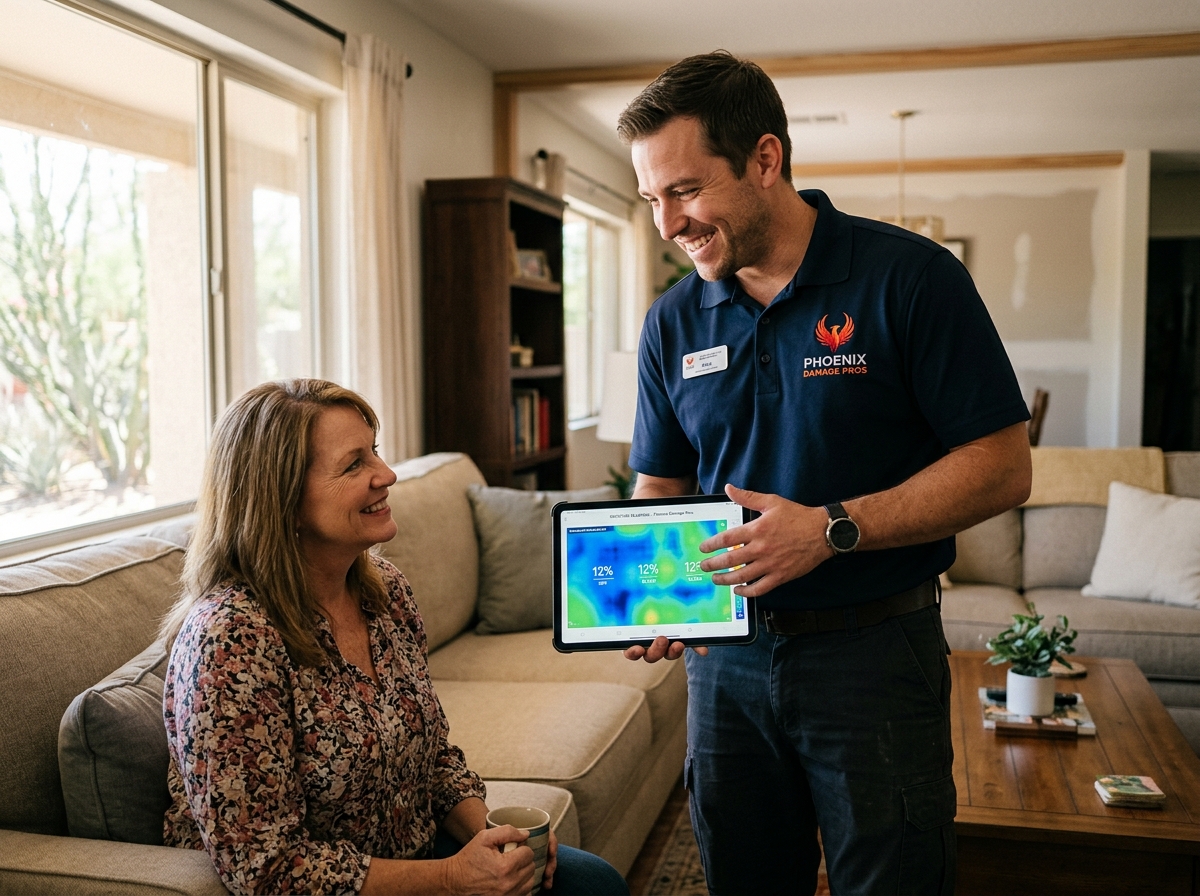
- FLIR® Infrared Thermal Imaging: Thermal cameras detect subtle surface temperature differentials caused by evaporative cooling, revealing hidden water migration behind commercial demising walls, under tiles, and inside ceiling plenums.
- Tramex Non-Destructive RF Impedance Scanners: Provide instantaneous, non-invasive moisture profiling across large-area commercial floors and wall surfaces without damaging high-end finishes.
- Deep-Wall Pin-Type Resistance Probes: Enable technicians to measure exact moisture content percentages (%MC) within structural wood studs, fire-rated gypsum cores, and acoustic insulation.
Phase 4: Psychrometric Controlled Dehumidification & Cavity Injection (Days 1–4)
Once bulk water is removed, our engineers deploy high-capacity LGR dehumidifiers, industrial desiccant drying trailers, and axial air movers calculated to match the building’s exact volume and saturation metrics. Technicians inspect equipment daily, logging psychrometric readings (temperature, RH, and GPP) to optimize equipment configurations as materials transition through drying phases.
Phase 5: Antimicrobial Sanitization, IAQ Clearance & Reconstruction Handoff
All exposed structural framing, concrete slabs, and accessible wall cavities are treated with EPA-registered, broad-spectrum antimicrobial solutions to inhibit bacterial colonization and prevent fungal amplification. Our leads compile detailed drying certification logs and deliver a seamless transition package to commercial reconstruction contractors under **AZ ROC #342819**.
6. Commercial Property Insurance Claims & Xactimate® Subrogation Mastery
Commercial property insurance claims involve substantial financial sums, intense adjuster scrutiny, and forensic engineering oversight. Insurance adjusters working on behalf of commercial carriers (such as Travelers, Liberty Mutual, State Farm, Chubb, Zurich, and FM Global) demand comprehensive, standardized documentation before authorizing major claim payouts.
Submitting unorganized, non-standardized contractor invoices inevitably triggers claim disputes, audit delays, and significant out-of-pocket exposure for property owners. Phoenix Damage Pros operates with total claims transparency, utilizing the exact standardized systems mandated by commercial insurance carriers:
A. Standardized Xactimate® Itemized Estimating
We build all restoration estimates using Xactimate®, the universal estimating software recognized across the commercial insurance industry. Every piece of equipment, square foot of extraction, hour of labor, and linear foot of containment is itemized using current regional Phoenix commercial pricing database codes:
| Xactimate® Category / Selector | Activity Description | Standard Commercial Application |
|---|---|---|
| WTR EXT> | Water Extraction – Heavy Commercial Gluedown Carpet | High-volume extraction using weighted commercial ride-on units. |
| WTR DHM> | Dehumidifier – Large Industrial LGR / Desiccant | 24-hour psychrometric structural moisture extraction per unit. |
| WTR DRY> | Air Mover – Commercial Centrifugal / Axial Fan | High-velocity laminar airflow generation across wet substrates. |
| WTR BARR> | Containment Barrier – Plastic Sheeting & Tension Poles | Zoned isolation barriers separating affected and unaffected tenant suites. |
| WTR APMD | Apply Plant-Based / EPA-Registered Antimicrobial Agent | Topical sanitization to inhibit bacterial and fungal proliferation. |
| WTR INJ> | In-Cavity Wall Drying Manifold System | Directed cavity drying to salvage expensive double-layer Type X drywall. |
B. Daily Psychrometric Drying Logs & Cloud Documentation
To substantiate that drying equipment was necessary and operated for an appropriate duration, our project managers maintain detailed daily psychrometric logs documenting:
- Ambient Dry-Bulb Temperature, Relative Humidity (%RH), and Grains Per Pound (GPP) for unaffected baseline control areas.
- Chamber conditions inside each active drying containment zone.
- Dehumidifier exhaust performance (logging grain depression—the difference in GPP between air entering and leaving the unit).
- Specific moisture content percentages (%MC) in structural wood framing, concrete slabs, and drywall substrates.
C. Direct Carrier Coordination & Subrogation Support
We work directly alongside your commercial risk management team and assigned insurance adjuster, attending on-site walkthroughs, providing forensic thermal imagery, and explaining our drying methodology. Furthermore, if your water loss was caused by a third-party contractor or upper-floor tenant, our forensic photo and moisture documentation provides vital evidence for your carrier’s subrogation recovery efforts.
7. Commercial Facility Emergency Action Checklist: The First 60 Minutes
The decisive actions executed by on-duty building engineers, property managers, and security staff during the initial 60 minutes of a major water intrusion will dictate the ultimate scale of physical and financial loss. Facility teams should follow this standardized triage checklist:
- Isolate Primary Water Risers or Zone Valves: Ensure maintenance personnel locate and close the affected riser, mechanical isolation valve, backflow assembly, or municipal street curb stop. If dealing with an active fire sprinkler head discharge, notify the monitoring station and engage the main riser control valve immediately.
- Execute Electrical Lock-Out / Tag-Out (LOTO): Prioritize life safety. If water has reached floor electrical boxes, baseboard raceways, or ceiling fixtures, de-energize impacted electrical sub-panels immediately from a dry location. Do not enter standing water in energized zones.
- Protect High-Value Mission-Critical Infrastructure: Elevate server rack components, computer towers, irreplaceable paper files, and high-value inventory onto elevated pallets or relocate them to dry upper floors. Drape plastic sheeting over critical office equipment.
- Isolate and Ground Commercial Elevators: Water cascading down elevator shafts compromises hoistway electrical cables, traveling cables, and pit buffers. Recall all elevator cars to the highest unaffected floor, discharge passengers, and lock out elevator power breakers.
- Cordon Off Impacted Corridors and Common Areas: Post commercial wet-floor signage, lock exterior doors leading into flooded wings, and stage absorbent containment booms to prevent slip-and-fall liabilities.
- Mobilize a Certified Commercial Restoration Partner: Contact Phoenix Damage Pros immediately at (602) 587-1380. Inform dispatch of building square footage, number of impacted floors, water source category, and site access protocols.
Facing an Active Commercial Water Disaster in Phoenix?
Do not let standing water compound into structural destruction, tenant disputes, and prolonged facility shutdown. Phoenix Damage Pros provides rapid 24/7/365 commercial emergency response throughout Phoenix, Scottsdale, Tempe, Mesa, Chandler, and Glendale.
Call Emergency Commercial Dispatch: (602) 587-1380
Licensed, Bonded & Insured: AZ ROC #342819 | IICRC Certified Master Water Restorers | Direct Commercial Insurance Billing
Frequently Asked Questions for Commercial Property Directors
1. Can our commercial facility remain open while restoration and drying are underway?
Yes. In the vast majority of commercial mitigation projects, our project managers deploy physical polyethylene containment barriers, negative air scrubbers, and designated transit corridors. This engineering controls strategy enables unaffected office wings, retail storefronts, or tenant suites to continue operating safely without exposure to noise, airborne particulates, or moisture.
2. How quickly can your commercial disaster fleet arrive at our Phoenix property?
Phoenix Damage Pros maintains emergency response units staged across the Phoenix Valley 24/7/365. For commercial emergencies, our certified crews arrive on-site within 30 to 45 minutes of dispatch, equipped with heavy truck-mounted extraction machinery, portable generators, and industrial drying equipment.
3. Does commercial property insurance cover the cost of water mitigation?
Yes, standard commercial property policies almost universally cover sudden and accidental water discharges (such as ruptured domestic supply risers, fire sprinkler discharges, and mechanical HVAC loop failures). We document all drying metrics using Xactimate® and coordinate billing directly with your commercial property insurance carrier.
4. How long does the structural drying process take in a large commercial property?
While bulk standing water extraction is completed within hours, full scientific structural drying of concrete slabs, metal framing assemblies, and commercial drywall typically requires 3 to 5 days, depending on building materials, initial saturation depth, and psychrometric conditions.
5. Why can’t standard commercial janitorial staff handle commercial water extraction?
Janitorial crews lack the industrial high-lift extraction equipment, desiccant dehumidifiers, non-destructive moisture meters, and psychrometric training required to dry deep structural substrates. Standard mop-and-shop-vac methods leave moisture trapped inside wall cavities and concrete slabs, virtually guaranteeing structural rot, floor adhesive failure, and toxic black mold growth within 48 hours.
6. How do you verify that concrete slabs are dry enough for new flooring installation?
We enforce strict adherence to the ASTM F2170 standard, utilizing in-situ relative humidity probes drilled into the concrete slab. We log verified slab internal RH below 75% to 80% to ensure that flooring adhesives will not re-emulsify and void manufacturer warranties.