
24/7 Commercial Flood Disaster Dispatch: If your industrial distribution center, commercial manufacturing plant, corporate business park, retail shopping center, or multi-family complex in Phoenix or Maricopa County is actively inundated with monsoon stormwater, municipal retention basin overflow, or flash flood runoff, contact our heavy disaster response unit immediately at (602) 587-1380. Our IICRC-certified Master Water Restorers deploy within 30 to 45 minutes with high-volume industrial trash pumps, mobile power generation trailers, and industrial desiccant drying fleets.
When severe summer monsoon thunderstorms erupt across the Salt River Valley—unleashing torrential downpours exceeding two to three inches of rainfall in under sixty minutes—commercial real estate properties across Phoenix, Glendale, Mesa, Tempe, Scottsdale, Chandler, and Tolleson confront an acute operational catastrophe. In the desert Southwest, flash flooding is not a gentle accumulation of standing water; it is a violent, high-velocity surge of surface stormwater runoff that overwhelms municipal storm sewers, breaches concrete retention basins, cascades across industrial parking aprons, and breaches ground-level commercial facilities through loading docks, pedestrian entries, and warehouse roll-up doors.
For industrial plant directors, logistics terminal superintendents, retail asset managers, and commercial portfolio executives, commercial flooding represents an existential operational threat. Under the IICRC S500 Standard and Reference Guide for Professional Water Damage Restoration, outdoor floodwater and storm runoff are universally classified as Category 3 “Black Water”—grossly contaminated water teeming with pathogenic biological agents, fecal coliform bacteria, petroleum hydrocarbons, toxic heavy metals, and abrasive desert silt. Every hour that Category 3 floodwaters stand across commercial concrete slabs, structural moisture wicks upward into interior demising walls, destroys palletized warehouse inventory, shorts high-voltage electrical switchgear, and triggers widespread microbial amplification under ambient Arizona heat.
Remediating large-scale commercial flood disasters requires specialized industrial-capacity infrastructure far beyond the capabilities of standard commercial janitorial companies or residential restoration outfits. It demands a dedicated **commercial flood restoration company in Phoenix** equipped with high-volume submersible trash pumps, industrial vacuum tankers, large-tonnage desiccant dehumidification fleets, and hospital-grade decontamination chemistry operating under **AZ ROC #342819**.

1. The Hydrology & Meteorology of Phoenix Commercial Flash Flooding
To understand why commercial facilities in Maricopa County face such catastrophic vulnerabilities to flood damage, facility directors must examine the intersection of desert soil geology, atmospheric monsoon dynamics, and regional civil engineering design:
A. The “Caliche” Soil Saturation Barrier
Unlike Midwestern or Eastern soils rich in organic matter and high percolation porosity, the native desert soil across the Phoenix Valley consists of dense, sun-baked clay and sedimentary hardpan known regionally as caliche. Caliche is cemented with calcium carbonate, creating an impervious subsurface layer resembling natural concrete. During intense summer monsoon storms (the North American Monsoon extending from late June through September), rainfall rates vastly exceed the soil’s microscopic infiltration capacity. Less than 5% of rainfall penetrates the ground; the remaining 95% converts instantaneously into sheet-flow surface runoff traveling across parking lots, highways, and industrial commercial developments.
B. Municipal Retention Basin Surcharges & Overflow Dynamics
Phoenix commercial civil engineering relies heavily on dry retention basins integrated into commercial parking parcels to capture stormwater. However, when consecutive storm cells train over the same commercial corridor, these retention basins reach 100% capacity in minutes. Once surcharged, excess floodwater seeks the lowest topographic elevation—frequently flowing directly toward subterranean parking structures, depressed warehouse loading docks, and low-lying commercial building entries.
C. Depressed Warehouse Loading Docks as Inadvertent Sump Pits
In logistics hubs, cross-dock distribution terminals, and manufacturing plants across West Phoenix, Tolleson, and Goodyear, depressed loading dock truck wells slope downward toward facility roll-up doors. While designed with small catch basins and sump pumps, these systems are easily overwhelmed by sudden flash flood volumes or localized electrical grid blackouts during storm-induced lightning strikes. The truck wells transform into accidental collection reservoirs, accumulating five to eight feet of standing water that exerts tremendous hydrostatic pressure against dock seals, ultimately bursting into warehouse interiors.
| Commercial Facility Type | Primary Flood Vulnerability Point | Contamination & Structural Risk Level | Priority Mitigation Strategy |
|---|---|---|---|
| Industrial Logistics & Warehouses | Depressed truck wells, dock levelers, slab expansion joints. | Category 3 Black Water / Inventory loss / Forklift short-circuit. | Heavy submersible pumping, silt removal, desiccant slab drying. |
| Subterranean Parking & High-Rise Basements | Parking ramps, sump pit failure, elevator hoistway pits. | Catastrophic structural flooding / Elevator hydraulic failure. | High-head trash pumps, electrical lockout, elevator pit dewatering. |
| Retail Centers & Strip Plazas | Storefront threshold breaches, surcharging retention basins. | Merchandise destruction / Black water VCT floor failure. | Rapid weighted extraction, temporary containment berms, virucidal washing. |
| Commercial Kitchens & Food Processing | Floor drain backflow, exterior grease trap surcharge. | Extreme biological pathogen contamination (E. coli, Salmonella). | Hospital-grade disinfection, health department clearance verification. |
| Corporate Business Parks | Parapet roof drain blockages, courtyard drainage overflows. | Multi-suite carpet saturation / Raised floor computer wiring short. | High-CFM vacuum extraction, in-cavity wall drying, sub-floor drying. |
2. Category 3 “Black Water” Environmental & Biological Profiling
A critical operational error made by untrained building staff is treating outdoor floodwater as if it were clean water from a broken pipe. Under the IICRC S500 standard, water intrusion is categorized into three distinct classes of contamination:
- Category 1 (“Clean Water”): Originates from a sanitary source (such as broken domestic supply lines or commercial ice machine feeds) and poses minimal health risk upon initial release.
- Category 2 (“Gray Water”): Contains significant contamination with the potential to cause discomfort or sickness (such as commercial dishwasher discharge, washing machine overflows, or sump pump failures).
- Category 3 (“Black Water”): Grossly contaminated water containing pathogenic agents, toxins, biohazards, and chemical pollutants that will cause severe illness or death if ingested or exposed to open skin or respiratory tracts.
All outdoor storm runoff, monsoon flash floodwaters, and municipal sewer overflows entering a commercial facility are automatically designated Category 3 Black Water.
The Biological & Chemical Hazard Inventory of Phoenix Floodwaters
When stormwater surges through Phoenix streets, parking lots, and industrial yards before penetrating a facility, it absorbs a lethal cocktail of environmental pollutants:
- Pathogenic Bacterial Microorganisms: Overwhelmed sanitary sewers mix with street runoff, introducing massive colony counts of Escherichia coli, Salmonella enterica, Pseudomonas aeruginosa, and Enterococcus faecalis. Exposure can trigger severe gastroenteritis, septicemia, and life-threatening skin infections.
- Viral Pathogens: Raw wastewater contains human enteric viruses, including Hepatitis A, Rotavirus, and Norovirus, which remain biologically active on commercial concrete slabs and carpet fibers for days.
- Chemical & Petroleum Hydrocarbons: Street runoff dissolves motor oil, antifreeze (ethylene glycol), hydraulic fluids, tire rubber residues, and industrial solvents, which adhere to commercial concrete and emit hazardous VOCs.
- Agricultural & Landscaping Chemicals: High concentrations of chemical fertilizers (nitrates, phosphates) and pesticides (organophosphates) are carried from surrounding commercial landscaping directly into building interiors.
- Abrasive Caliche Silt & Microparticulates: Desert floodwaters carry metric tons of pulverized mineral silt. If allowed to dry naturally, this silt forms an airborne silicate dust that causes acute respiratory distress and irreversibly damages commercial air handling machinery.

3. The 6-Stage Industrial Flood Mitigation Protocol for Commercial Properties
Stabilizing a commercial facility following catastrophic flood intrusion requires a massive, coordinated engineering response. Phoenix Damage Pros executes a disciplined 6-stage disaster recovery protocol governed strictly by IICRC S500 and OSHA 29 CFR 1910 standards:
“`
[Stage 1: Emergency Mobilization, Site Hazard Triage & Power Isolation] (0-2 Hours)
│
▼
[Stage 2: High-Volume Heavy Submersible Pumping & Water Displacement] (2-6 Hours)
│
▼
[Stage 3: Sludge, Silt & Biohazard Silt Mechanical Removal & Bagging]
│
▼
[Stage 4: Pressurized Decontamination & Hospital-Grade Antimicrobial Sanitization]
│
▼
[Stage 5: High-Capacity Desiccant Trailer Dehumidification & Structural Drying] (Days 1-5)
│
▼
[Stage 6: ASTM Slab Testing, IAQ Clearance Certification & Reconstruction Handoff]
“`
Stage 1: Emergency Mobilization, Site Hazard Triage & Power Isolation (0–2 Hours)
Upon arriving on-site, our certified commercial project managers coordinate directly with building engineers, security staff, and corporate risk personnel:
- Electrical Hazard Lock-Out / Tag-Out (LOTO): Entering standing floodwater in a commercial building with energized subterranean switchgear or submerged floor electrical boxes is potentially fatal. Our crews coordinate with licensed commercial electricians to verify electrical isolation before personnel enter flooded spaces. If grid power is down, we deploy trailer-mounted mobile diesel generators to power our emergency extraction systems.
- Structural Integrity & Foundation Assessment: Our project leads inspect commercial perimeter walls for signs of lateral hydrostatic soil displacement, foundation undermining, or floor-slab shifting.
- Biohazard Containment Zoning: We construct temporary physical containment barriers utilizing 6-mil poly-sheeting and zip-poles to isolate flooded warehouse bays from clean administrative suites, preventing airborne bio-contaminants from cross-contaminating unaffected commercial areas.
Stage 2: High-Volume Heavy Submersible Pumping & Bulk Water Displacement (2–6 Hours)
Extracting thousands of gallons of deep floodwater requires heavy industrial pumping machinery:
- Gasoline & Diesel Submersible Trash Pumps: Capable of passing solids up to 2 inches in diameter, these heavy-duty pumps discharge between 10,000 and 25,000 gallons per hour through 3-inch and 4-inch discharge hoses, rapidly clearing submerged truck wells, elevator pits, and basement levels.
- Truck-Mounted Vacuum Tankers: High-vacuum extraction units with positive displacement blowers providing continuous suction across extensive warehouse footprints.
- Ride-On Weighted Extractors: For commercial gluedown carpet in retail and office zones, motorized weighted extraction units squeeze saturated carpet fibers and padding directly against the concrete slab, removing thousands of gallons that standard wands leave behind.
Stage 3: Silt, Sludge & Heavy Debris Mechanical Removal
Desert flash floods deposit thick layers of abrasive mud, caliche clay, and organic sludge across commercial slabs. If left to dry, this mud hardens into concrete-like silt that binds permanently to porous floors. Our crews utilize commercial extraction squeegees, heavy-duty mechanical shovels, and specialized slurry vacuum systems to remove all mud deposits, sealing hazardous waste into heavy-gauge poly-bags for legal environmental disposal.

Stage 4: Pressurized Decontamination & Hospital-Grade Antimicrobial Sanitization
Because floodwaters carry Category 3 biological hazards, superficial cleaning is illegal under public health standards. Technicians wearing Level C Personal Protective Equipment (full-body Tyvek suits, PAPR respirators, and heavy nitrile gloves) perform full decontamination:
- Hot-Water Pressurized Bio-Washing: Concrete slabs and structural masonry are washed using pressurized hot water (180°F+) combined with industrial surfactants to strip away oil, grease, and biological residues.
- Hospital-Grade Virucidal & Bactericidal Application: We apply EPA-registered, broad-spectrum disinfectants formulated to eradicate E. coli, Salmonella, Norovirus, and fungal spores with a 99.999% verified kill rate.
- Controlled Removal of Saturated Porous Substrates: Porous materials submerged in Category 3 water—including standard drywall up to 2 feet above the water line, acoustic ceiling tiles, fiberglass insulation, and tackless carpet—cannot be sanitized and are safely cut, bagged, and removed under containment.
Stage 5: High-Capacity Desiccant Trailer Dehumidification & Structural Drying (Days 1–5)
Extracting standing water is only the first phase; commercial concrete slabs and structural building framing hold massive volumes of moisture in their microscopic pores. To dry hundreds of thousands of square feet of industrial space, standard refrigerant dehumidifiers are inadequate. Phoenix Damage Pros deploys trailer-mounted industrial desiccant dehumidifiers generating 5,000 to 15,000 CFM of ultra-dry air (delivering grain depressions below 15 GPP and relative humidity under 10%). High-velocity industrial axial fans direct laminar airflow across slabs, drawing deep-seated moisture out of concrete foundations before secondary mold colonization can occur.
Stage 6: ASTM Slab Testing, IAQ Clearance Certification & Reconstruction
Prior to certifying the facility safe for re-occupancy, our project managers perform comprehensive moisture audits, logging relative humidity, temperature, and material moisture content (%MC). We drill in-situ relative humidity probes into concrete slabs under ASTM F2170 to verify that sub-slab moisture has returned to safe baseline thresholds. All documentation is compiled into a formal insurance clearance package, and our licensed general contracting division (**AZ ROC #342819**) manages complete structural rebuild and tenant improvement restoration.
4. Salvaging Mission-Critical Industrial Equipment & High-Value Assets
In manufacturing plants, logistics hubs, and corporate technology parks, the physical machinery and electrical distribution equipment inside the facility frequently represent far greater capital value than the building structure itself. When floodwaters submerge industrial equipment, rapid specialized triage determines whether assets can be saved or written off as complete structural losses:
A. Commercial Electrical Switchgear & Motor Control Centers (MCC)
When Category 3 floodwaters contact electrical distribution gear, transformer vaults, or motor control centers, the combination of water, dissolved minerals, and silt compromises electrical insulation resistance (dielectric strength). Standard procedure mandates:
- Do NOT Re-Energize Equipment While Wet: Attempting to power up submerged switchgear causes catastrophic arc-flash explosions, destroying internal bus bars and creating fatal life-safety hazards.
- De-Ionized Water Wash & Ultrasonic Cleaning: Certified electrical restoration technicians wash switchgear assemblies with de-ionized water to remove conductive silt residues, followed by chemical moisture displacement agents.
- Megohmmeter Dielectric Insulation Testing: Before utility power is restored, certified electrical engineers perform high-voltage “Megger” insulation resistance testing to verify that wiring meets NETA (InterNational Electrical Testing Association) safety standards.
B. Commercial Elevator Hoistways & Hydraulic Pits
In multi-story office towers and commercial parking garages, subterranean elevator pits act as natural sumps for floodwaters. Flood intrusion introduces several critical failure points:
- Hydraulic Fluid Emulsification: Water entering hydraulic elevator cylinder packings emulsifies hydraulic oil, causing pump cavitation and complete valve failure.
- Traveling Cable Satiation: Flexible electrical traveling cables that provide control power to elevator cars absorb water, compromising electronic communication.
- Pit Safety Buffer Submersion: Oil and spring safety buffers must be disassembled, drained, cleaned, and certified by licensed state elevator inspectors before cars can re-enter service.
C. Palletized Warehouse Inventory & Racking Stability
In logistics distribution centers, corrugated cardboard boxes absorb floodwater through capillary action. Saturated cardboard loses 90% of its stacking compressive strength, causing multi-tier pallet racks to lean, buckle, and collapse under their own weight. Our emergency crews deploy specialized structural shoring, secure leaning pallets with industrial banding, and transfer unaffected inventory to dry staging bays under strict chain-of-custody documentation.
5. Specialized Industrial Operations: Warehousing Logistics, Cold Storage & Manufacturing
Commercial flood mitigation strategies must adapt dynamically to specialized industrial facility architecture. In the Phoenix industrial real estate corridor, three specific property categories require specialized engineering protocols:
A. High-Bay Automated Logistics Centers & Cold-Storage Warehouses
Modern high-cube distribution centers feature 36-foot to 40-foot clear heights, automated storage and retrieval systems (ASRS), and delicate automated optical sensors. When stormwater breaches warehouse perimeters:
- Laser-Guided Vehicle (AGV) Sensor Protection: Recessed floor magnetic strips and optical positioning markers become coated with caliche silt, paralyzing automated guided vehicle operations. Detailed solvent cleaning and dry-wiping are required before robotics can re-engage.
- Cold-Storage Vapor Barrier Breaches: In refrigerated distribution facilities (cooler and freezer storage rooms operating at -10°F to 34°F), water entering sub-floor thermal insulation freezes into massive ice lenses. The expanding ice heaves concrete slabs, cracking insulated sandwich panel walls. Our teams utilize specialized low-temperature desiccant drying arrays to extract moisture without thawing stored perishable food freight.
B. Precision Manufacturing & CNC Machine Shops
In aerospace, defense, and semiconductor machine shops across Chandler, Mesa, and North Phoenix, multi-axis CNC milling centers, coordinate measuring machines (CMMs), and precision laser cutters operate within microscopic tolerances. When floodwaters inundate machine bases:
- Precision ground ways, ball screws, and hydraulic chucks oxidize rapidly from dissolved mineral salts. Technicians apply specialized water-displacing corrosion inhibitor oils (WD-grades formulated for mil-spec aerospace protection) to unpainted steel tooling surfaces within 2 hours of arrival.
- Coolant sump reservoirs contaminated with outdoor stormwater must be fully drained, biocidally flushed, and recharged to prevent bacterial aerosolization during subsequent machining cycles.
C. Commercial Food Processing Plants & USDA/FDA Regulated Facilities
Food processing and packaging plants operate under stringent federal oversight (USDA-FSIS and FDA Food Safety Modernization Act regulations). A flood event involving Category 3 water constitutes an immediate regulatory shutdown. Phoenix Damage Pros executes full microbial bio-containment, implements adenosine triphosphate (ATP) bioluminescence surface swab testing to verify complete absence of organic residue, and provides comprehensive documentation packets for federal agricultural inspectors.
6. Commercial Flood Insurance, NFIP & Xactimate® Subrogation Mastery
Navigating commercial insurance recovery after a major flood is one of the most complex financial undertakings a property manager will experience. A primary point of confusion in commercial risk management is the distinction between standard commercial property insurance and dedicated commercial flood insurance:
Commercial Property Policy vs. Commercial Flood Insurance (NFIP / Private Flood)
Standard commercial property policies (ISO CP 00 10) explicitly exclude water damage resulting from external rising surface water, storm surges, or overflowing bodies of water. Flood coverage must be secured either through the National Flood Insurance Program (NFIP) Commercial Policy (which carries a maximum structural coverage limit of $500,000 and contents limit of $500,000) or through a specialized Commercial Excess / Difference in Conditions (DIC) Private Flood Policy.
However, if outdoor flooding was exacerbated by municipal storm sewer backpressure, negligent off-site civil construction, or blocked storm drainage on adjoining parcels, experienced restoration contractors help property owners document third-party subrogation recovery claims against responsible municipal or private entities.
Standardized Xactimate® Itemized Flood Estimating
Commercial flood adjusters working for commercial carriers or FEMA mandate itemized estimates prepared using Xactimate®, utilizing the exact regional Phoenix commercial price database codes:
| Xactimate® Code | Standard Commercial Flood Activity | Justification for Adjuster Approval |
|---|---|---|
| WTR EXTPUMP> | Pumping – High-Volume Submersible Trash Pump | Mandated for extracting deep water from flooded basements and truck wells. |
| WTR EXT | Water Extraction – Commercial Concrete Slab / Silt Slurry | Extraction of abrasive water and silt prior to high-pressure washing. |
| WTR DECON> | Pressure Wash & Sanitize – Heavy Biological Contamination | Pressurized hot-water washing and EPA virucidal application for Category 3 water. |
| WTR DHMD> | Dehumidifier – Large Industrial Desiccant Trailer Unit | High-volume psychrometric drying of deep-seated moisture inside concrete slabs. |
| WTR DRY> | Air Mover – Commercial High-Velocity Axial Fan | Generates continuous laminar airflow across floor and wall framing. |
| WTR BARR> | Containment Barrier – 6-mil Flame Retardant Polyethylene | Isolates contaminated black water zones from clean corporate suites. |
| HAZ DISP | Hazardous Biohazard Waste Disposal & Transport | Permitted transport and certified disposal of Category 3 contaminated materials. |
7. Commercial Facility Emergency Action Plan (EAP): Flash Flood Triage Checklist
When severe weather warnings indicate impending flash flooding or when stormwater breaches perimeter thresholds, on-duty facility supervisors must execute this disciplined 6-point triage checklist:
- Prioritize Human Safety & Evacuate Low-Lying Zones: Direct all building occupants, warehouse staff, and retail customers away from ground-level and subterranean suites. Never permit employees to walk or drive through moving stormwater or flooded parking structures.
- Execute Electrical Lock-Out / Tag-Out (LOTO): From a dry, elevated location, de-energize electrical sub-panels feeding ground-floor raceways, submerged floor boxes, and low-lying electrical conduits. If the main electrical switchgear vault is in danger of submersion, coordinate emergency utility grid disconnect with Arizona Public Service (APS) or Salt River Project (SRP).
- Stage Emergency Sandbag & Inflatable Flood Barriers: If storm surges have breached parking structures but not yet entered building entries, deploy rapid-fill sandbags or commercial inflatable water barriers across loading dock doors and glass entrance vestibules.
- Recall and Lock Out Commercial Elevators: Surcharged water rushes down hoistways, destroying electrical traveling cables. Immediately recall all elevators to the top floor, ensure all passengers exit safely, and disconnect main hoistway breaker switches.
- Shut Off Central Air Handling Units (AHUs): Do not run building HVAC systems if floodwater has entered low-level returns, floor registers, or supply plenums. Operating fans will circulate airborne bio-pathogens, sewage aerosols, and chemical odors throughout the entire facility.
- Mobilize a Certified Commercial Flood Restoration Contractor: Contact Phoenix Damage Pros immediately at (602) 587-1380. Inform emergency dispatch of total estimated square footage, standing water depth, building structural type, and primary utility status.
Emergency Commercial Flood Disaster in Phoenix?
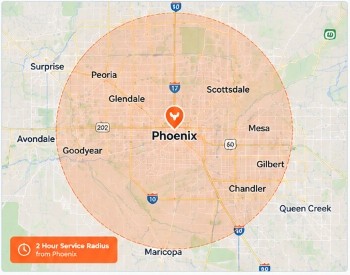
Do not allow Category 3 storm floodwaters to compound into structural condemnation, business interruption, and tenant litigation. Phoenix Damage Pros provides rapid 24/7/365 commercial emergency flood response throughout Phoenix, Scottsdale, Tempe, Mesa, Chandler, Glendale, and Peoria.
Call Emergency Flood Dispatch: (602) 587-1380
Licensed, Bonded & Insured: AZ ROC #342819 | IICRC Certified Master Water Restorers | Direct Commercial Insurance Billing
Frequently Asked Questions for Commercial Facility Directors
1. Why can’t in-house commercial janitorial staff handle outdoor floodwater extraction?
Outdoor floodwater is classified as Category 3 Black Water, laden with sewage pathogens, toxic chemicals, and petroleum hydrocarbons. Standard janitorial shop-vacs and commercial mops lack the necessary filtration, volume displacement, and biohazard containment systems. Attempting janitorial cleanup aerosolizes dangerous bio-contaminants, violates OSHA workplace safety standards, and leaves massive moisture volumes trapped inside concrete slabs, guaranteeing toxic mold proliferation within 48 hours.
2. How quickly can your commercial disaster units arrive at our Phoenix facility?
We maintain emergency disaster response units staged across the Phoenix Metropolitan Area on permanent 24/7/365 standby. In commercial flooding emergencies, our crews typically arrive on-site within 30 to 45 minutes of dispatch, fully equipped with heavy submersible trash pumps, industrial vacuum units, and portable diesel generators.
3. Does commercial property insurance cover damage from monsoon flash flooding?
Standard commercial property policies typically exclude surface water flooding unless the property maintains a specific Commercial Flood Policy (through the NFIP or a private carrier) or a Difference in Conditions (DIC) endorsement. However, if the flooding was caused by a sudden roof drain pipe failure, mechanical drain backup, or municipal sewer overflow, coverage is frequently available under standard policy endorsements. We provide line-item Xactimate® documentation to substantiate all claims.
4. What happens to porous commercial building materials that touch Category 3 floodwaters?
Under IICRC S500 standards, porous building materials—such as standard drywall, acoustic ceiling tiles, fiberglass insulation, and carpet padding—submerged in Category 3 Black Water cannot be sanitized and must be removed under containment. Non-porous materials (concrete slabs, structural steel, masonry) can be fully decontaminated using pressurized hot-water washing and EPA-registered hospital-grade disinfectants.
5. How long does the complete commercial structural drying process take?
While bulk standing floodwater extraction and silt removal are accomplished within the first 6 to 12 hours, complete scientific structural drying of concrete slabs and commercial building framing utilizing industrial desiccant dehumidification trailers typically requires 3 to 5 days, depending on initial saturation depth and building envelope construction.
6. How do you verify that concrete slabs are safe for new flooring after a flood?
We enforce strict ASTM F2170 in-situ probe testing. Precision holes are drilled into the concrete slab, and calibrated digital relative humidity probes measure internal slab moisture. We verify that slab RH has dropped below 75% to 80% before certifying the slab safe for resilient commercial flooring reinstallation, protecting manufacturer adhesive warranties.
7. What should we do if our commercial electrical transformer vault is submerged?
Never enter standing water near submerged electrical equipment. Immediately contact SRP or APS to isolate primary utility feeds, coordinate with a licensed commercial electrician for lock-out/tag-out, and allow Phoenix Damage Pros to deploy explosion-proof dewatering pumps to safely lower water levels before electrical inspections begin.
8. How does business interruption insurance calculate flood downtime?
Business interruption claims require proving the direct financial impact of physical structural unavailability. Our daily equipment logs, moisture mapping, and project timeline documentation substantiate exactly how long the building envelope was legally and physically uninhabitable, expediting maximum compensation for lost operational revenue.
Civil Engineering Drainage Protocols & Municipal Surcharge Guidelines in Maricopa County
Commercial building operators throughout Phoenix, Tempe, and Glendale should maintain close operational coordination with local flood control districts and the Flood Control District of Maricopa County (FCDMC). During regional 50-year and 100-year storm events, municipal arterial retention corridors and drainage easements often experience temporary hydrostatic surcharge, resulting in localized backwater conditions that overwhelm standard commercial on-site catch basins. Implementing secondary perimeter swales, positive sub-slab drainage slopes (minimum 2% grade away from building perimeters), and commercial dual-redundancy sump pump systems with dedicated backup battery inverters drastically reduces flood vulnerability during peak Sonoran Desert monsoon surges. Furthermore, facility managers should preserve all post-flood industrial hygiene reports and ASTM concrete moisture certifications for a minimum of seven years to maintain full compliance during commercial real estate portfolio audits.
Commercial Tenant Rent Abatement and Business Continuity Legal Disclosures
Under Arizona revised statutes and commercial lease contracts operating throughout the Phoenix metropolitan marketplace, building landlords are required to maintain written logs documenting emergency storm water mitigation actions. Commercial tenants experiencing operational interruption resulting from external storm runoff ingress into leased suites may seek contractual lease rent abatement until third-party environmental clearance certificates confirm structural safety and normal fungal ecology. Phoenix Damage Pros provides complete forensic documentation packets to support both property owners and corporate tenants throughout the insurance recovery lifecycle.