
24/7 Hotel & Resort Disaster Command Center: If a burst domestic water supply line, guest bathroom overflow, PTAC condensate flood, or commercial kitchen pipe failure is affecting guest rooms or public banquet spaces in your hotel or resort in Phoenix, Scottsdale, Paradise Valley, Tempe, or Mesa, contact our dedicated hospitality emergency restoration division immediately at (602) 587-1380. Our IICRC-certified Master Restorers deploy ultra-quiet cleanroom drying fleets, non-destructive moisture extraction systems, and industrial hydroxyl odor neutralizers within 45 minutes under AZ ROC #342819.
Greater Phoenix and the neighboring luxury enclave of Scottsdale represent one of the premier hospitality, resort, and convention destinations in the world. With millions of leisure tourists, corporate executives, and conference attendees arriving annually to enjoy world-class desert golf resorts, luxury spas, and downtown convention centers, hotel operations depend entirely on guest satisfaction and uncompromised brand reputation. In the fast-paced lodging industry, financial performance is governed by strict metrics: Revenue Per Available Room (RevPAR), Average Daily Rate (ADR), and overall room occupancy. When an indoor water disaster strikes a hotel or resort property, the operational and financial fallout extends far beyond simple physical repairs.
Every single hour that a guest room remains classified as Out-of-Order (OOO) represents an unrecoverable loss of daily room revenue. In high-season winter and spring months across the Valley of the Sun—when luxury resort suites routinely command ADRs exceeding $500 to $1,200 per night—taking six, eight, or twelve rooms offline for multiple weeks inflicts catastrophic revenue hemorrhages. Furthermore, water intrusions in hospitality environments trigger immediate guest satisfaction crises. Saturated carpet backing, damp drywall, and musty microbial odors drive negative online guest reviews, damage global brand loyalty, and can force hotel operators to issue costly guest room refunds, travel compensations, or emergency guest relocations to competing properties.
Restoring a water-damaged hospitality property requires specialized engineering protocols that conventional restoration contractors cannot provide. Demolishing luxury vinyl wallcoverings, tearing out custom cherry millwork, and running deafening commercial fans in active corridors will quickly alienate remaining hotel guests and paralyze operations. Hospitality restoration demands non-destructive in-place structural drying, ultra-quiet “whisper-mode” dehumidification fleets operating below 52 decibels, chemical-free hydroxyl odor neutralization, and surgical containment that shields public corridors from visual or acoustic disruption. Phoenix Damage Pros delivers a turnkey, brand-compliant hospitality disaster recovery service engineered specifically to protect RevPAR, minimize room downtime, and preserve guest trust across Maricopa County.

1. Unique Hydraulic Vulnerabilities in Desert Hospitality Properties
Modern hotels, high-rise urban towers, and sprawling desert resorts feature complex mechanical plumbing infrastructures designed to handle intensive, variable occupant loads. Several recurring mechanical failures account for the vast majority of hotel water losses across the Valley.
A. Packaged Terminal Air Conditioner (PTAC) & Fan Coil Condensate Overflows
In resort guest rooms across Phoenix and Scottsdale, cooling is delivered either by through-the-wall Packaged Terminal Air Conditioners (PTACs) or vertical fan coil units (FCUs) concealed within bathroom ceiling plenums. During blistering summer months when outdoor temperatures exceed 115°F, guest air conditioners operate under continuous maximum cooling duty cycles:
- Algal Biofilm & Hard Water Scaling: Phoenix tap water carries heavy mineral hardness (calcium and magnesium carbonate). When hard mineral deposits combine with airborne lint and dust, condensate drain lines choke. Algal slime proliferates in the warm drain pan, forming an impermeable plug.
- Silent Sub-Floor Saturation: Blocked drain pans overflow silently behind PTAC wall sleeves or within ceiling drop chases. Water seeps unseen beneath commercial carpet tiles and vinyl baseboards, migrating horizontally into adjoining guest rooms and vertically through floor-ceiling assemblies before housekeeping notices surface staining.
B. Multi-Floor Vertical Gravity Cascades from Guest Bathroom Overflows
Guest behavior represents an uncontrollable risk variable in hospitality management. Whether due to intoxicated guests falling asleep while filling whirlpool bathtubs, foreign objects flushed into high-pressure commercial toilets, or deliberate vandalism, upper-floor fixture overflows are common. A bathtub overflowing at 8 gallons per minute on the 5th floor releases hundreds of gallons of clean tap water that rapidly migrates downward along plumbing chases, electrical conduits, and elevator hoistways, saturating guest rooms on floors 4, 3, 2, and ground-level lobby spaces before staff can intervene.
C. Commercial Laundry Main Breaches & Boiler Loop Failures
Hospitality properties operate industrial on-premise laundry (OPL) facilities that wash thousands of pounds of linens, towels, and bedding daily. High-capacity commercial washing machines connected to 2-inch and 3-inch pressurized hot water mains operate under heavy mechanical vibration. A ruptured flexible supply hose, cracked commercial water heater tank, or circulating hydronic heating loop valve failure can release an industrial flood of thousands of gallons of scalding water into back-of-house utility corridors, threatening primary building electrical switchgear.
D. Banquet Kitchen Fire Suppression & Commercial Dishwasher Deluges
Hotel banquet kitchens and on-site fine dining restaurants feature high-volume commercial dishwashing machines, ice machines, and automated Ansul wet-chemical fire suppression systems. A fractured copper supply pipe behind a commercial combi-oven or an accidental sprinkler discharge over a banquet kitchen line can flood grand ballrooms and conference meeting spaces hours before a major corporate banquet, risking multi-million-dollar event cancellations.
E. Commercial Swimming Pool, Hydrotherapy Spa & Architectural Water Feature Surges
Desert luxury resorts across Scottsdale, Paradise Valley, and Phoenix are famed for elaborate outdoor and rooftop aquatic amenities, including Olympic-sized heated lap pools, infinity-edge swimming basins, indoor hydrotherapy spas, and multi-tier decorative lobby waterfalls. These complex hydraulic systems circulate tens of thousands of gallons under high-pressure automated filtration. Catastrophic failures occur when underground PVC circulation loops rupture beneath exterior concrete pool decks, backwash surge valves stick in open bypass mode, or automated chlorination balancing lines fracture within subterranean equipment vaults. Water from subterranean equipment vaults or overflowed decorative water features rapidly breaches exterior curtain walls, subterranean parking structures, ballroom service basements, and ground-level luxury cabana suites. Because pool and spa water carries elevated concentrations of chlorine, bromines, muriatic acid, and algorithmic stabilizing chemicals, moisture intrusions from aquatic amenities represent chemical Category 2 greywater emergencies requiring targeted neutralizing washdowns, rapid subsurface extraction, and heavy-duty structural dewatering before chemical residues etch natural travertine floors, corrode metallic structural anchors, or degrade structural masonry foundations.
2. The RevPAR Equation: Economic Urgency of Out-of-Order (OOO) Status
In hotel asset management, an un-occupied room is a perishable asset; a night of lost room revenue can never be resold. When water damage forces hotel general managers to place guest rooms into Out-of-Order (OOO) status, the compounding financial losses quickly surpass the cost of physical restoration.
A. Calculating the True Daily Cost of Room Downtime
To quantify the financial stakes of a multi-room water loss in the Phoenix-Scottsdale hospitality market, consider the direct and indirect economic impacts:
- Direct Room Revenue Loss: If a pipe rupture takes 10 luxury resort suites offline during peak spring season in Scottsdale with an ADR of $650, the property loses $6,500 every single day in room revenue alone. Over a standard 14-day conventional restoration cycle, the lost room revenue totals $91,000.
- Ancillary Revenue Deprivation: Hotel guests do not spend money solely on sleeping accommodations; they patronize on-site restaurants, book spa appointments, rent pool cabanas, and purchase retail merchandise. Industry metrics show that ancillary guest spend averages 40% to 60% of room rate. Taking 10 rooms offline incurs an additional $36,000 to $54,000 in lost food, beverage, and resort amenities revenue.
- Guest Relocation & Walk Costs: If the hotel is operating at 100% occupancy during major Valley events (such as the Waste Management Phoenix Open, Barrett-Jackson Car Auction, or Cactus League Spring Training), displaced guests must be “walked” to competing properties. Hotel ownership must pay the competitor’s inflated walk rate, provide limousine transportation, and issue brand loyalty reward points, compounding financial losses.
B. Defending Brand Standards & Online Review Reputation
Modern travelers scrutinize online guest reviews on Google, TripAdvisor, and online travel agencies (OTAs) before booking. A single negative review mentioning “musty mildew smell in room 312,” “noisy industrial dehumidifiers in the hallway,” or “damp carpet” can degrade a hotel’s TripAdvisor ranking, driving down overall property RevPAR for months. Phoenix Damage Pros prioritizes discrete, quiet, and rapid structural restoration engineered to safeguard property reputation.
C. Franchise Brand Standards & Quality Assurance (QA) Audit Protection
Major international hospitality flags—including Marriott International (Luxury Collection, Ritz-Carlton, JW Marriott), Hilton Worldwide (Waldorf Astoria, Conrad), Hyatt Hotels, and InterContinental Hotels Group (IHG)—impose rigorous Brand Standard Audit protocols upon franchise and managed properties. Regional Quality Assurance (QA) evaluators perform unannounced multi-point property inspections evaluating physical asset condition, indoor air quality metrics, and guest room finishes. Discovering water-damaged baseboards, peeling vinyl wallcoverings, elevated wall moisture readings, or persistent mildew odor results in immediate catastrophic audit point deductions, severe financial penalties, and mandatory room decertification. In severe scenarios, repeated failure to rectify chronic moisture damage or unaddressed plumbing defects jeopardizes franchise license agreements and forces properties into costly mandatory Property Improvement Plans (PIPs). Phoenix Damage Pros protects hotel asset owners by delivering forensic restoration that restores guest rooms to exact brand specifications. Every structural assembly is dried to certified equilibrium, baseboard joints are seamlessly reinstalled to manufacturer tolerances, and indoor air quality is forensically tested, ensuring properties maintain perfect Brand Quality Assurance compliance without failing corporate hospitality audits.
3. In-Place Drying Engineering: Preserving Luxury Wallcoverings, Millwork & FF&E
Conventional restoration contractors operate with a destructive mindset: cutting out four-foot drywall sections, ripping off custom wood baseboards, and discarding expensive vinyl wallcoverings. In a luxury hotel environment, this aggressive demolition strategy is financially disastrous, requiring months of lead time to reorder custom European fabrics, architectural wallcoverings, and bespoke hospitality furniture, fixtures, and equipment (FF&E). Phoenix Damage Pros employs scientifically validated in-place drying protocols.
A. The Vinyl Wallcovering Mold Trap Hazard
Over 90% of commercial hotel guest rooms utilize heavy-duty Type II commercial vinyl wallcoverings for durability and aesthetic beauty. However, vinyl wallcovering is an absolute, non-breathable vapor barrier (permeance < 0.1 perm). When water enters a wall cavity from an upper-floor leak:
- Moisture wicks into the porous gypsum drywall core, becoming trapped between the impervious vinyl wallcovering on the room side and the exterior vapor barrier on the structural side.
- Deprived of convective airflow, trapped moisture combines with starch-based wallpaper adhesives and warm desert temperatures, germinating virulent colonies of Stachybotrys, Aspergillus, and Penicillium mold directly behind the vinyl sheet within 48 to 72 hours.
- If left untreated, mold consumes the paper drywall backing and bleeds through the vinyl as unsightly pink, green, or black stains, releasing toxic spores into the guest breathing zone.
B. Non-Destructive In-Cavity Desiccant Injection Drying
Rather than tearing off expensive designer vinyl wallcoverings and facing weeks of room re-papering and texture matching, Phoenix Damage Pros utilizes precision in-cavity structural drying technology:
- Our technicians carefully remove the decorative wood or vinyl baseboards along the floor perimeter.
- We drill tiny, 5/8-inch ventilation release ports through the drywall into each wall cavity stud bay beneath the baseboard line.
- We connect specialized positive-pressure manifolds that deliver high-velocity, low-grain heated desiccant air directly into the wall cavity, forcing humid air out through opposing return ports.
- Once electronic moisture meters confirm the wood framing and gypsum core have reached dry standard equilibrium (typically 8% to 12% moisture equivalent), the small holes are sealed, and the original baseboards are re-installed. The wall is fully restored with zero damage to the visible vinyl wallcovering above.
C. Custom Architectural Millwork & Hardwood Headboard Preservation
Luxury resort guest rooms feature custom built-in desks, architectural crown moldings, and solid hardwood headboards anchored directly to wall studs. Removing these furnishings destroys them, requiring expensive custom carpentry replacements. Our restoration specialists deploy localized thermal drying mats and high-vacuum suction blankets across saturated millwork, safely pulling bound moisture out of solid woods without warping, cupping, or ruining custom varnish finishes.
D. Luxury Carpet Delamination Prevention & Custom Wool Broadloom Hydro-Extraction
Luxury resort guest corridors and executive penthouse suites frequently feature custom woven Axminster broadloom carpets, hand-tufted New Zealand wool rugs, or heavy-duty patterned commercial nylon with dense acoustic cushion backing. When clean tap water or bathroom overflows saturate commercial broadloom carpeting, the latex adhesive bonding the primary backing to the secondary polypropylene scrim weakens exponentially. If untrained maintenance personnel pull, stretch, or walk heavily on waterlogged carpeting, secondary backing delamination occurs, permanently destroying the carpet and necessitating tens of thousands of dollars in premature replacement. Phoenix Damage Pros prevents carpet delamination through non-invasive hydro-extraction. Our certified commercial technicians deploy self-propelled, weighted extraction rovers that apply calibrated downward head pressure (over 1,200 pounds of distributed compression) combined with high-cfm dual-vacuum blowers. This technology extracts up to 95% of trapped water directly out of thick carpet pile and commercial acoustic underlayment in a single pass without separating carpet fibers from their backing. By extracting free water at the molecular boundary layer before applying forced airflow, we preserve delicate broadloom textiles and drastically reduce total drying duration.
4. Acoustic Containment & Ultra-Quiet “Whisper” Dehumidification Fleets
The cardinal rule of hotel restoration is simple: never disturb neighboring guests. Standard commercial centrifugal air movers operate at noise levels between 72 and 78 decibels (dB), equivalent to running a lawnmower or vacuum cleaner directly inside the room. Running this loud equipment in an active hotel wing will provoke immediate guest complaints, checkout demands, and negative social media posts. Phoenix Damage Pros deploys specialized acoustic containment and whisper-quiet drying fleets.
A. “Whisper-Mode” Commercial Drying Fleets (< 52 dB)
To maintain guest serenity and allow adjacent rooms to remain fully occupied throughout the restoration project, Phoenix Damage Pros operates dedicated fleets of ultra-quiet commercial drying equipment:
- Variable-Speed Low-Decibel Air Movers: Operating with precision-engineered aerodynamic fan cowls and brushless DC motors, our axial air movers generate high-velocity laminar airflow while operating at sound levels below 50 to 52 decibels—equivalent to a quiet residential refrigerator or rainfall.
- Sound-Baffled LGR Dehumidifiers: Our compact Low Grain Refrigerant (LGR) dehumidifiers are fitted with internal sound-deadening insulation and vibration-isolating rubber feet, preventing low-frequency hum from transmitting through concrete floor slabs to rooms below.
- Exterior Trailer-Mounted Desiccant Drying: For large multi-room water intrusions, we stage industrial desiccant dehumidifiers outside the building envelope in service loading docks. Ultra-dry process air is ducted quietly into the hotel through service elevators or stairwells, eliminating all mechanical compressor noise from guest corridors entirely.
B. Acoustic Barrier Containment & Floor Isolation
When entering and exiting affected guest rooms, technicians must prevent visual and acoustic disruption from spilling into public hotel hallways. Our crews install temporary heavy-duty ZipWall® containment vestibules featuring magnetic self-closing entryways. Containment barriers are lined with sound-absorbing acoustic blankets that reduce sound transmission into corridors by up to 25 dB, ensuring guests walking through the hallway remain completely unaware of active restoration underway inside.
To further eliminate acoustic bleed, our technicians schedule equipment relocations, high-flow vacuum extraction, and structural moisture logging exclusively between 10:00 AM and 3:00 PM—the designated daily guest checkout and housekeeping turnover window. During evening hours and overnight rest cycles, drying machinery is throttled to silent maintenance velocity, preserving guest sleep cycles while continuously lowering ambient specific humidity.

5. Molecular Odor Neutralization: Hydroxyl Technology & Thermal Decontamination
In the luxury hospitality sector, sensory perception defines guest experience. Even if a room has been dried to certified technical standards, if a arriving guest detects the slightest hint of damp, musty, or stagnant odor, the room will be immediately rejected. Standard ozone machines cannot be used in occupied hotels because ozone gas is toxic to human lung tissue and degrades rubber foam mattresses, requiring lengthy multi-day room evacuations. Phoenix Damage Pros deploys chemical-free, safe atmospheric hydroxyl generation.
A. The Science of Hydroxyl Radical Decontamination
Hydroxyl radicals ((cdot OH)) are nature’s atmospheric cleansing agents, naturally created when solar ultraviolet rays react with water vapor. Phoenix Damage Pros utilizes industrial atmospheric hydroxyl generators that mimic this natural process indoors:
- Optics within the machine utilize multi-wavelength UV chambers (185nm to 254nm) to split ambient moisture molecules into active hydroxyl radicals and super-oxide ions.
- These reactive radicals are circulated continuously throughout the guest room, penetrating porous mattresses, plush draperies, upholstered headboards, and sub-floor carpeting.
- Hydroxyl radicals instantly neutralize volatile organic compounds (VOCs), sulfurous sewer gases, and fungal odor molecules via oxidation, breaking down complex odor compounds into harmless water vapor and carbon dioxide.
- Because hydroxyl radicals are 100% safe for human occupancy, they can be operated safely in occupied hotels without evacuating neighboring suites or damaging delicate fabric dyes.
B. Antimicrobial Fogging & Deep Carpet Micro-Cleaning
Following high-vacuum water extraction, all affected commercial carpet piles and padded sub-floors are treated with EPA-registered botanical antimicrobials derived from natural thyme oil. These broad-spectrum sanitizers eradicate bacteria and mold spores on contact without releasing toxic chemical fumes or synthetic perfumes, leaving guest rooms smelling completely neutral, crisp, and fresh.
C. Central Plant Air Filtration, Duct Sanitization & In-Plenum Decontamination
Large-scale resort properties rely on massive central chiller plants, multi-zone air handling units (AHUs), and extensive horizontal sheet metal duct networks traversing ceiling plenums. When water cascades down vertical plumbing chases or condensate pans overflow within mechanical rooms, moisture frequently infiltrates supply and return ductwork. Damp organic dust within dark, air-conditioned ductwork provides an ideal incubation habitat for fungal bio-contaminants. Circulating air handlers then aerosolize mold spores across hundreds of guest suites, triggering multi-floor cross-contamination and acute guest allergic reactions. Phoenix Damage Pros deploys closed-loop negative air HEPA scrubbing and commercial in-duct fogging to remediate contaminated HVAC networks. Our technicians introduce EPA-registered botanical antimicrobials into duct plenums using ultra-low-volume (ULV) cold fogging technology, creating a microscopic aerosol droplet distribution (5 to 15 microns) that coats every internal square inch of duct lining without saturating fiberglass sound insulation. Combined with high-efficiency MERV 13 filtration and in-plenum UV-C germicidal irradiation, we guarantee clean, sterile air distribution throughout guest corridors and luxury suites.
| Hotel Space / Asset | Water Infiltration Mechanism | Vulnerability & Brand Risk | Phoenix Damage Pros Restoration Solution |
|---|---|---|---|
| Luxury Guest Suites | Bathroom tub overflow, PTAC condensate leak | Vinyl wallpaper mold trap, RevPAR loss, guest complaints | Non-destructive in-cavity wall drying, whisper-mode LGR fleets, hydroxyl deodorization. |
| Public Corridors & Lobbies | Multi-floor plumbing riser burst | Acoustic disturbance, trip hazard, lobby visual blight | Magnetic vestibule containment, low-profile cabling, overnight extraction shifts. |
| Banquet Ballrooms | Ceiling air handler drain line break | Acoustic ceiling collapse, cancellation of major corporate events | High-volume truck-mount extraction, large desiccant purging, rapid ceiling restoration. |
| Commercial Kitchens | Grease trap backup, dishwasher supply rupture | Health department closure, cross-contamination into dining areas | Category 3 biohazard sanitization, hot-water pressure extraction, CIH clearance testing. |
| Elevator Banks & Hoistways | Top-down water cascade down elevator shaft | Corrosion of hoist cables, red-tag out-of-service orders | Pit vacuum dewatering, traveling cable desiccant drying, ADOSH safety coordination. |
6. End-to-End Hospitality Restoration Workflow: Rapid Room Turnover Protocol
To minimize Out-of-Order room days, Phoenix Damage Pros executes a disciplined 6-phase hospitality recovery workflow engineered for rapid turnover:
Phase 1: Emergency Command Dispatch & Discrete Arrival (0–45 Minutes)
Our rapid response teams arrive on-site within 45 minutes in unmarked commercial vehicles. Technicians enter through back-of-house service loading docks, avoiding guest lobbies and maintaining complete discretion.
Phase 2: Source Neutralization & Multi-Floor Moisture Mapping (Hour 1–2)
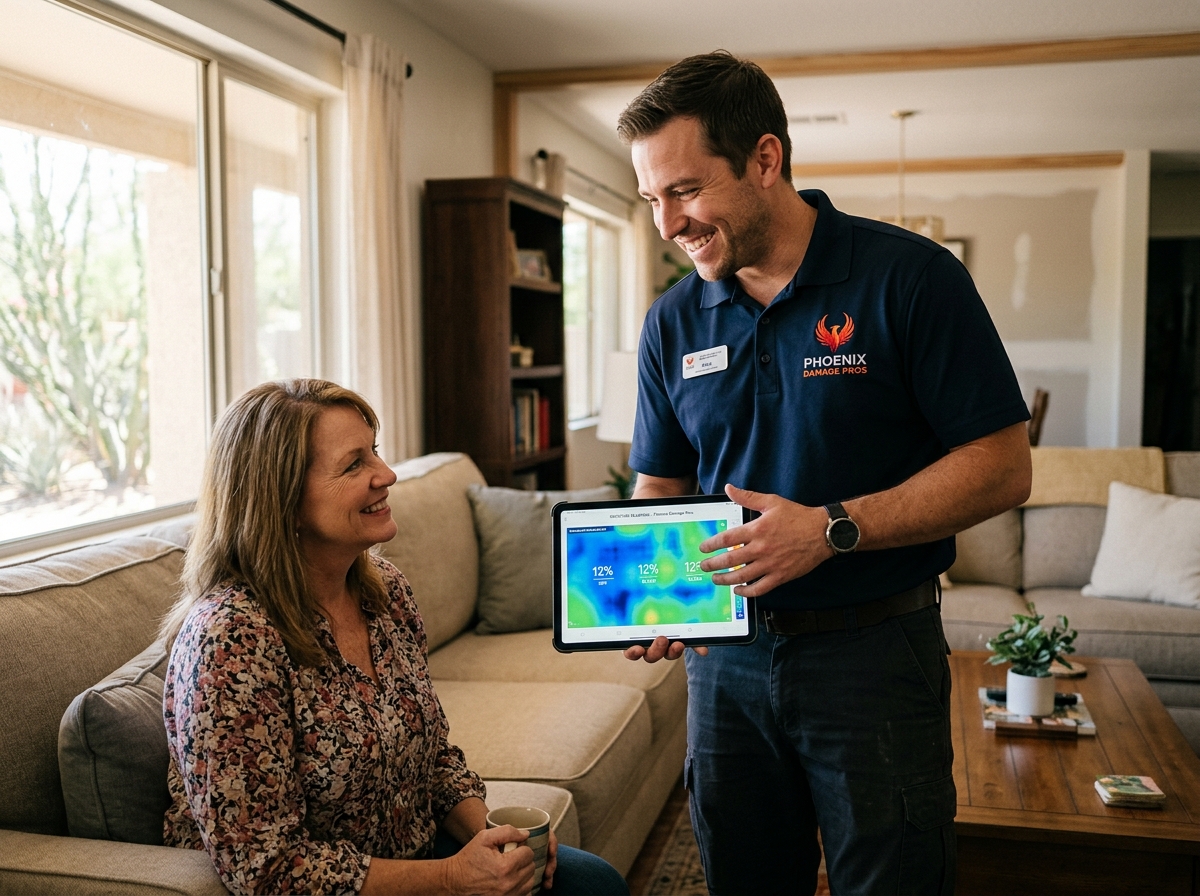
Technicians coordinate with hotel engineering to confirm plumbing isolation. Using FLIR® thermal imaging and non-invasive moisture meters, we inspect not only the source room, but all adjacent rooms and the suites directly below to map the complete footprint of water migration.
Phase 3: High-Vacuum Water Extraction & Carpet Preservation (Hour 2–4)
Deploying weighted Rover sub-surface extractors and truck-mounted vacuum units, we pull up to 90% of standing water directly out of commercial carpets and acoustic underlayments, saving floor coverings and eliminating the need for carpet replacement.
Phase 4: Non-Destructive In-Cavity Drying & Whisper Dehumidification (Days 1–3)
Baseboards are removed and precision injection drying manifolds are installed into wall cavities. Whisper-quiet commercial dehumidifiers (< 52 dB) operate continuously, drying framing and drywall in-place without generating acoustic noise in corridors.
Phase 5: Molecular Hydroxyl Deodorization & Carpet Micro-Cleaning (Day 3)
Hydroxyl generators operate for 12 to 24 hours, eradicating all trace odors from draperies, mattresses, and furnishings. Carpets receive hot-water extraction treated with EPA-registered botanical antimicrobials.
Phase 6: Quality Assurance Audit & White-Glove Room Turnover (Day 4)
Project supervisors conduct final digital moisture auditing, confirming all structural materials have returned to baseline dry standards. Baseboards are reinstalled, furniture is reset to brand specifications, and the room is officially released back to hotel housekeeping for immediate guest check-in.
7. Why Leading Phoenix & Scottsdale Resort Directors Trust Phoenix Damage Pros
Premier hotel general managers, luxury resort asset directors, and franchise operators across Maricopa County recognize Phoenix Damage Pros as the benchmark standard for commercial hospitality restoration:
- Dual-Licensed Contracting & Mitigation: Operating under Arizona ROC #342819, we seamlessly manage emergency water extraction, specialized in-place drying, and full general contracting reconstruction under a single contract.
- Guaranteed 45-Minute Discrete Response: Our teams deploy 24/7/365 across Phoenix, Scottsdale, Paradise Valley, Tempe, and Mesa, arriving through service docks within 45 minutes to protect your brand reputation.
- Ultra-Quiet & In-Place Drying Capabilities: We maintain the largest fleet of low-decibel whisper-mode drying equipment in Arizona, ensuring neighboring rooms remain occupied and revenue-generating.
- Direct Corporate & Insurance Billing: We document all restoration scopes utilizing Xactimate®, providing detailed daily drying logs and business interruption documentation for seamless insurance settlement.
- Local Headquarters in Phoenix: Headquartered at 2415 E Camelback Rd, Suite 400, Phoenix, AZ 85016, our executive leadership team is accessible, accountable, and deeply invested in Arizona’s hospitality economy.
Protect Your RevPAR & Hotel Reputation Today: Do not let guest room leaks or plumbing floods escalate Out-of-Order days or compromise guest reviews. Call Phoenix Damage Pros 24/7 at (602) 587-1380 for immediate discrete emergency dispatch or to establish a priority Hospitality Emergency Response Plan.
8. Frequently Asked Questions: Hotel & Hospitality Water Restoration in Phoenix AZ
1. How quickly can Phoenix Damage Pros return flooded hotel rooms back to service?
By deploying non-destructive in-place drying, weighted sub-surface extractors, and in-cavity wall drying, we typically restore guest rooms to certified dry standards within 3 to 4 days, compared to 2 to 3 weeks for conventional tear-out contractors. This rapid turnover saves tens of thousands in lost room revenue.
2. How do you prevent water damage restoration from disturbing hotel guests?
We operate specialized ultra-quiet commercial air movers and LGR dehumidifiers operating below 52 decibels (equivalent to rainfall). We stage heavy equipment outside through service entrances, install sound-absorbing magnetic corridor containment vestibules, and schedule noisy extraction work during midday turnover windows.
3. Can vinyl wallpaper in hotel guest rooms be saved after a water leak?
Yes. If addressed within 24 to 48 hours, we inject heated desiccant air through tiny 5/8-inch weep holes drilled behind the baseboard line into the stud cavity, drying the drywall core from the inside out without peeling or damaging the expensive vinyl wallcovering on the front.
4. What is the difference between ozone machines and hydroxyl generators for hotel odor removal?
Ozone gas is toxic to humans and damages rubber foam mattresses, requiring complete evacuation of adjacent guest suites for 24 to 48 hours. In contrast, hydroxyl radicals are 100% safe for human occupancy and can be safely operated in occupied hotels, neutralizing musty damp odors at the molecular level without room evacuations.
5. How does Phoenix Damage Pros help hotels recover lost RevPAR through insurance?
We document all project details in Xactimate®, tracking room-by-room moisture curves and daily Out-of-Order (OOO) timelines. We supply your insurance carrier with comprehensive documentation supporting Business Interruption and Extra Expense claims to recover lost room revenue and guest relocation expenses.
6. What happens if water leaks down multiple guest room floors?
We immediately dispatch multi-vehicle commercial response crews to isolate the plumbing source and deploy concurrent extraction teams on every affected floor simultaneously. Using thermal imaging cameras, we track vertical water paths through party walls and ceiling drops, preventing hidden moisture pockets.
7. Why should hotel general managers establish an Emergency Response Plan (ERP)?
An ERP establishes pre-authorized emergency service rates, pre-mapped mechanical shutoffs, and priority equipment reservations before disaster strikes. During major Valley weather events or peak tourist seasons when restoration equipment is scarce, ERP partner hotels receive guaranteed immediate dispatch priority.